
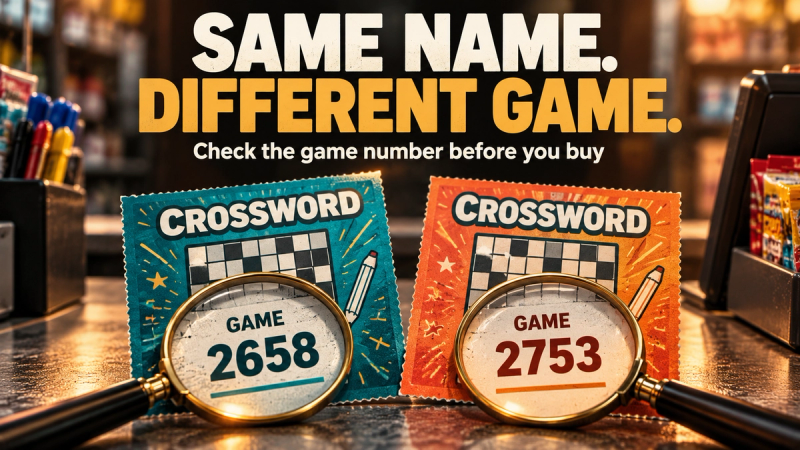
Same Name, Different Game: Why the Scratch-Off Game Number Is the First Thing to Check
10/19/2026
By Doug Moeller | Professional Gambler & Founder of Savvy Scratch
Texas is selling two different $20 scratch-offs called $1,000,000 Crossword right now. Same name. Same price. Six $1 million top prizes printed in each. According to the Texas Lottery's October 18 report, one of them still has five of those top prizes unclaimed. The other has one.
The only thing on the ticket that reliably tells them apart is a four-digit scratch-off game number.
If you look up "$1,000,000 Crossword," land on the first page Google gives you, and then buy whichever one the clerk pulls, there's a real chance you researched one game and paid for the other. The name gets you to the right neighborhood. The game number gets you to the right house.
I spent more than 15 years as a professional gambler, playing poker, counting cards, and working casino advantage plays. The first rule in all three was the same: make sure the information you're acting on belongs to the game you're actually sitting down at. Scratch-offs are no different, and the lottery's own data shows how easy it is to get this wrong.
Two $1,000,000 Crossword Games, Two Very Different Stories
I pulled both games from the Texas Lottery's Top Prizes Claimed report and their official detail pages on October 19, 2026. On paper they're twins. Both cost $20, both printed six $1 million top prizes, and both printed twenty $20,000 prizes. The similarities stop there.
Game 2658 went on sale June 16, 2025, so it's been on the rack for 16 months. It's down to one unclaimed $1 million prize, and all twenty of its $20,000 prizes are gone. Ninety-six percent of its $20 winners have already been cashed, which is a rough but useful sign that most of the print run is in players' hands. Texas has flagged it "Closing Soon."
Game 2753 launched July 20, 2026, about three months ago. It still has five of its six $1 million prizes unclaimed and fifteen of its twenty $20,000 prizes. Only 18% of its $20 winners have been cashed. Same name, same price, same printed prize ladder, and a completely different game at the counter. (Lower-tier claim figures on those two pages were dated October 14 and 15.)
That single remaining $1 million prize on 2658 deserves extra suspicion. When a game is mostly sold, a lone unclaimed top prize has a good chance of already being bought and sitting in someone's drawer, waiting to be cashed. I broke down why in why the most honest number on a prize page is zero, and 2658 is a textbook case.
None of this tells you which individual ticket wins. Nothing does. What it tells you is that these are two separate games with two separate prize pools, and one game's numbers can't describe the other. If you read 2753's five remaining top prizes and then walk out with a 2658, you made a decision based on data from a game you didn't buy.
Check the game number, not just the name. Every game page on Savvy Scratch shows the game number right in the title, next to the full prize table, launch odds, and prizes left. Create a free account with no card required and the New and Bad tabs are yours. The full Good and Neutral rankings are $5 a month or $50 a year, with a 30-day worry-free guarantee. Start free at savvyscratch.com
Read the Pay Table, Not the Name on the Glass
Video poker taught me this lesson before scratch-offs ever did. Walk any casino floor and you'll find rows of machines that all say "Jacks or Better" on the glass. Same game name, same denomination, sometimes bolted right next to each other. But one pays 9 coins per coin bet for a full house and 6 for a flush, and the one beside it pays 8 and 5. Players call them 9/6 and 8/5. They look identical from the aisle, and the cheaper pay table quietly takes more of your money on every full house and flush you hit.
As an advantage player, I never sat down because of the name on the glass. I read the pay table on that specific machine. The scratch-off version of the pay table is the prize table on the lottery's website, and the game number is how you know you're reading the right one. That habit sits at the center of why a winning gambler's playbook works for scratch-offs: pick your spot on data, not on what the sign says.
Same Name, Different Starting Odds: 200X The Cash
You might assume two games with the same name at least started out the same. Texas says otherwise. It currently sells two $20 games called 200X The Cash, and they were built differently from day one.
Game 2714 launched January 5, 2026, with about 7.1 million tickets and four $1 million top prizes. That works out to launch odds of roughly 1 in 1.78 million for the top prize. Its second-biggest prize is $20,000, with 23 printed.
Game 2613 launched July 1, 2026, with about 8.2 million tickets and the same four $1 million top prizes, so its launch odds for the top prize were longer, roughly 1 in 2.05 million. Its second tier is completely different: five $100,000 prizes instead of a stack of $20,000s.
Now check the top prizes. Both games show two of four $1 million prizes unclaimed. If that's all you looked at, you'd call them even. They aren't. Game 2714 has had about 61% of its $20 winners cashed, while 2613 is around 32%. (Those claim figures were dated October 16 and 18.) Same two top prizes left, but on 2714 they're likely spread across a much smaller pool of unsold tickets. Our board flags 2613 as Bad today. 2714 isn't on that list.
Two more things jump out. The published overall odds of winning any prize differ too, 1 in 3.88 on 2714 versus 1 in 3.41 on 2613, and both Texas pages say those odds are "based on the End of Production Prize Structure." That number describes the whole print run on launch day. It isn't a live estimate of your next ticket, and it has nothing to do with your shot at the top prize. I covered that trap in why the number on the back of the ticket is lying to you.
The second thing: game 2613 has the lower number but launched six months after 2714. Don't read game numbers as a calendar. Read them as an ID.
This isn't limited to two titles, either. The same Texas list carries two $10 games called Limited Edition Mega Loteria, numbers 2676 and 2721. Lotteries reuse titles, and the older version doesn't always leave the rack before the new one shows up.
A Count Belongs to One Shoe
When I was counting cards, a running count was only true for the shoe it came from. If I walked from one table to another, the count in my head was worthless at the new table, even if the new table had the same rules, the same limits, and the same color felt. Carrying a +8 count from table 4 to table 6 isn't an edge. It's a mistake that feels like an edge, which is worse.
Scratch-off research works exactly the same way. The prize table you read is the count, and the game number is the shoe it belongs to. A friend who swears 200X The Cash "still has two million-dollar prizes" might be right about both games, and still steer you into the one our data rates Bad. A video, a forum post, or an old article about a named game was made about specific games on a specific date. That goes for my own writing too, including the Texas games I flagged back in May. Before you act on anyone's take, check that the game number they're talking about matches the one on your ticket.
Where to Find the Game Number on a Scratch Ticket
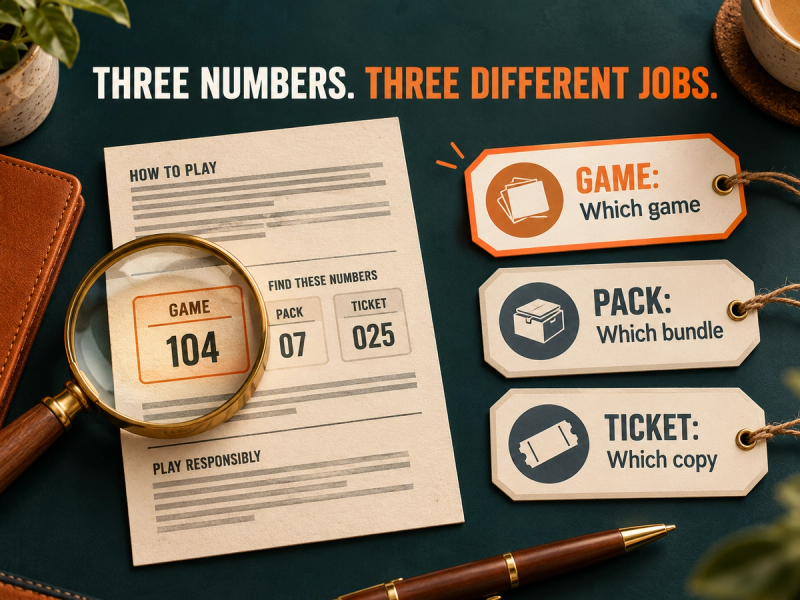
The numbers printed on a scratch-off are easy to mix up, so here's what each one does, using Texas as the example.
Texas prints a 14-digit Game-Pack-Ticket Number on every ticket. The official game procedures for 2753 spell out the format as 2753-0000001-001. The first four digits are the game number. The next seven identify the pack. The last three identify the ticket's position in that pack, running from 001 to 025 because Texas packs these $20 games 25 to a pack. The bar code on the back of the ticket also carries the four-digit game ID. (Texas game 2753 procedures)
For checking a prize table, the game number is the only part that matters. The pack number and ticket number tell you nothing about whether a ticket wins, so don't let anyone sell you a "system" built on them. The 13-digit serial number under the scratch coating isn't the game number either, and you can't see it before you buy anyway.
One more number to ignore: the slot number on the store's dispenser. That's usually the store's own bin position, not the game number. Other states lay out their tickets differently, so if you play outside Texas, check your lottery's own game procedures or ticket guide rather than assuming the number sits in the same spot.
The 30-Second Check Before You Pay
You don't need to turn a gas station stop into a research project. This takes less time than the line.
Start with your budget. Decide what you're spending before you look at a single game. Checking the game number makes a decision you were already going to make sharper. It isn't a reason to spend more. If you want a framework for that, I laid one out in how scratch-off players stay in control with a plan.
Pull up the game by state, price, and name. Use your state lottery's site or the Savvy Scratch board for your state, and keep the price in view. Name plus price narrows it down. It doesn't finish the job.
Confirm the game number. Ask the clerk to read it off the ticket, or check it yourself if the ticket is in hand. If the clerk can't tell you which version is in the slot, you're allowed to walk away. An information gap is a reason to wait, and it's exactly why you should stop letting the cashier pick your ticket in the first place.
Match it to the page you researched. If the numbers don't match, throw that research out for this purchase. It belongs to a different game.
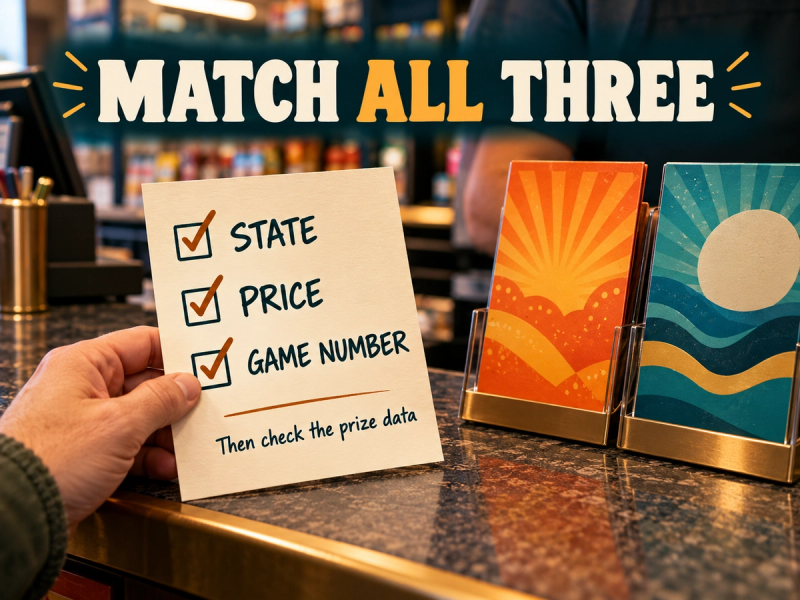
Then read the prize table. Top prizes left, how far the game has sold, the report date, and whether the lottery has flagged the game as closing. If you want the full walkthrough of that step, it's in how to read scratch-off odds before you buy.
A note on your phone with three things, state, price, and game number, beats a screenshot of a familiar-looking ticket every time.
See which version of a game is worth your $20. Savvy Scratch gives every game its own page, so 2753 and 2658 never get mixed together. The free account shows you New and Bad games with no card required. Paid access adds today's recalculated odds, a buy-or-skip call, and the full Good and Neutral rankings for $5 a month or $50 a year, backed by a 30-day worry-free guarantee. Try it free
Once the Number Matches, Read the Right Numbers
Getting the right game is the first check. It isn't the last one.
Different figures on a lottery page answer different questions. The overall odds describe the prize structure at the end of production. The claims table describes what the lottery has paid out so far, which can trail what's actually been sold. Any "current odds" estimate, including ours, depends on how many tickets are still out there.
Report dates matter too. On the day I pulled these numbers, Texas's summary report was dated October 18, but the individual game pages carried claim dates ranging from October 14 to October 18. Both are official. They just weren't updated at the same moment. When two sources disagree, check the dates before you decide one of them is wrong.
Keep the questions in order. First: am I looking at the right game? Then: what does this game's data actually say? Skip the first one and you can do perfect math on the wrong ticket.
Why Every Savvy Scratch Game Page Carries the Game Number
This is the reason we build our pages around the number, not just the name. On the Savvy Scratch Texas board, the two Crossword games live at separate addresses: $1,000,000 Crossword #2753 and $1,000,000 Crossword #2658. Same for 200X The Cash #2714 and 200X The Cash #2613. The game number is in the page title and the URL, so the version you look up is the version you're reading about.
Every one of those pages shows the public prize table, launch odds, prizes left, and print run for free. Members get the part that changes daily: recalculated odds for every prize tier, our buy-or-skip call, and where that game ranks against everything else in the state at its price.
I won't pretend any of this predicts a winner. No game number does, and no comparison guarantees a return. You still choose whether to buy, and you're still buying a scratch-off. But matching the game number is one of the few things in this hobby you can get 100% right before you spend a dollar.
Write Down Four Digits
Next time you're about to buy a ticket you've read about, pull out your phone and compare the four-digit game number on the ticket against the page you checked. If they match, read the prize table and make your call. If they don't, you just avoided paying for someone else's research.
A familiar name should start the lookup. The game number finishes it.
Find the exact game before you buy. Create a free account, pick your state, and open the game by its number. See New and Bad games free with no card required, or get everything, including the full Good and Neutral rankings, for $5 a month or $50 a year with a 30-day worry-free guarantee. Get started at savvyscratch.com
Frequently Asked Questions
What is the game number on a scratch-off?
It's the number the lottery uses to identify one specific scratch-off game and its prize pool. Two tickets can share a name, price, and top prize and still have different game numbers, which means different prize tables, different print runs, and different prizes remaining.
How do I find the game number on a Texas scratch ticket?
Texas tickets carry a 14-digit Game-Pack-Ticket Number, formatted like 2753-0000001-001. The first four digits are the game number. The bar code on the back also includes the four-digit game ID. Other states use different layouts, so check your state lottery's game procedures or ticket guide.
Can two scratch-offs have the same name?
Yes. As of October 2026, Texas was selling two $20 games called $1,000,000 Crossword (2658 and 2753), two $20 games called 200X The Cash (2613 and 2714), and two $10 games called Limited Edition Mega Loteria (2676 and 2721). Each one is a separate game with its own prize table.
Is the game number the same as the pack number or ticket number?
No. The game number identifies the game. The pack number identifies a bundle of tickets within that game, and the ticket number identifies a ticket's position in its pack. Neither the pack number nor the ticket number tells you whether a ticket is a winner.
Does the game number tell me if a ticket will win?
No. The game number tells you which prize table to read. It doesn't reveal anything about an individual ticket. Its job is to make sure the information you're using belongs to the game you're actually buying.
About the Author: Doug Moeller is a professional gambler with over 15 years of experience in poker, blackjack card counting, and casino advantage play, with over $500K in lifetime winnings. He built Savvy Scratch to bring the same read-the-pay-table discipline from the casino floor to scratch-off prize data, game by game and number by number. Follow Doug on X | YouTube
Scratch-offs are entertainment, not income. If gambling stops being fun, visit our responsible gambling page or call or text 1-800-GAMBLER.