What Are the Odds of Winning a Scratch-Off? (And Why the Number on the Back Is Lying to You)
5/28/2026
By Doug Moeller | Professional Gambler & Founder of Savvy Scratch
Walk into any gas station, pull a scratch-off out of the dispenser, flip it over, and you'll see a number. Something like "Overall odds: 1 in 3.75." It looks official. It looks like the answer. Most players read it, do some quick mental math, and figure they understand the bet they're about to make.
They don't. Not because the number is fake, but because it's describing a game that no longer exists.
That printed number is the odds the game had on the day it launched, before a single ticket was sold. It was calculated off the full print run, every prize still sitting in the pile, nothing claimed yet. From the moment the first pack hit a store, that number stopped being true and never updated itself once. So when someone asks me what the odds of winning a scratch-off are, the honest answer isn't a single number. It's "depends on which game, which prize you actually care about, how many tickets were printed, how many of the good prizes are still out there, and how far the game has already sold through." That's the real question, and almost nobody is asking it.
This is the gap I built Savvy Scratch to close. Not lucky numbers, not systems, not predictions. Just a clear daily read on which games still have their best prizes available so you can stop buying blind. But you don't need the app to understand the idea, so let's get into it.
What the printed odds actually mean
When a ticket says "overall odds: 1 in 3.75," that's the chance of hitting any prize at all, averaged across the entire game from the first ticket to the last.
The problem hiding inside that number is the phrase "any prize." A win could be a free replacement ticket. It could be five bucks back on a five-dollar ticket, which means you broke even and the lottery still counts it as a winner in the odds math. It could be ten dollars, fifty, a thousand, or the headline jackpot that pulled you to the counter in the first place. All of those get folded into one tidy "1 in 3.75."
In most games, the large majority of those "wins" are the small consolation prizes. A game can advertise gorgeous overall odds and still be built almost entirely out of two and five dollar refunds. Another game with worse overall odds might have far better top-prize potential. A third might have looked great on launch day and quietly turned into a corpse after the good prizes got claimed, with the same printed number still sitting on the back like nothing happened.
The overall odds are one input. They are not the answer.
Printed odds are launch-day odds, frozen in time
This is the single most important thing to understand about scratch-offs, so I'm going to be blunt about it.
Before a game goes on sale, the lottery knows exactly how many tickets exist and exactly how many of those are winners. Divide one by the other and you get the printed odds. Simple. Honest, even, at that moment.
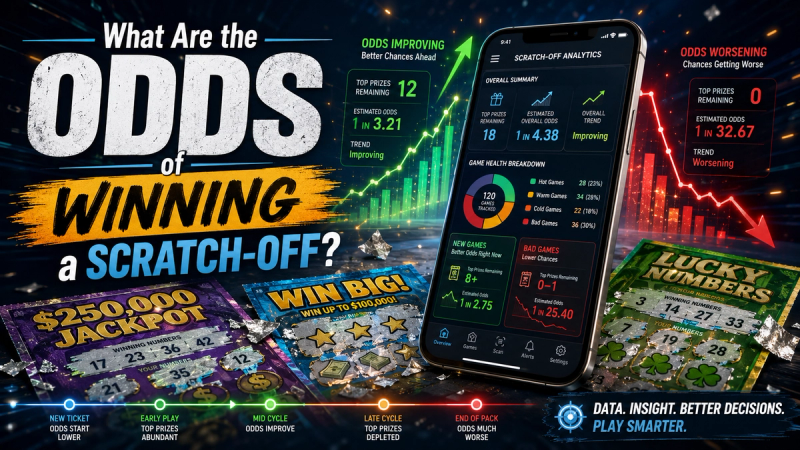
Then the game launches and reality starts diverging from the print. Tickets sell. Winners get claimed and removed from the pool. Top prizes disappear one by one. Sometimes a game holds onto its best prizes deep into its life and gets quietly better for whoever buys next. Sometimes the jackpots are gone in the first two months and the game spends the next year as a refund machine with a pretty photo on the front.
The ticket does not know any of this happened. The "1 in X" on the back is the same on day 500 as it was on day one. The number froze. The game kept moving.
Scratch-offs are dependent games, and that changes everything
Here's where my background actually matters, because this is the same math I spent years getting paid to do at a blackjack table.
I counted cards for a living, alongside poker and a handful of casino advantage plays, over fifteen-plus years and north of half a million dollars in lifetime winnings. Counting cards isn't the Hollywood version where you memorize the whole deck. It's simpler and more practical than that. You track the ratio of high cards to low cards still left in the shoe. When the shoe is rich in tens and aces, the next hand favors the player, so you bet bigger. When it's been picked clean of high cards, you bet the minimum or you get up and leave. The cards already dealt change the math on the cards still coming. That's the entire edge.
A scratch-off game is a closed shoe. There's a fixed number of tickets printed and a fixed number of prizes seeded into that run. Every prize that gets claimed is one less prize in the pile the rest of us are buying from, but the losing tickets keep coming out at the same rate. When the top prizes are still in the pile relative to how many tickets are left, the unsold inventory is rich, like a hot shoe. When they've been claimed out, the inventory is depleted, and no printed odds on the back will warn you. A card counter would never use the house edge off a freshly shuffled shoe to decide a bet halfway through the deck. Reading launch-day scratch-off odds in a year-old game is the exact same mistake. I broke down the full mechanics of this in card counting for lottery tickets if you want the deeper version.
Let me make the asymmetry concrete with a simple structure. Picture a game that launches with ten million tickets and five top prizes, overall odds of 1 in 4. Now run it forward two ways.
In the first version, six million tickets have sold and all five top prizes are still unclaimed. The pile of tickets you're buying from shrank by more than half, but every jackpot is still in there. For a jackpot hunter, that game is quietly better than it was on launch day, and getting better with every ticket someone else scratches.
In the second version, the same six million tickets sold, but all five top prizes are already gone. Same printed odds on the back. Same price. Maybe sitting in the same dispenser slot. But there is no jackpot left to win. The headline number that pulled you in is mathematically impossible now.
Two games that read identical on the ticket. One is worth playing and one is a husk. The only way to tell them apart is the current data, which is the whole reason the only thing that actually matters is top-prize availability.
Odds of winning anything vs. odds of winning something good
When a ticket brags about 1 in 3.75, that's the odds of winning any prize, refunds included. But nobody buys a scratch-off dreaming about getting their five dollars back.
So separate the two questions in your head and keep them separate:
The odds of winning any prize, and the odds of winning a prize you'd actually be excited about. They are wildly different numbers. A ten-dollar ticket might hand back small wins at 1 in 3.3 while the jackpot sits at one in several million. A five-dollar ticket might pay small prizes more often but offer almost nothing at the top. A thirty-dollar ticket might carry bigger prizes without that automatically making it the smart play for your budget.
This is also why price point matters when you compare. Stack five-dollar games against other five-dollar games. Compare ten against ten, twenty against twenty. Don't assume the most expensive ticket on the wall is the best one, and don't let the biggest jackpot number printed on the front do your thinking for you. If you want a structured way to run those comparisons instead of eyeballing it, that's exactly what an odds calculator built for scratch-offs is for.
Why "best odds" is a trap question
Plenty of lottery sites and store displays push "best odds" like it settles the matter. It doesn't, because it never says best odds for what.
Best odds to win anything? Best odds to break even? Best odds to win more than the ticket cost? Best odds to hit a top prize? Best current odds compared to launch? Those are five different questions with five different answers, and a game that wins one can lose the other four.
A ticket with the "best odds" to win any prize is often just good at handing back small money. Fine if you're trying to stretch a session, useless if you're hunting a real win. Meanwhile a game with worse overall odds might be sitting on a stack of unclaimed top prizes. The smarter framing, and the one I built the tool around, isn't "which ticket has the best printed odds." It's "which ticket gives me the best opportunity right now based on what's still left." If you want the full breakdown of how to pick by that standard, I went deep on it in what the data tells you about the best scratch-off tickets.
The biggest mistake players make (it isn't buying a loser)
Everybody buys losing tickets. That's the game. Losing a ticket isn't the mistake.
The real mistake is buying a ticket without knowing whether the game is still worth playing. Players choose based on the artwork, a favorite number, the gas station where a cousin won once, what hit last time, what some guy on social media played, or the biggest prize printed on the front. None of that tells you a single thing about whether the game's good prizes are still in the pile.
The front of the ticket is marketing. The current prize data is the actual story. And the lottery's art department is very, very good at making a dead game look exactly as exciting as a live one. That two-thousand-dollar headline still flashes across the photo months after the last one of those prizes got claimed. This is the most expensive habit in scratch-off play and it's completely invisible from the rack. I covered how to stop falling for it in these scratch ticket habits worth breaking, and it's the same trap I describe as the dead-game problem in the full lottery analysis guide.
One more thing while we're on wasted value. If your state runs second chance drawings, a losing ticket isn't always worthless. Most people are too lazy or forgetful to enter, which is exactly what makes the second chance play worth a look when you've already paid for the ticket anyway.
Can picking better games guarantee a win?
No. Flatly, no.
No app, system, site, or strategy can guarantee a winning ticket. Scratch-offs are gambling. The state builds a house edge into every game and over a long enough run, every recreational player ends up net negative. I won't pretend otherwise, because the second I do I'm just another guy selling a lottery system, and I built this whole thing in opposition to those people.
What checking the data does is narrower and real. It keeps you out of games where the best prizes are already gone. It points you toward games that have held or improved their top-prize position. It tells you when a new game just launched with everything still intact. Good data doesn't remove the risk. It removes the guessing, and the guessing is where players quietly bleed the most money.
How to check scratch-off odds before you buy
You don't have to analyze every ticket in the store. You just have to ask a few honest questions about the games in your price range before you spend.
Does the game still have top prizes left, and how many did it start with? How far into its print run has it sold? Is it brand new with everything still in the pile? Has it gotten worse since launch, or better? And how does it stack up against the other games at the same price point?
You can answer all of that yourself. Every state lottery commission publishes the prize claim data. The catch is that it's buried in PDFs and tables that look like they were designed in 2004 and never touched again. I used to pull those reports apart by hand, one game at a time, every price point, every state I tracked. It took the better part of an evening per state. Nobody's doing that standing in line at the counter, which is the entire reason the manual version doesn't actually help most people.
Where Savvy Scratch fits
I built Savvy Scratch because doing this by hand is miserable and I'd already done it a thousand times. The app pulls the prize-remaining data straight from your state's lottery, compares current odds against launch odds for every active game, and sorts everything into Good, Neutral, Bad, and New so you can see at a glance which games still have life in them and which ones to walk past.
It currently covers 20 states and it's free to start. You can sign up free, pick your state, and immediately see the Bad games and the New games, no credit card required. The Bad tab alone is genuinely useful, because knowing which games to avoid is half the battle. When you want the full picture, the Good and Neutral tabs are five dollars a month or fifty a year, with a 30-day worry-free guarantee. I priced it to cost less than a single losing ticket a month on purpose. If it keeps you out of one or two dead games, it's already paid for itself.
See which games are worth playing in your state right now → Sign up free at savvyscratch.com
So, what are the odds of winning a scratch-off? The number on the back is your starting point and nothing more. The real opportunity lives in what's still in the pile today. A ticket can look good and be dead. A ticket can look ordinary and be the best bet on the wall. A ticket can advertise a jackpot that someone else already cashed. That's the part almost nobody checks, and checking it is the closest thing to an edge a scratch-off player will ever get.
Scratch-offs will always involve luck. Deciding which one to play doesn't have to be blind.
Pick your state and check the data before your next trip → Free to start, no card required. Good and Neutral tabs are $5/month or $50/year, with a 30-day worry-free guarantee.
About the Author: Doug Moeller is a professional gambler with over 15 years of experience in poker, blackjack card counting, and casino advantage play, with over $500K in lifetime winnings. He built Savvy Scratch to bring the same data-driven approach that works at casino tables to scratch-off lottery tickets, now covering 20 states. Follow Doug on X | YouTube