Stop Letting the Cashier Pick Your Lottery Ticket
8/10/2025
By Doug Moeller | Professional Gambler & Founder of Savvy Scratch
You've done it. I've done it. Everybody standing in line at the gas station has done it at least once.
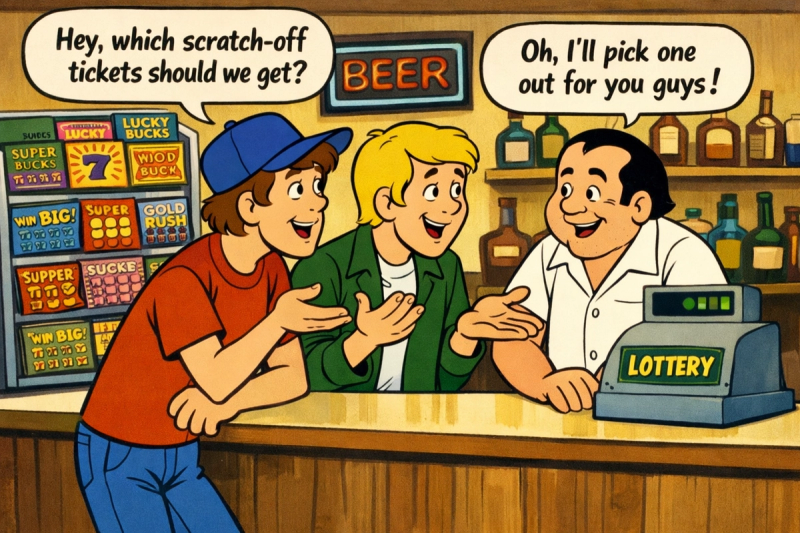
You walk up to the counter, stare at thirty different scratch-off games lined up behind the glass, and your brain just... stalls. Too many options, not enough information, and a line forming behind you. So you do what feels natural: you ask the cashier what's good.
They point at something. Maybe it's the newest game. Maybe it's the one with the shiniest packaging. Maybe it's just whatever is closest to their hand. You pay, you scratch, you lose. And the worst part isn't losing. The worst part is that you never had a plan in the first place.
That moment at the counter is where most lottery players give away their only real advantage. And I'm going to explain why, because I've spent 15 years as a professional gambler learning that the difference between winning and losing almost always comes down to preparation before you place the bet.
Savvy Scratch shows you which games have the best remaining odds in your state, updated with real lottery data. Plans start at $5/month or $50/year with a 30-day money-back guarantee.
The Cashier Isn't Tracking Anything
Here's what the person behind the counter knows about the scratch-off games they're selling: the price, the name, and where each roll sits in the display. That's it. They aren't checking which games still have jackpots available. They aren't comparing the odds across price points. They aren't looking at how many tickets have already been sold or how many top prizes have been claimed.
And why would they? They're paid to ring up transactions, not to coach your scratch-off strategy. Asking a cashier which ticket to buy is like asking the bartender which horse to bet on. They might have an opinion, but it isn't based on anything that helps you.
Most cashiers default to one of three habits when you ask for a recommendation. They suggest whatever game just came in because it's new and they've heard people talking about it. They point at whatever game they personally think looks cool. Or they just grab whatever is right in front of them because there are four people waiting behind you. None of these methods have anything to do with your actual odds of winning.
The real problem isn't that cashiers are bad at picking tickets. It's that the question itself is wrong. You're asking someone with zero data to make a decision that should be based entirely on data.
What a Professional Gambler Sees That You Don't
I spent years counting cards at blackjack tables. The entire concept behind card counting is simple: the composition of the remaining deck changes as cards are dealt, and those changes shift the odds in predictable ways. When the deck is rich in tens and aces, the player has an edge. When it's full of low cards, the house has the advantage. A card counter doesn't guess. They track what's already happened and use that information to decide how much to bet and when.
Scratch-off tickets work on the same principle. Every scratch-off game starts with a fixed number of tickets and a fixed number of prizes at every level. As tickets sell and prizes get claimed, the composition of the remaining pool changes. Sometimes it changes in your favor. A game might start with 1-in-1,300,000 odds for the top prize and improve to 1-in-380,000 after 85% of tickets have sold, because most of the jackpots are still in the pool. Other times the opposite happens, and a game's top prizes get claimed early, leaving you chasing a jackpot that no longer exists.
This isn't theory. State lotteries publish this data. They tell you how many tickets were printed, how many prizes remain at each level, and in many cases how many tickets have been sold. The math isn't complicated. But the cashier isn't doing it. Neither is the guy in front of you, or the woman behind you, or basically anyone else in that store.
The players who check this information before walking up to the counter are playing a fundamentally different game than everyone else. It's the same split I saw at poker tables for years. Most players sit down and play whatever hand they're dealt, reacting to the cards. The winning players already know the math before the cards hit the table. They've done the work. They have a plan. And when the moment comes to make a decision, they don't freeze, they don't ask the dealer for advice, and they don't pick based on what looks pretty.
Why "Clerk's Choice" Actually Hurts You
Let's think about what happens when you hand your decision to the cashier. You're not just picking randomly. You're actually picking worse than randomly in most cases, and here's why.
Cashiers tend to recommend new games. New games get prominent display space, they come with marketing pushes from the state lottery, and retailers hear about them first. But a new game with every prize still available isn't always the best play. Sometimes an older game that's been running for months has dramatically better top-prize odds because a large percentage of tickets have sold while most big prizes remain unclaimed. You'd never know that by looking at the display. You'd only know it by looking at the numbers.
Cashiers also tend to recommend popular games. Popularity drives faster ticket sales, which means prizes get claimed faster. The game everyone is buying might have worse remaining odds than the game nobody is talking about. High volume is great for the lottery commission's revenue. It's not necessarily great for your odds.
And here's the part that should bother you most: some games on that wall have zero top prizes remaining. The jackpots are gone. Every single one has been claimed. But the tickets keep selling because the game isn't officially closed yet. There are still smaller prizes in the pool, sure. But if you walked up hoping for a shot at the big money, you never had one. The cashier doesn't know this. The display doesn't show it. Only the data tells you.
You can learn more about how scratch-off odds change over time and how to read the numbers that actually matter.
How to Walk Up Ready
Picking a scratch-off ticket with intention doesn't take hours of research. It takes about two minutes of preparation before you get in line. Here's the approach.
First, know your budget before you walk into the store. Decide whether you're spending $10, $20, or $50 today. This narrows your options immediately and removes the temptation to overspend because the cashier suggested something outside your range.
Second, check which games in your state still have top prizes available. Every state lottery publishes remaining prize data on their website. You're looking for games where the ratio of remaining tickets to remaining top prizes works in your favor. A game with 3 million tickets left and 5 jackpots is a very different proposition than a game with 3 million tickets left and 1 jackpot.
Third, compare across games in your price range. You might find that two $10 games have wildly different odds for prizes above $1,000. One might be 4x or 5x better than the other at the same price point. This is the kind of edge that disappears the moment you let someone else choose for you.
The whole process mirrors what professional lottery analysis looks like at a basic level: you gather the available data, compare your options, and make a decision based on math rather than marketing.
Savvy Scratch does this analysis automatically across 16 states, updating with real prize data so you can check your best options in seconds. $5/month or $50/year with a 30-day money-back guarantee.
The Confidence Changes Everything
There's a secondary benefit to walking up with a plan that has nothing to do with odds or data. It changes how you experience the game.
When you step up to the counter and say "Two of game number 2588, please," something shifts. You're not frozen. You're not scanning the display hoping something jumps out. You're not relying on a stranger's whim. You made a decision based on information, and now you're executing it. Win or lose, you played your game. Not the cashier's game. Not the lottery commission's marketing department's game. Yours.
I felt the same thing the first time I sat down at a blackjack table with a real count in my head instead of just hoping for good cards. The outcome of any single hand didn't change. The odds are still the odds. But the feeling of knowing you're making the mathematically best decision available to you? That changes the entire experience. You stop playing defensively and start playing with purpose.
Scratch-offs are entertainment. Nobody's arguing otherwise. But there's a difference between informed entertainment and blind entertainment, the same way there's a difference between a poker player who understands position and pot odds and one who just calls every hand because the cards are pretty.
The Real Cost of Outsourcing Your Picks
Think about what "clerk's choice" actually means over the course of a year. Say you buy $40 worth of scratch-offs per month. That's $480 a year. If even a quarter of those purchases went to games with depleted prize pools or inferior remaining odds because you let the cashier pick, you spent roughly $120 on tickets that were statistically worse than what was available to you at the same price.
That's not a guarantee you would have won more. Scratch-offs are still long-shot bets. But it means you consistently played at a disadvantage when you didn't have to. In poker, we call that a leak. It's a small, repeated mistake that doesn't hurt you on any single hand but bleeds your bankroll over time. The best players find their leaks and plug them. This is one of the easiest leaks to fix.
The January post on the Savvy Scratch blog explains how fast odds can shift during high-volume periods, and why checking current data before buying makes the biggest difference when everyone else is playing blind.
Stop Asking. Start Knowing.
Next time you're standing in line at the gas station, skip the question. Don't ask the cashier what's good. Don't grab whatever catches your eye. Don't default to the game you always play just because it's familiar.
Pull up the current odds for your state. Find the game in your price range with the best remaining prize structure. Walk up, ask for it by number, and scratch it knowing you made the smartest play available.
You might still lose. That's scratch-offs. But you'll never wonder if you left a better ticket on the wall because you let someone else decide for you.
See which scratch-offs have the best odds in your state right now. Savvy Scratch tracks real-time prize data across 16 states for $5/month or $50/year, backed by a 30-day money-back guarantee.
About the Author: Doug Moeller is a professional gambler with over 15 years of experience in poker, blackjack card counting, and casino advantage play, with over $500K in lifetime winnings. He built Savvy Scratch to bring the same data-driven approach that works at casino tables to scratch-off lottery tickets. Follow Doug on X | YouTube