
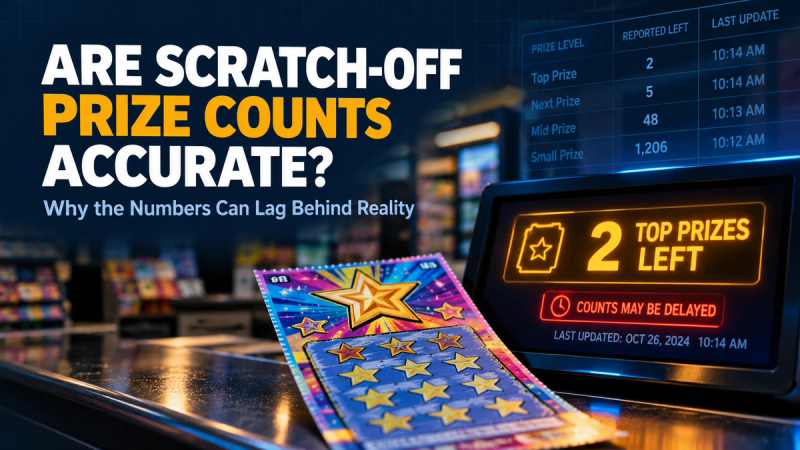
Are Scratch-Off Prize Counts Accurate? The Most Honest Number on the Page Is Zero
10/16/2026
By Doug Moeller | Professional Gambler & Founder of Savvy Scratch
A reporter once asked the Massachusetts Lottery a simple question: where are the winning tickets? The answer, from the lottery's own communications director, was that the lottery doesn't know where winning tickets end up or whether they've even been sold. A big winner, he said, "could be in the trash or a junk drawer." (CBS Boston, 2017)
Keep that in mind the next time your state's website says a game has one $1 million prize remaining.
So are scratch-off prize counts accurate? Yes, about one specific thing. They're accurate about claims. "Prizes remaining" almost always means prizes nobody has cashed yet. It doesn't mean those prizes are sitting unsold on a store counter. Once you understand that difference, you can tell which numbers on a prize page are rock solid and which ones deserve a second look.
I spent more than 15 years as a professional gambler, playing poker, counting cards, and working casino advantage plays. The whole job came down to knowing exactly how much weight a piece of information could carry. Scratch-off prize data is the best public information a player has. It just isn't a live inventory of what's on the rack, and reading it like one costs people money.
What a Prize Count Actually Measures
When a winning ticket gets bought, the lottery doesn't find out. It finds out when the ticket is scanned for a payout or when a big winner starts the claim process. Until then, that prize still shows up in the public count as unclaimed.
Some lotteries say this out loud. South Carolina's prize page puts it plainly: "The number of prizes remaining unclaimed is an estimate. It does not guarantee that the prize is available." It goes on to warn that winning tickets "may be sold at the time of this update or after, or players may not have redeemed their winning tickets yet." (SC Education Lottery) Texas doesn't even call its table "prizes remaining." The heading reads "Scratch Ticket Prizes Claimed." (Texas Lottery)
That means every prize listed as remaining is in one of two places. It's either still attached to an unsold ticket somewhere in the distribution chain, or it's already been bought and is waiting in someone's wallet, glovebox, or kitchen drawer. No public database tells you which. And no lottery will point you to the store holding the winning pack, because if anyone could locate winners before buying, the whole game would fall apart.
None of this means the lottery is hiding anything. It means the number answers a slightly different question than the one most players think they're asking.
See which games in your state still have their top prizes, and which ones are already dead. Create a free account at Savvy Scratch, no card required, and the Bad and New tabs are yours at no cost. Full Good and Neutral rankings are $5 a month or $50 a year, with a 30-day worry-free guarantee. Start free at savvyscratch.com
Why the Numbers Lag Behind Reality
There are four normal reasons the public count drifts from what's actually happening right now.
The ticket hasn't been scratched or cashed yet
Plenty of people don't scratch on the spot. They save tickets for later, stuff them in a birthday card, or forget about them entirely. Others scratch a small winner and wait weeks before cashing it. Every one of those tickets is sold, but in the lottery's books, the prize is still out there.
Big winners take their time
You can scan a $20 winner at the counter and be done. A life-changing prize is a different process. Winners often talk to an attorney or financial advisor first, decide how they want to take the money, and figure out how public they want to be. The ticket can sit in a safe for weeks while that happens, and the top prize stays on the "remaining" list the entire time.
Websites update on a schedule
A prize page is a report, not a live feed. Some states refresh daily, some less often, and a claim processed after today's update won't show up until the next one. That's the gap between a public report and a real-time financial system, and it's normal.
Some counts are estimates by design
When a lottery like South Carolina labels its numbers an estimate, that's the honest description of a system where tickets can be sold without being claimed. A count of one top prize remaining is not a promise that one top-prize ticket is still sitting on a rack.
Card Counters Deal With This Exact Problem
Anyone who has counted a hand-held double-deck game already understands claim lag. In a pitch game, the players' cards come out face down. As a counter, you can't count a card you can't see, so your count is always a little behind the real deck until hands resolve and those cards get flipped over. Somebody's holding a ten you haven't seen yet. It's already out of play, but it's not in your count.
I never threw away a count because a few cards were face down. That would be insane. The count was still the best information at the table. What I did was respect its limits: I knew the count got sharper as the round resolved, and I knew which situations made the hidden cards matter more. Scratch-off prize data works the same way. A bought-but-uncashed top prize is a card dealt face down. It's gone from the shoe, it just hasn't been flipped. The count catches up when the winner walks into the claim center.
The Most Honest Number on the Page Is Zero
Here's the part almost nobody talks about. Claim lag only pushes the count in one direction. It can make a game look like it has more top prizes than are really available. It can never make a game look like it has fewer.
A claimed prize is a verified prize. Somebody showed up with the ticket and got paid. So when a game shows zero top prizes remaining, there is no ambiguity at all. That game no longer offers its advertised top prize, period. It might still have $500 and $1,000 prizes left, but the reason most people bought it is gone.
And those dead games don't vanish from the rack when the last top prize is claimed. When NBC 5 in Chicago looked into it, the Illinois Lottery explained that its cleanup process aims to pull unsold tickets back from retailers within 10 to 12 weeks of starting, which means a ticket can sit on the counter for close to three months with no top prize left to win. (NBC Chicago) Texas is upfront about the same thing, noting that "during closing, games may be sold even after all top prizes have been claimed." If you've ever wondered whether it's even legal to keep selling a game with no top prize left, I covered that separately. Short version: in most places, it is.
This isn't a rare edge case. I pulled the numbers from our database on October 16, 2026, across 2,037 active games in 27 states that updated this week. 272 of them, about 13%, show zero top prizes remaining. That's the most reliable signal in the entire data set, and it's the one most players never look at, because most players never check the scoreboard in the first place.
The Shakiest Number on the Page Is One
If zero is the most honest number, "one remaining" is the one that needs the most context.

Think about it this way. In a game that just launched, almost nothing has been sold, so a top prize that hasn't been claimed is almost certainly still out there on an unsold ticket. In a game that's 90% sold, the math flips. Most of the tickets are already in players' hands, so the odds that the last unclaimed top prize is one of them, sitting in a drawer and waiting to be cashed, go way up.
Poker taught me how to handle exactly this. When an opponent bets, you never know his two cards. You put him on a range of hands and weigh how likely each one is based on everything you've seen. A "1 top prize remaining" listing is a range, not a hand. It could be on a rack, or it could be in someone's glovebox. The age of the game and how much of it has sold tell you how to weight that range. A young game with one unclaimed top prize leans heavily toward "still out there." An old, mostly sold game with one unclaimed top prize leans the other way. Good players don't pretend they know the exact hand. They play the range. That's the same discipline I wrote about in why you wouldn't play poker blind, applied to a prize page.
The data shows how often this comes up. Of those 2,037 games, 555 show exactly one top prize left. More than half of them, 304 games, are an estimated 75% or more sold. 99 are an estimated 90% or more sold. Those are the listings where claim lag matters most.
At the far end, a game can sell out completely and still show top prizes as unclaimed. In that same CBS Boston report, Massachusetts had a sold-out game with five $1 million prizes that might never be collected. Every ticket was gone. The prizes were "remaining" only on paper.
Stop guessing which "one left" listings are real. Savvy Scratch puts the top-prize picture next to how far each game has sold, so you can see the difference between a young game with prizes to spare and an old one hanging on by a thread. Plans are $5 a month or $50 a year with a 30-day worry-free guarantee, and you can start with a free account. Try it free
How to Read a Prize Count Like a Pro
Treat the count as a filter, not a guarantee. Here's the order I'd work through it.
Start by crossing off every game with zero top prizes left if a big win is part of why you're playing. That's the one decision the data makes for you with no uncertainty.
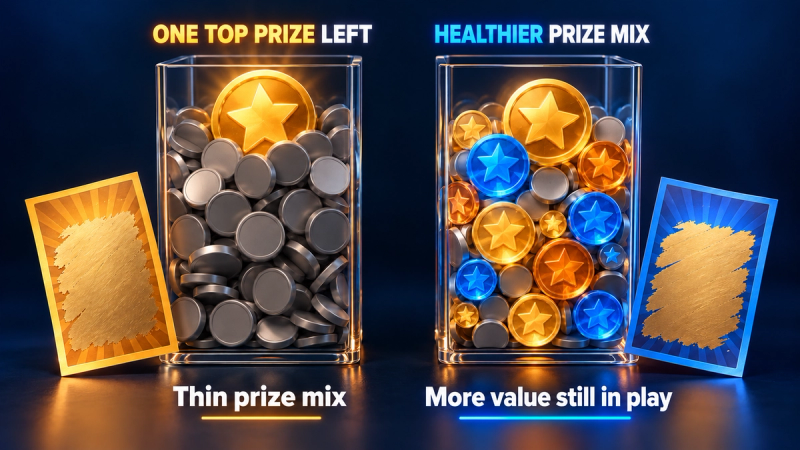
Then look at what share of the original top prizes is still unclaimed, not just the raw number. Two prizes left out of three is a very different game from two left out of twenty. Compare that share against how much of the game has sold. A game that's 70% sold but still holds most of its top prizes is in far better shape than the raw count suggests. A game that's 70% sold and down to its last one is a thin play, and the lag risk sits on top of that.
Check the middle tiers too. A game can show thousands of prizes remaining while every meaningful one is gone, because the count is padded with break-even and small winners. A big number next to "prizes remaining" says nothing about the quality of what's left.
Finally, compare the game against others at the same price. There's usually a better option sitting one slot over. In our October 16 snapshot, 794 games still had at least two top prizes left and held half or more of their original top prizes. You don't have to settle for a game hanging on by its last one. If you want to see what that looks like on a real board, pull up the Texas scratch-off board, where closing procedures start once the top prizes are claimed, next to the Massachusetts board, where you'll see plenty of games still selling with none left.
Why Current Data Still Beats the Odds Printed on the Ticket
The odds printed on the back of a scratch-off are set before the first ticket ships. They describe the entire print run on launch day and never change.
But a scratch-off isn't reset after every purchase. It's a fixed pool of tickets and prizes moving through the market over months, and as top prizes get claimed, the pool changes. That's why the odds on a scratch-off shift every single day while the ticket keeps printing the same numbers.
A prize count with a little lag is still miles ahead of a printed number that's frozen in time. A scoreboard that's a few seconds behind the action is still more useful than refusing to look at the score. The data doesn't predict your next ticket. Nobody can honestly do that. What it does is keep you out of games that are already dead and point you toward the ones that still have what you're playing for. If you want more on what public lottery data can and can't tell you, I went deeper on that here.
How Savvy Scratch Handles the Uncertainty
Savvy Scratch pulls official prize data from state lotteries and ranks active games by what's still unclaimed, not by what was printed on day one.
I'm not going to pretend the data is magic. A listed prize may have been sold and not cashed yet. State reports update on their own schedules. And no app, including mine, can tell you which individual ticket is a winner. Anybody who claims otherwise is selling you something you shouldn't buy.
What the data can do is show you, in seconds, which games have already lost every top prize, which ones have held their top prizes better than similar games at the same price, and how far each game has sold. That's the difference between using information and chasing certainty. The point is to know your game before you reach the counter, not to stand there squinting at a display case.
Before Your Next Trip to the Counter
Open your state's games and do three things. Cross off anything showing zero top prizes. Be skeptical of old, mostly sold games hanging on to a single top prize. Then pick from the games that still hold a healthy share of their top prizes at your price point. It takes a couple of minutes, and it puts you ahead of almost everyone else in line.
You're still buying a scratch-off. No ticket is ever "due," there's no secret barcode that reveals a winner, and an unclaimed prize isn't guaranteed to be on a shelf. But the players who read the count correctly stop paying full price for games that have nothing left to give.
Check the count before you buy. Create a free account, pick your state, and see the Bad and New tabs with no card required. Get the full Good and Neutral rankings for $5 a month or $50 a year, backed by a 30-day worry-free guarantee. Get started at savvyscratch.com
Frequently Asked Questions
Are scratch-off prizes remaining accurate?
They're accurate about claims. The count tells you how many prizes haven't been cashed yet, based on the lottery's latest update. It doesn't tell you how many are still on unsold tickets, because the lottery doesn't know whether a winning ticket has been bought until someone redeems it.
Does "prizes remaining" mean the winning tickets are still in stores?
Not necessarily. A prize listed as remaining could be on an unsold ticket, or it could already be in a player's hands waiting to be scratched or cashed. Some states, including South Carolina, state directly that their remaining-prize numbers are estimates and don't guarantee a prize is available.
Can a game with zero top prizes left still be sold?
Yes. Lotteries commonly keep selling a game while they pull unsold tickets back from retailers, and that process can take weeks. Illinois described a cleanup window of 10 to 12 weeks in a 2023 news investigation. A zero on the prize page is the most reliable number you'll find, so trust it.
How often are scratch-off prize counts updated?
It depends on the state. Some update daily, others less often, and claims processed after an update won't appear until the next one. Large prizes can also take longer to show as claimed because they require more verification.
Can the lottery tell me which store has a winning ticket?
No. Lotteries don't track whether specific winning tickets have been sold or where they are, and publishing that would break the game for everyone.
About the Author: Doug Moeller is a professional gambler with over 15 years of experience in poker, blackjack card counting, and casino advantage play, with over $500K in lifetime winnings. He built Savvy Scratch to bring the same count-what-you-can-see discipline from the blackjack table to scratch-off prize data. Follow Doug on X | YouTube
Scratch-offs are entertainment, not income. If gambling stops being fun, visit our responsible gambling page or call or text 1-800-GAMBLER.