
About Doug Moeller.
Founder of Savvy Scratch and a lifelong edge-seeker. My background is not in casual gambling — it is in professional gambling, probability, bankroll management, and finding situations where the math quietly shifts in your favor.
That mindset is exactly what I brought into the scratch-off world.

Most people play scratchers with almost no real information.
They buy what looks good, what feels lucky, or what the cashier suggests. I saw that and immediately recognized the problem. In any other gambling environment, serious players want better data before they put money in action. Scratch-offs should be no different.
That is why I built Savvy Scratch.
I Don't Look At Scratchers Like a Casual Player
I look at them like an analyst.
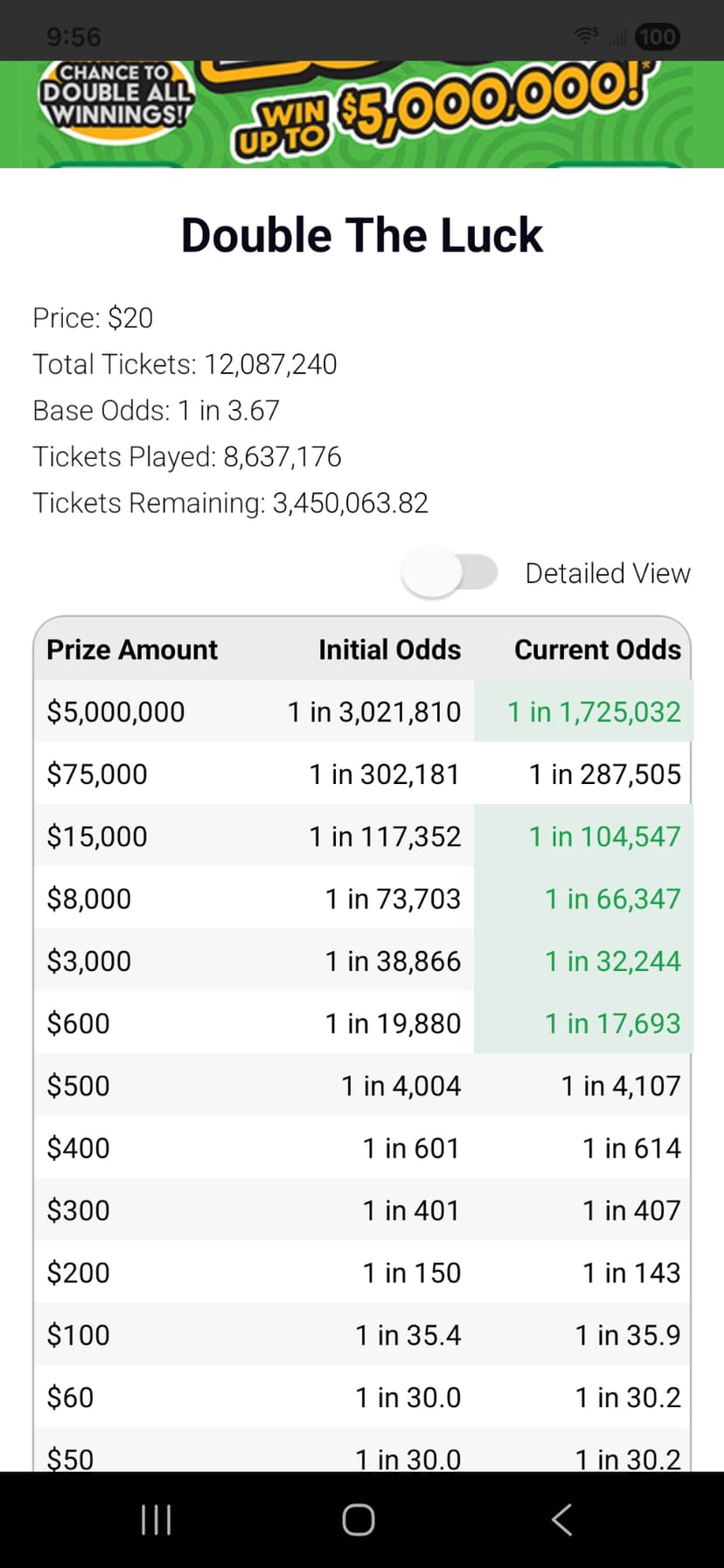
I study how games evolve over time. I care about how many top prizes are left, how far a game has sold through, how the ratio of remaining prizes changes, and how the odds can shift as tickets get depleted.
I pay attention to the real story under the surface, not just the flashy number printed on the front of the ticket.
A lot of people treat scratchers like pure luck. I do not. I treat them like a live data environment where the quality of a game can improve, decline, or become completely uninteresting depending on what is happening underneath the hood.
Why My Perspective Is Different
I did not come into this space as a marketer chasing a trend. I came into it as someone who has spent years thinking about risk, expectation, edges, discipline, and decision-making under uncertainty. In professional gambling, you learn quickly that most people lose because they are making bets without context.
Real-time Prize Decay
Track how top prizes deplete over time and spot when odds shift materially.
Liquidity Ratios
Understand sell-through rates and remaining prize distribution at a glance.
Jackpot Odds Shift
Identify games where your jackpot odds have improved.
Live Conditions
Evaluate games based on current state, not just launch-day odds that no longer apply.
What Savvy Scratch Is Really Built To Do
Savvy Scratch was created to help players stop guessing and start using better information. The goal is simple: help people avoid bad games, notice promising ones earlier, and make smarter scratch-off decisions using real data instead of impulse.
I believe that even in a game of chance, better decision-making matters. Better filters matter. Better timing matters.
I am not claiming to predict the future or manufacture certainty where none exists. What I do believe is this: when you can see how a game is changing, you can make more informed decisions than the person buying blind next to you.
That is the lane I live in.
Avoid Bad Games
Stop wasting money on depleted games where the best prizes are already gone.
Data Over Impulse
Replace gut feelings with actual prize distribution data and sell-through analytics.
Spot Opportunities
Find games where remaining prize ratios have quietly improved.
My Work Is Built Around Daily Scratcher Analytics
I focus on the numbers that actually matter. I analyze remaining top prizes, game progression, prize distribution, and how those variables change over time. I care about live conditions, not just launch-day odds. I believe scratchers should be evaluated as moving targets, because that is what they are.
A game is not static.
A ticket that looked decent months ago may be terrible today.
Shifts create opportunity.
A game that was nothing special at launch may become far more interesting later if the right prizes are still standing.
Most players have zero visibility.
That kind of shift is where analysis becomes useful — and where I provide the edge.

I Built This Because the Space Needed a Smarter Voice
Too much scratch-off content is built around hype, superstition, and surface-level reactions. I wanted to build something different.
I wanted to bring a sharper, more disciplined, more data-driven voice into the conversation. A voice that respects the player enough to tell the truth. A voice that says not every game is worth your money. A voice that is willing to point out when a ticket is weak, stale, or simply not a good bet relative to the alternatives.
That is how I think.
That is how I built Savvy Scratch.
That is how I approach this business every day.
I Wrote a Book About All of This
Scratch-Offs, Played Smarter is a short book that covers everything I just described. Game selection, the three numbers that matter, bankroll discipline, and the framework I used across fifteen years of professional gambling. It is free. No credit card, no trial, no upsell on page one.
I wrote it because most scratch-off advice online is noise. I wanted one clear resource that a player could read in twenty minutes and walk away thinking about tickets differently. Chapter seven on bankroll is the one I get the most emails about. Read it twice.
Enter your email and the PDF lands in your inbox. Unsubscribe anytime.
My Mission
My mission is to help scratch-off players make smarter decisions.
Not louder decisions.
Not more emotional decisions.
Smarter ones.
I want people to understand that scratchers are not just random pieces of cardboard with flashy branding. They are data-driven games that change over time. And when you understand that, you stop looking at them the way the average player does.
You start asking better questions.
You start avoiding worse spots.
You start respecting the math.
If You Want More Than Blind Luck
If you have ever wondered whether all scratch-off tickets are really equal, whether timing matters, whether some games become much better than others, or whether there is a smarter way to approach the counter — that is exactly what my work is about.
I built Savvy Scratch for players who want clarity.
For players who want better information.
For players who want a more disciplined way to play.
That is what I stand for, and that is what this company is built on.