
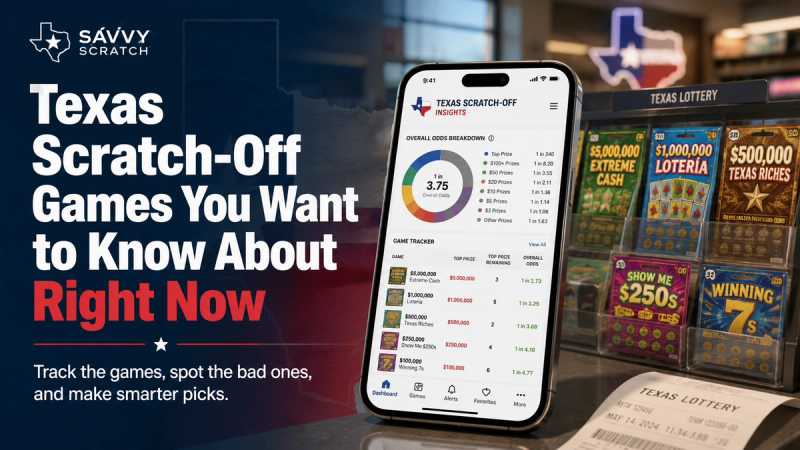
Texas Scratch-Off Games You Want to Know About Right Now
5/21/2026
By Doug Moeller | Professional Gambler & Founder of Savvy Scratch
If you play Texas scratch-offs, you've stood at the counter and done the same thing I used to do before I knew better. Wall of tickets behind the glass. A few dozen choices ranging from a buck to a hundred. New games, old games, games that have been sitting in that dispenser for over a year. And you pick one in about ten seconds based on which one catches your eye.
That decision is almost the entire bet. Not the scratch itself. The pick. Because not every Texas scratch-off game still has what was advertised on the front of the ticket. Some do. A lot don't. And the lottery commission is not going to put a sticker on the dead ones telling you to walk past.
I've spent over fifteen years making money beating games of chance. Poker mostly, some blackjack card counting, and a handful of casino advantage plays back when those edges were still around. Lifetime, I'm north of half a million in winnings, and exactly none of it came from picking the prettiest option at the table. It came from knowing which game I was sitting down at before I put any money on it. That's all this post is. The Texas equivalent of that same question, applied to the wall of scratchers at your local 7-Eleven.
Texas Has More Active Scratch-Off Games Than Almost Any Other State
Texas runs one of the largest scratch-off operations in the country. At any given moment there are scratch tickets in play across every price point from $1 up to $100, and the Texas Lottery Commission organizes them on its site by price tier, with separate views for current games, new releases, games closing soon, and games already closed. That's a lot to wade through.
The reason it matters is the reason most Texas players never think about. A scratch-off is not like Powerball. The Powerball drawing reshuffles every time. Every Tuesday and Saturday, the math resets. A Texas scratch-off does not work that way. Each game is a closed print run with a fixed number of tickets and a fixed number of prizes inside them. The day the game launches, every advertised prize is sitting in the unsold pile somewhere. As tickets sell and prizes get claimed, the composition of what's still out there changes. Sometimes in your favor. Usually not.
Think about it like a poker table. In poker there's a concept called table selection, and it is the single biggest factor in whether a pro has a winning month. Not how well you play. Which table you sit down at. Eight pros and you at a table, you break even at best. Eight recreational players who are tired and drunk, you make money. The cards are the same. The math of the game is the same. What changes is the company you're keeping at the felt. A scratch-off game has the same dynamic, except instead of opponents, it's the remaining prizes. Same ticket, same price, completely different table depending on what's already been claimed. The pro never sits down without checking. The recreational player sits down at the first open seat and orders a drink. If you want to stop being the second guy, start by checking which Texas games still have their good prizes intact before you spend the money. There's a practical, data-driven guide on the broader framework if you want the long version, but the short version is the rest of this post.
What "Knowing the Game" Actually Means in Texas
There are three numbers that tell you whether a Texas scratch-off is worth your money. The Texas Lottery publishes all three on its website. Almost nobody reads them.
First, the print run. How many tickets were originally manufactured. A game with a few million tickets printed is a different bet than a game with twenty-plus million, even if the top prize is identical, because the smaller print run drifts faster as prizes get claimed.
Second, tickets sold so far, which when subtracted from the print run gives you how many tickets are still in retailer inventory waiting to be bought. Express that as a percentage and you have a rough read on how mature the game is.
Third, and this is the one that matters most, prizes remaining at each tier. The top prizes especially. If a game launched with four top prizes worth seven figures and three of them have already been claimed while most of the tickets are still out there, you are buying a ticket whose meaningful prize structure has already been gutted. The math has moved sharply against the unsold inventory. The lottery is still allowed to sell it. The ticket still costs the same. The fantasy on the front is still printed in gold ink. The shot you think you're paying for is mostly gone.
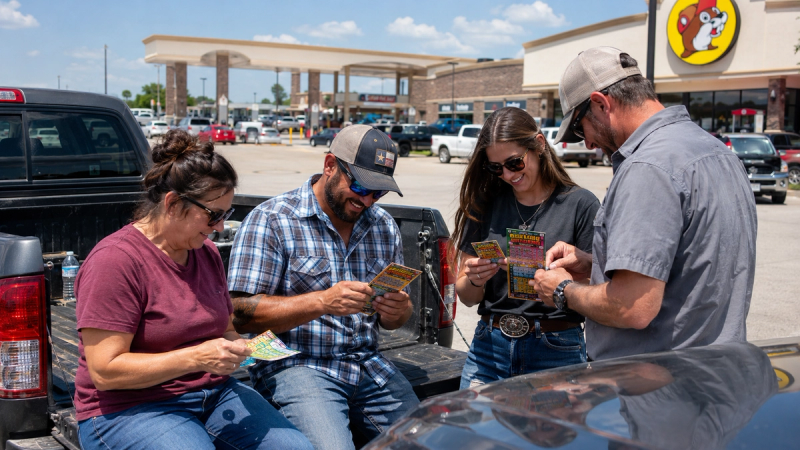
When you stack those three numbers together, every active Texas scratch-off falls into one of a few clear buckets. Brand new games where the full prize pool is still intact. Live games where the top prizes are still proportionally available given how many tickets have moved. Drifting games where the picture has gotten meaningfully worse. And dead games where most of the meaningful prizes are claimed but the tickets keep selling because the commission keeps stocking them. Walking past that fourth bucket is the easiest money any Texas player will ever save. The savings just don't show up in the bank account because they look like an absence, the dollars you didn't spend on a husk of a game that pulled you in with its packaging.
The Categories of Texas Games Worth Paying Attention To
Here's how I think about the Texas wall every time I look at it.
The newest releases get a quick look because the prize pool is intact by definition. There's no data drift yet. If the initial odds were decent and the prize structure is interesting, a new game is essentially the cleanest version of itself it will ever be. That doesn't make every new Texas game a buy. A new game with a weak initial prize structure is still a weak bet. But for the first few weeks of any game's life, what you see on the back is roughly what you're getting on the front.
Then come the games with most of their top prizes still unclaimed despite meaningful ticket sales. These are the games that interest me most, and they're the hardest for a regular player to identify without help, because nothing about the rack or the packaging will tell you. A $10 or $20 game that has been selling for months but still has all of its headline prizes sitting in the unsold inventory is a game where the math has actually drifted in your favor compared to launch day. That's the closest thing scratch-offs offer to the moments a counter waits for at a blackjack shoe. Not every shoe gets there. The ones that do, you press. I broke down the front-end side of this — what data tells you about your odds in more detail in a separate post if you want the longer treatment.
After that, the games where most of the headline prizes are already gone. These are the dangerous ones, because the marketing photo, the price point, and the placement on the rack all look identical to the live games next to them. The clerk has no idea. The art department did its job. The eye candy is identical. The thing you'd actually be excited to win, though, was claimed months ago by somebody in another city. You're paying full price for a ticket that mathematically can't pay you the fantasy on the front.
Games closing soon need a separate kind of attention. The Texas Lottery publishes which games are in the closing window. Some closing games still have meaningful prize inventory left. Some don't. The official list breaks it into closing games with top prizes still unclaimed and closing games with zero top prizes remaining. That second list is the one most casual players never see, because nothing on the rack tells them. The same ticket art that was on display six months ago is still hanging there, and unless somebody flips it over and checks the data, the player has no way to know the headline prize they're chasing was claimed before Thanksgiving.

And then the high-dollar games. The $50 and $100 Texas scratch-offs. These deserve the most scrutiny by a wide margin, and most players give them the least. A hundred-dollar ticket buys you exposure to a different prize structure than a five-dollar ticket, sure, but it also costs twenty times as much per pull. The downside of guessing wrong on a $100 game is twenty bad $5 games stacked end to end. The Texas $50 and $100 games are exactly the spots where a few minutes of checking pays for itself many times over. If most of the seven-figure prizes on a $100 game launched three years ago are already gone, you're buying $100 worth of mid-tier consolation refunds dressed up as a jackpot chase. The data tells you immediately. The packaging tells you nothing.
Why the Texas Lottery Ticket Wall Is Designed Against You
This part nobody likes hearing, but it's true.
The Texas Lottery commission has every incentive to keep selling tickets right up until the last copy of any game is gone. The state's take is fixed at the print plant. From their perspective, every additional ticket sold is more revenue, regardless of whether the player buying it has any real shot at the advertised prize. So you'll see dead games on the rack right next to live ones. You'll see closing games with zero top prizes left still on display, because somebody's going to walk in and not check. You'll see flashy artwork on games that are mathematically retired but legally still for sale. None of this is a conspiracy. It's just the business model. The lottery's design goal is to keep ticket revenue moving. The player's design goal is the opposite, to direct their existing budget into the games where the headline prize is still actually live.
The Habits That Cost Texas Players the Most Money
A lot of Texas players bleed money in ways that have nothing to do with the games themselves. They develop a favorite gas station because their cousin won there once. The store has no influence on which tickets win, because tickets are pre-printed and distributed essentially at random. They buy the same game every week because they like the artwork. The artwork doesn't change. The remaining prize inventory does. They get pulled in by flashy packaging on a game whose top prizes were claimed before the last Cowboys season started. They chase losses, which is the deadliest pattern in any form of gambling. Card players call it tilt. Recreational lottery players don't have a name for it because most of them don't realize they're doing it.
I've written about the psychology of those impulse mistakes before, and it's worth reading if you've ever caught yourself buying a second or third ticket to make up for the first one that lost. That single discipline, walking out of the store at your planned spend whether or not the last ticket hit, will save more Texas scratch-off bankrolls than any analytical tool ever will.
How to Actually Use the Data Before Your Next Buy
You don't need to read the Texas Lottery's PDF reports by hand. I used to do that for a while when I was first figuring this out, and it's exactly as boring as it sounds. The data is published. It's public. It's just buried under design choices that make you want to close the tab.
Savvy Scratch pulls that data automatically for Texas and the other states it covers, runs the comparison between current odds and initial odds for every active game, and ranks them so you can see at a glance which games still have live top prizes and which ones don't. The free account shows you the Bad games tab and the New games tab, which together cover most of the "do not buy" decisions you'd want to make at the counter. The Good and Neutral tabs are part of the paid subscription, which is five dollars a month or fifty a year, with a thirty-day worry-free guarantee. If a month of using it doesn't save you the price of admission across the tickets you would've bought anyway, the guarantee is real and the refund is one email away.
You can sign up free here and see the bad games and new games in Texas right now, no credit card needed. The point isn't to play more. It's to make the next ticket you were already going to buy a smarter one.
The Texas scratch-off wall has a lot of choices behind the glass. Most of them are not equally worth your money. Take a minute before you spend twenty bucks to figure out which ones are.
About the Author: Doug Moeller is a professional gambler with over 15 years of experience in poker, blackjack card counting, and casino advantage play, with over $500K in lifetime winnings. He built Savvy Scratch to bring the same data-driven approach that works at casino tables to scratch-off lottery tickets, with coverage across Texas and 18 other states. Follow Doug on X | YouTube