Buying a Whole Roll of Scratch-Offs: Does It Pay?
11/19/2026
By Doug Moeller | Professional Gambler & Founder of Savvy Scratch
Buying a whole roll of scratch-offs feels like the closest thing the lottery has to a sure thing. You get every winner in the book. Nobody walks in behind you and pulls the big one out of your stack. And in Texas, the lottery even prints a guaranteed payout for every pack.
So I pulled the official numbers on four Texas games that are on sale right now, from a $5 ticket up to a $100 ticket. Every one of them carries a published pack guarantee. If the book pays only that guarantee, every one of them loses money, and the best of the four still leaves you $155 short.
I've spent 20+ years as a professional gambler in poker, blackjack card counting, and casino advantage play. The first habit that work beats into you is separating what feels safe from what the numbers actually promise. A whole book of scratchers is one of the cleanest examples of that gap I've seen in the lottery.
How many tickets are in a roll of scratch-offs?
It depends on the ticket price, and the lottery sets it game by game. Players call it a roll, a book, or a pack. They all mean the same thing: one sealed, consecutively numbered pack of a single game.
In Texas, the pack gets smaller as the price goes up. The $5 game Lucky Scratch comes 75 tickets to a pack. The $20 game $1,000,000 Ca$h! comes 25 to a pack. The $50 game $5 Million Royale comes 20 to a pack, and the $100 game $5 Million Titanium Black comes 15 to a pack.
That puts the price of a whole roll at $375 for the $5 game, $500 for the $20 game, $1,000 for the $50 game, and $1,500 for the $100 game. Other states use their own pack sizes, so check the specific game's official page before you do the multiplication. And check the game number, not just the name. Two games can share a name and nothing else.
What a "guaranteed" pack actually guarantees
Here's the part most full-roll videos skip. Texas lists a "Guaranteed Total Prize Amount" per pack on every one of these game pages. It's real, it's official, and it's the minimum the whole book will pay.
Now line it up against the cost.
A pack of Lucky Scratch (#2784) costs $375 and guarantees $220. That covers about 59% of what you paid and leaves you $155 down at the floor.
A pack of $1,000,000 Ca$h! (#2744) costs $500 and guarantees $290. That's 58% of your money back and a $210 loss at the floor.
A pack of $5 Million Royale (#2624) costs $1,000 and guarantees $350. That's 35%. If the book pays the minimum, you hand the clerk a thousand dollars and walk out $650 lighter.
A pack of $5 Million Titanium Black (#2627) costs $1,500 and guarantees $950. That's the strongest guarantee of the four at about 63%, and it still leaves a $550 hole.
Two things jump out. First, the guarantee never comes close to the price of the book. Second, a more expensive ticket does not buy a better guarantee. The $50 game guarantees a smaller share of your money back than the $5 game does. If you assumed a pricier book was a safer book, the official numbers say otherwise.
The guarantee is a floor, not a forecast. Your book can pay more. It just isn't promised to.
Before you spend $375 or $1,500 on a stack of tickets, look at the game first. A free Savvy Scratch account shows you which games land in the Bad and New categories in your state, with no credit card required. Sign up free here.
A guarantee is a sign on the machine, not an edge
Casino floors have a cousin of the pack guarantee called the must-hit-by progressive. The meter promises the jackpot will hit before it reaches a set amount, and that promise is real. The machine will pay. In advantage play, the promise was never the thing I evaluated. What mattered was where the meter sat relative to the cap and what it would cost me to get there. A must-hit-by machine sitting far from its cap is just a slot machine with a nice sign on it. The guarantee only means something when the numbers around it line up.
A scratch-off pack guarantee is that same sign, except the meter never moves. Texas tells you before you buy that a $1,000 Royale book pays at least $350. That gap is printed on the official page and it's identical for every book in the game. Nothing about buying the whole roll closes it. When a guarantee comes with the loss already spelled out next to it, it isn't protecting you. It's telling you the price of admission.
How many winners are in a roll of scratch-offs?
There's no fixed number, and the winners don't show up on a schedule.
$1,000,000 Ca$h! lists overall odds of 1 in 3.99. If those odds were dealt out evenly, a 25-ticket book would hold about six winners. They aren't dealt out evenly. Overall odds are just total tickets divided by total prizes across millions of tickets. Washington's Lottery says it plainly on its own odds page: 1 in 5 "does not mean that there's an automatic winner within every five consecutive tickets." Three losers in a row does not make the fourth ticket a winner.
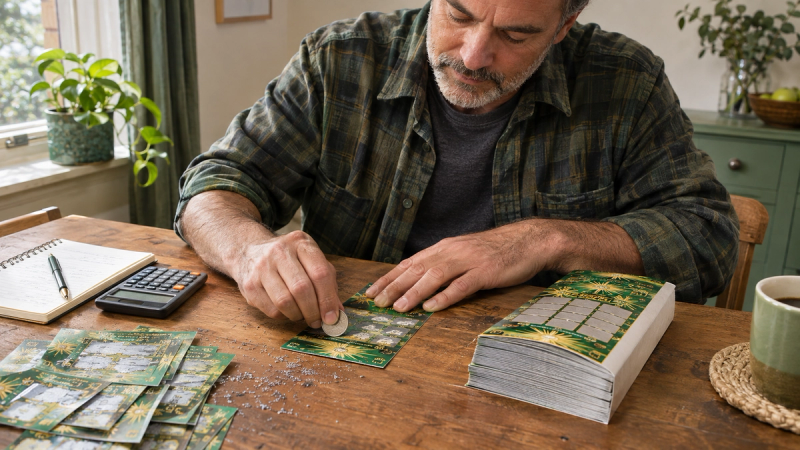
The bigger problem is what counts as a "winner." Lucky Scratch is a $5 ticket, and Texas printed 547,936 prizes of exactly $5 in that game. Every one of them counts toward the overall odds. Every one of them hands you back your own money and nothing more.
That's why the winner count on a full-roll video can look great while the purchase is underwater. The only math that matters for a book is this: total prizes collected minus total ticket cost. If you spend $500 and cash $320, you lost $180, and it doesn't matter whether that $320 came from three tickets or thirteen. I walk through how to read the odds printed on the back in How to Read Scratch-Off Odds Before You Buy a Ticket.
Buying the whole book is playing every hand
Every poker room has the player who can't fold. He sees every flop, so he drags a lot of pots, and if you only watched the pots he won you'd think he was crushing the game. He isn't. He's paying to see hand after hand that was never going to win, and the pots he does take don't cover what he spent getting there. One of the first things poker taught me is that how often you win and whether you win are two different numbers.
Buying a whole roll is playing every hand. You will see every winner in that book. You will also pay for every ticket in it that was never going to hit, and the pack guarantee already tells you the winners don't cover the cost at the floor. More tickets buys more chances at a prize. It does not make each dollar you spend work any harder. That's the same reason spending $2 on Powerball makes sense but spending $200 doesn't: scaling up a bad price just makes the bill bigger.
The top prize is almost never in your book
The pack guarantee is built out of small and mid-tier prizes. The prize people actually buy a whole roll hoping to find is the top one, and the book math on that is brutal.
$5 Million Royale was printed as roughly 6,039,620 tickets. At 20 tickets a pack, that's about 301,981 books. Texas printed four $5 million prizes, which means at most four of those books ever held one. Two have been claimed. When you buy a whole book of Royale, you're buying one of roughly 302,000 books, and at most two $5 million tickets are still out there.
Lucky Scratch works out to 68,508 books with four $100,000 top prizes. $1,000,000 Ca$h! works out to 244,202 books with four $1 million prizes, two of them still unclaimed. A whole roll doesn't get you meaningfully closer to the top prize. It just makes your one attempt cost more.
And "unclaimed" doesn't mean "unsold." A top prize can be sitting in a winner's sock drawer right now, bought but not cashed. I broke down why in Are Scratch-Off Prize Counts Accurate?. The same logic kills the idea that somebody's big win "proves" the next book is loaded. It proves the opposite, which is why chasing the game that just paid out is a losing habit.
This is where price stops being a shortcut too. A $100 ticket comes with a bigger top prize, but higher-priced scratch-offs don't reliably carry better jackpot odds. What matters is how many top prizes are left in the game, not how much the ticket costs.
That count is exactly what Savvy Scratch tracks. Paid members see the Good and Neutral categories and current top-prize odds for every game in their state, updated daily. It's $5 a month or $50 a year, and it comes with a 30-day worry-free guarantee. See the full rankings.
Should you buy the rest of a roll after a string of losers?
No, and this is the version of the whole-roll idea I'd worry about most. You've scratched ten tickets from a pack at the counter, all losers, and the clerk mentions there are fifteen left. It feels like the winners have to be in there.
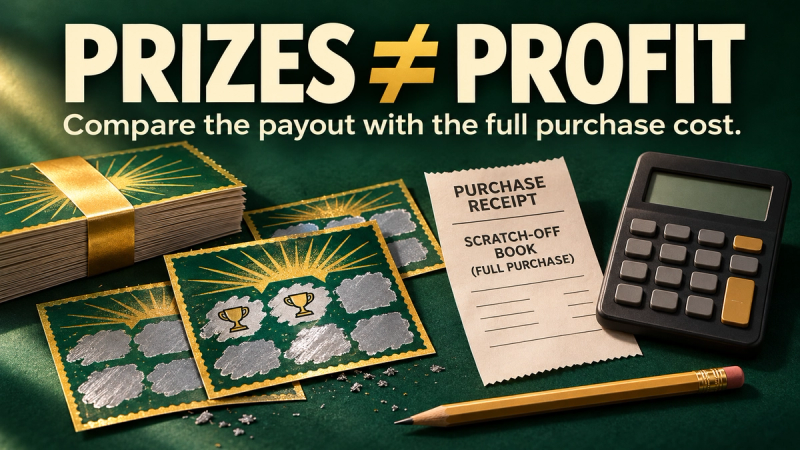
The pack guarantee applies to a complete, unsold pack. Nobody knows what was already pulled from that book, or what the person before you cashed. A streak of losers tells you nothing about the next ticket, and the guarantee doesn't follow the leftovers. That impulse to buy your way back to even is the same one I wrote about in Stop Chasing Losses, and it's how a $50 stop at the gas station turns into $300.
If you're going to buy a whole book anyway, check these four things
Some people buy a full pack because they enjoy the ritual, and that's their call. If that's you, do it with your eyes open.
Confirm the exact game number and the full pack cost. Multiply the ticket price by the official pack size. A $50 ticket in a 20-ticket pack is a $1,000 decision, not a $50 one.
Read the actual guarantee, then subtract. Find the game's official page, write down the guaranteed pack total, and subtract it from the pack cost. That number is how much you can lose with the guarantee fully honored. If there's no published guarantee, assume nothing.
Check how many top prizes are left before you buy. If the game has no top prizes remaining, a whole book of it is a bulk purchase of tickets that can't pay what's printed on the front. Your state's game list on Savvy Scratch, like the Texas scratch-off board, shows top prizes remaining for every active game.
Set your number before you walk in. If the book costs more than your entertainment budget, the guarantee doesn't make it affordable. The Florida Lottery's responsible-play guidance says the same thing I'd tell you: pick a dollar limit, stay inside it, and don't try to win back losses by playing more. My full approach to a lottery budget is in Scratch-Off Bankroll Management: The Tournament Pro's Guide to Surviving Variance.
Want to know which games still have their top prizes before you spend a dime? Start with a free account: Bad and New game categories, no credit card. Upgrade to the full rankings for $5 a month or $50 a year, backed by a 30-day worry-free guarantee. Create your free Savvy Scratch account.
Frequently asked questions about buying a whole roll of scratch-offs
How many tickets are in a roll of scratch-offs?
It varies by game and price. In Texas, current packs run 75 tickets for a $5 game, 25 for a $20 game, 20 for a $50 game, and 15 for a $100 game. Other states set their own pack sizes, so check the specific game's official page.
Does every roll of scratch-offs have a guaranteed winner?
Only if that specific game publishes a pack guarantee. Texas lists a guaranteed total prize amount per pack on its game pages, but the guarantee in the four games I checked ranged from 35% to 63% of the pack's cost. Overall odds printed on the ticket do not promise a winner in any particular stretch of tickets.
How many winners are in a roll of scratch-offs?
There's no fixed number. A $20 game with overall odds of 1 in 3.99 would average about six winners in a 25-ticket pack if prizes were spread evenly, but they aren't. Many of those winners only return the ticket price.
Is it worth buying a whole roll of scratch-offs?
Not as a way to make money. In all four Texas games I checked, a book that pays only its guaranteed minimum loses between $155 and $650. A book can pay more than its guarantee, but nothing about buying the whole roll promises that.
Does buying a whole roll improve your odds?
It gives you more tickets, so more chances to hit a prize. It does not improve the odds on each ticket, and it does not make the top prize meaningfully more reachable, because a single game is printed as tens or hundreds of thousands of books with only a handful of top prizes.
Can Savvy Scratch tell me which book has a winner?
No. Nobody outside the lottery can see inside a sealed pack. Savvy Scratch tracks official prize data to show which games still have top prizes left and how their odds have shifted, so you can choose a game before you choose how much to spend on it.
About the Author: Doug Moeller is a professional gambler with 20+ years of experience in poker, blackjack card counting, and casino advantage play, and over $500K in lifetime winnings. He built Savvy Scratch to bring the same discipline that works at casino tables to scratch-off tickets: read the real numbers, skip the bad games, and never confuse a guarantee with an edge. Follow Doug on X | YouTube
Play only if you are of legal lottery age in your state, and spend only what you can afford to lose.