
Why Chasing the Game That Just Paid Out Is a Waste of Money
8/12/2025
By Doug Moeller | Professional Gambler & Founder of Savvy Scratch
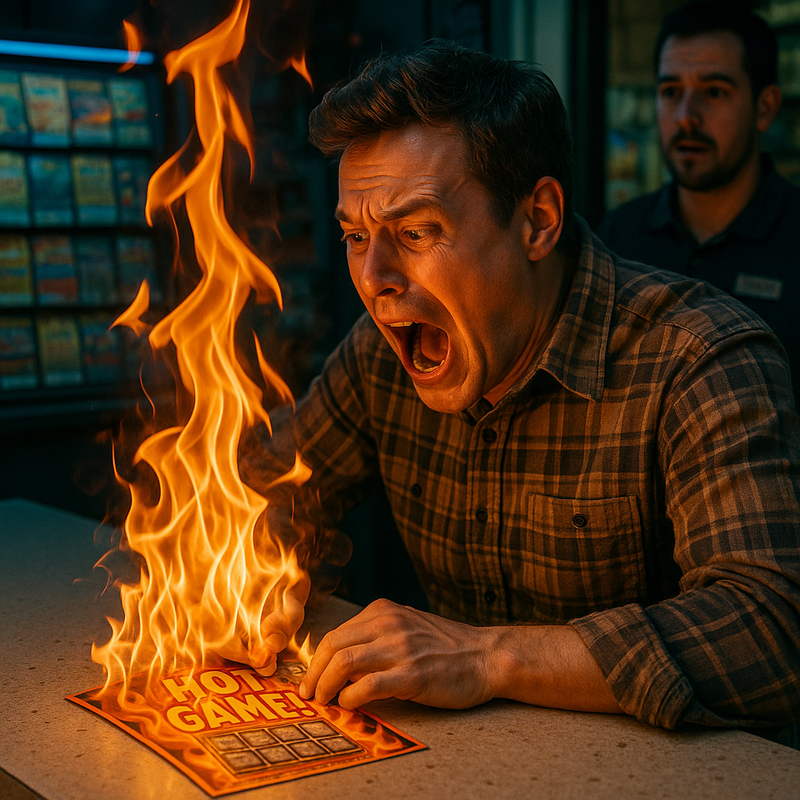
The cashier grins at you as you walk in. "Someone just won five hundred bucks on that one," she says, nodding toward a scratch-off game in the display.
Your brain does something immediate and automatic. It thinks: that game is paying out. That game is hot. I should buy that game.
So you do. You peel off a ten or a twenty, grab the same ticket, and scratch it with the quiet expectation that the winning hasn't stopped yet. Because lightning just struck here, and maybe the storm isn't over.
Here's the problem. In scratch-off lottery games, lightning doesn't work the way your gut thinks it does. When a big prize gets claimed from a game, the remaining tickets in that game just got worse, not better. You're not buying into a hot streak. You're buying into a thinner prize pool. And that instinct that told you to jump in? It's the exact same instinct that has cost gamblers money since the first dice were carved out of bone.
I know this because I've fought that instinct at casino tables for 15 years. And I can tell you from expensive personal experience that every game has a version of this trap.
SavvyScratch shows you which scratch-off games actually have the best remaining odds right now, not which ones just paid out. Plans start at $5/month or $50/year with a 30-day money-back guarantee.
The Hot Hand That Doesn't Exist
In poker, there's a type of player everyone at the table loves to see: the guy who just watched someone else win a huge pot and immediately thinks, "That seat is running hot." He'll fight to get that chair if the winner leaves. He'll play looser because the "energy" at the table feels right. He has absolutely no mathematical reason to believe any of this, but he believes it so deeply that he'll put real money behind the feeling.
I used to play in a weekly game where one particular seat at the table had produced three big winners in a row over consecutive weeks. Different players, same chair. By the fourth week, two guys almost got into an argument over who got to sit there. The guy who won the seat played every hand for the first hour, convinced the chair was blessed. He lost $600 before dinner.
That chair had no memory. The cards didn't know who was sitting in it. The deck gets shuffled before every hand, and the probabilities reset completely. But the human brain is wired to see patterns even where none exist, and "this spot just produced a winner" is one of the most powerful false patterns in all of gambling.
Scratch-off tickets trigger the exact same false pattern, except in scratch-offs, chasing the recent winner isn't just neutral. It's actively worse than random selection. Here's why.
The Math Moves Against You
Every scratch-off game starts with a known quantity: a fixed number of printed tickets and a fixed number of prizes distributed across those tickets. State lotteries publish these numbers. When the game launches, you can calculate the odds for every prize tier because you know the total pool.
As tickets sell, two things happen simultaneously. The total pool of remaining tickets shrinks, and prizes get claimed. The relationship between those two forces determines whether a game is getting better or worse for the people still buying.
When a big prize gets claimed, the prize pool just lost one of its most valuable pieces, but the remaining ticket count only dropped by one. Think about what that means. If a game had 4 top prizes spread across 2 million remaining tickets, your odds of hitting a jackpot were roughly 1 in 500,000. Now one of those prizes is gone. You have 3 top prizes across roughly 1,999,999 tickets. Your odds just shifted to about 1 in 667,000. That's a 33% decline in your jackpot chances, triggered by the exact event that made you want to buy the ticket in the first place.
The cashier told you someone just won big on that game. Your brain heard "opportunity." The math heard "one fewer prize in the pool." These two messages could not be more different.
This is the part that trips people up because it runs completely counter to everyday intuition. In most areas of life, success breeds more success. A restaurant with a line out the door is probably serving good food. A movie with great reviews is probably worth watching. But scratch-off games are finite, dependent systems. Every winner makes the remaining pool slightly worse. The game that "just paid out" is definitionally a worse game than it was ten minutes ago.
The Slot Machine Delusion
The "hot ticket" instinct comes from the same place as the "hot slot machine" belief in casinos. Someone hits a jackpot on a slot, and suddenly every person on the floor wants that machine. They'll stand behind the winner waiting for their turn, convinced the machine is in some kind of paying mood.
I spent years doing casino advantage play, and I can tell you that the players who understood how slot machines actually work never chased a machine that just paid. Modern slots use random number generators. Each spin is independent. The machine that just paid a $10,000 jackpot has the exact same probability of paying another jackpot on the very next spin as it did before the first one hit. The jackpot didn't make the machine "due" to go cold, and it didn't make it "hot."
But here's where scratch-offs are actually worse than slots for the chaser. With a slot machine, at least the odds stay the same after a big payout. The random number generator doesn't change. With scratch-offs, the odds literally decline when a prize gets claimed, because that prize is permanently removed from a finite pool. The slot machine chaser is making a neutral mistake. The scratch-off chaser is making a negative one.
So if chasing hot slots is irrational, and the math there is at least neutral, then chasing a scratch-off that just paid out is irrational and mathematically disadvantageous. You're following a false instinct into a game that just got worse.
The Lucky Store Myth
This same logic extends to the popular idea of "lucky stores." You've heard it before. "That gas station on Fifth Street has sold three big winners this year. I only buy my tickets there now."
The reason certain stores produce more winners is the same reason certain parking lots have more fender benders. Volume. A high-traffic store selling thousands of tickets per month will naturally produce more winners than a low-traffic store selling a few hundred. That's not luck. That's just how large numbers work. If you flip a coin a thousand times, you'll see more heads than someone who flips it fifty times. The coin isn't luckier. You just flipped it more.
The Savvy Scratch blog covers how scratch-off odds actually change over time and why the only thing worth tracking is the relationship between remaining tickets and remaining prizes, not which store sold the last winner.
Savvy Scratch tracks real-time prize data across 16 states so you can see which games are improving and which ones are depleted. $5/month or $50/year with a 30-day money-back guarantee.
What to Do When You Hear "Someone Just Won"
When a cashier tells you a game just paid out, your move is the opposite of what your gut says. That announcement is information, and it's useful, but not in the way most people think.
If someone just claimed one of the top prizes in a game, that game now has fewer top prizes in its remaining pool. Whether it's still a good game depends entirely on what the numbers look like after that claim. If the game had 8 jackpots and just lost one, dropping to 7 across a large remaining ticket pool, it might still be one of the better options in your price range. But if it had 2 jackpots and just lost one, it might have gone from a decent play to one of the worst on the wall.
The only way to know is to check the data. Not the cashier's enthusiasm. Not the buzz in the store. Not your gut feeling about which games are "running hot." The data.
Here's the practical approach. When you hear about a recent winner on a specific game, make a mental note of it and then check the current remaining prize information for that game before putting any money down. Compare it against other games in the same price range. If the game that just paid out still has a favorable ratio of remaining prizes to remaining tickets, then sure, play it. But play it because the numbers justify it, not because someone else won.
And if the numbers show that the game is now depleted relative to other options? Walk right past it. Let the next person in line chase the false pattern while you buy the ticket with better actual odds.
This is the same decision framework that separates professional poker players from recreational ones. Recreational players follow the action. They want to be in hands where big pots just happened because it feels exciting. Professional players follow the math. They fold in exciting spots and bet in boring ones because that's where the edge lives. The excitement and the edge are almost never in the same place.
The Game Nobody Is Talking About
There's a corollary to the "hot ticket" fallacy that works in your favor once you understand it. While everyone is crowding around the game that just produced a winner, the games nobody is talking about are sitting there quietly with untouched prize pools.
A game that launched three months ago and hasn't generated any local buzz might have most of its top prizes still available with a significant chunk of tickets already sold. That means the odds have been improving steadily while nobody paid attention. The game isn't flashy. Nobody at the counter is whispering about it. It doesn't have a story. But it has better math than the "hot" game everyone is chasing.
The January scratch-off post on the Savvy Scratch blog walks through this dynamic in detail, showing how older games can develop dramatically better jackpot odds than newer or more popular ones simply because they've flown under the radar. The best opportunities in scratch-offs, like the best opportunities in professional gambling, tend to be the ones that don't come with fanfare. They're buried in the data, waiting for the player who bothers to look.
Patterns Your Brain Invents vs. Patterns That Actually Exist
The human brain is a pattern-recognition machine. That's its job. It's what kept our ancestors alive when they needed to notice that rustling in the grass might be a predator. The problem is that this same machinery produces false positives constantly, especially in random or semi-random systems like gambling.
"That game just paid out, so it's hot" is a false pattern. "That store sells a lot of winners, so it's lucky" is a false pattern. "I've lost four tickets in a row, so I'm due for a win" is a false pattern. None of these are connected to reality. They feel real because your brain is doing exactly what it evolved to do: finding patterns and assigning meaning.
The only pattern that actually exists in scratch-off games is the mathematical relationship between remaining prizes and remaining tickets. That's it. Everything else is noise that your brain is turning into a signal. And every time you act on that false signal by chasing a hot game, playing at a lucky store, or buying extra tickets because you feel due, you're making decisions based on a pattern that doesn't exist.
Professional gamblers learn to override this instinct, or they go broke. I spent years training myself to ignore the voice that said "this table is hot" or "that dealer is cold" and instead focus only on the information that actually predicted outcomes: the count in blackjack, the pot odds in poker, the edge in whatever game I was playing. It's not natural. It takes practice. But once you learn to separate the real patterns from the invented ones, you stop making expensive mistakes.
With scratch-offs, you don't need years of training. You need about two minutes and a tool that shows you which games have the best remaining odds in your state. That replaces the pattern-recognition guesswork with actual data. And data, unlike your gut, doesn't get excited when the cashier says someone just won.
Next time you hear about a big winner on a scratch-off game at your local store, congratulate the winner. Then buy a different ticket. The one the data says is the best play right now, not the one the story says is hot.
See which scratch-offs have the best odds in your state right now. Savvy Scratch tracks real-time prize data across 17 states for $5/month or $50/year, backed by a 30-day money-back guarantee.
About the Author: Doug Moeller is a professional gambler with over 15 years of experience in poker, blackjack card counting, and casino advantage play, with over $500K in lifetime winnings. He built Savvy Scratch to bring the same data-driven approach that works at casino tables to scratch-off lottery tickets. Follow Doug on X | YouTube
The lottery isn’t about riding “luck.”
It’s about knowing which games have value right now.
When a game just hit big at your store, that’s your cue to walk away and put your money where it still has room to win.