
Stop Chasing Losses: The Silent Trap in Lottery Play
8/20/2025
By Doug Moeller | Professional Gambler & Founder of Savvy Scratch
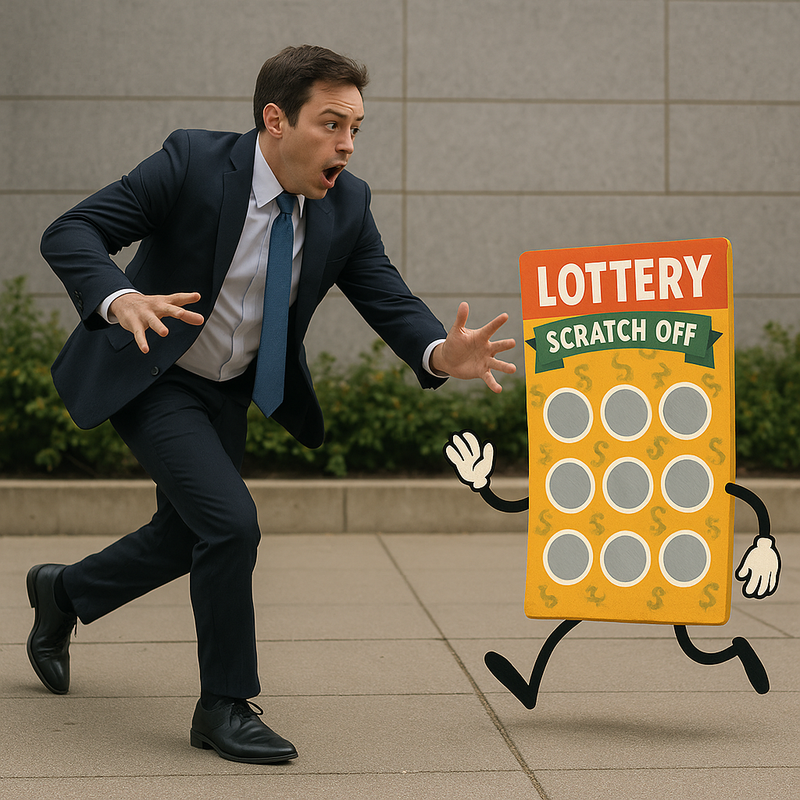
You planned to spend $20. You lost. So you spent $40 to even up. Then $60. By the time you hit $100, you're not really playing the lottery anymore. You're in recovery mode, buying tickets to get back to zero instead of for the chance at a jackpot.
That's chasing losses. And it's the most expensive habit in scratch-off play, not because any single ticket costs too much, but because the pattern turns a $20 entertainment decision into a $100 emotional one.
I've won over half a million dollars across professional poker, blackjack card counting, and casino advantage play. The single biggest threat to a winning player's bankroll isn't bad luck. It's what bad luck triggers in your head.
If you want to play scratch-offs with some actual discipline behind your decisions, Savvy Scratch shows you the real-time odds across 17 states so you're choosing tickets based on math instead of momentum. Get started for $5/month, with a 30-day money-back guarantee.
Why Your Brain Tells You to Buy One More
The mental trap has a name in casino circles: the gambler's fallacy. Your brain pattern-matches on everything, including randomness. After a string of losing scratch-offs, it generates the feeling that a win is overdue. "It can't lose forever" is the internal logic. But scratch-off tickets don't have memory. Each one is a sealed, pre-printed outcome that has nothing to do with what happened before it.
A ticket that hasn't paid out in five purchases isn't "building up" to a win. It's just a ticket.
The odds don't accumulate. The universe doesn't owe you a jackpot. The machine doesn't notice you've been losing. These are uncomfortable facts for a brain wired to find meaning in patterns, which is exactly why chasing feels logical even when it isn't.
What Poker Taught Me About This
In professional poker, we call it tilt. It's the state you enter after a bad beat, when your decisions stop being driven by math and start being driven by the emotional need to recover. I've watched some of the most technically skilled players I know light their bankrolls on fire in an hour because they took one beat they couldn't let go of.
The tell is always the same: bets get bigger, decisions get faster, and the goal shifts from playing correctly to playing for revenge against bad luck. Those aren't the same objective, and they produce wildly different results.
Scratch-off chasing is tilt in retail form. You buy the first ticket with a goal in mind, maybe a jackpot shot, maybe just some entertainment. Then you lose, and the next ticket isn't about the jackpot anymore. It's about making the loss feel smaller. Then the one after that is about getting even. You've changed the game you're playing without realizing it, and the version you're now playing has much worse terms than the one you started with.
The difference between a disciplined poker player and one on tilt isn't skill. It's whether they can recognize when emotions have replaced math as the decision driver. The same separation matters here.
The Real Cost, by the Numbers
Here's what the math actually looks like when chasing takes over.
You decide you're willing to spend $20 on scratch-offs this week. You lose on the first $20. That's within budget, that's the cost of playing. But then the chasing pattern kicks in: you spend another $20 to try to recoup. You lose again, so you spend another $40 to make up the $40 already gone. A few rounds of this and you've spent $120 on a budget of $20. Not because you wanted to spend $120. Because each individual purchase felt like the logical response to the one before it.
Multiply that across a month and you're looking at a player who budgeted $80 for lottery entertainment spending somewhere between $300 and $500. Not because they're reckless, but because chasing is self-compounding. Each loss generates the emotional justification for the next purchase.
The scratch-off itself isn't the financial problem. The response to losing the scratch-off is.
Ready to pick tickets based on data instead of frustration? Savvy Scratch tracks real-time prize availability across 17 states, so you know which games still have jackpots worth playing for. $50/year, 30-day worry free guarantee.
How to Stop the Cycle
The fix isn't willpower. Relying on willpower in the moment is how you end up at the counter buying your fourth ticket while telling yourself it's the last one. The fix is making the decision before the loss happens, when your head is clear.
Set a number before you buy your first ticket. Not a "I'll stop if things go bad" number, but a hard ceiling you commit to regardless of outcome. This is exactly how professional gamblers manage bankroll: you determine in advance what you're willing to lose in a session, and when you hit it, the session is over. No exceptions for "almost even." No exceptions for "just one more."
Write it down if you need to. Leave the rest of your cash in the car. Whatever it takes to build distance between the emotional impulse and the actual decision.
Tracking is the other piece most players skip. If you log every ticket you buy, even just in a notes app, you create an objective record that's harder to rationalize around. The human brain is very good at remembering wins and blurring losses into a rough feeling of "about even." Actual numbers don't cooperate with that story. Players who track tend to spend less, not because the math changes, but because reality is harder to avoid when it's written down.
It also helps to reframe what a loss actually is. When you sit down at a poker table with $200 and leave with $0, you didn't "lose" $200 in the sense of something being taken from you. You paid $200 for the experience of playing. If you bought four hours of poker with that money, that's the transaction. Scratch-offs work the same way: your budget is the cost of participation. When it's gone, the participation is over. That's not failure. That's the agreement you made with yourself before you started.
Picking Better Tickets Doesn't Fix a Broken Budget
One clarification worth making: understanding which scratch-offs have better current odds is genuinely useful. When more tickets have been sold than prizes claimed, the remaining jackpot odds improve. A game that started at 1 in 1.2 million for the top prize might be sitting at 1 in 650,000 after 60% of tickets have sold and only two of the original five jackpots have been claimed. That's a real mathematical difference. You can use an odds calculator to find those spots before you buy.
But better odds on a single ticket don't override a broken budget discipline. If you're going to spend $80 regardless because you'll keep buying until you "feel even," the quality of the individual ticket decisions is secondary to the behavioral pattern they're happening inside of.
Fix the pattern first. Then use the data to make better picks within whatever budget you've actually decided on. That's the right order.
The Players Who Stay Ahead
The lottery players who consistently stay within their budgets aren't the ones who win more. They're the ones who decided in advance what they were playing with, treated it like entertainment spending instead of an investment to recover, and walked away when it was gone.
That's it. No secret framework. No complex system. Just the decision, made clearly, before emotions have anything to weigh in on.
I spent years at poker tables watching smart people lose money they couldn't afford because they let frustration drive decisions that should have been made by math. The dollar amounts are different at the gas station. The psychology is identical.
Protect your budget. Play the odds. Quit when you said you would. The players who do all three are the ones who don't have a chasing problem.
If you want to make sure the tickets you're buying at least have current jackpots worth playing for, check the Savvy Scratch data for your state before your next purchase. It takes two minutes and costs less than one ticket. ($5/month or $50/year, with a 30-day worry free guarantee.)
About the Author: Doug Moeller is a professional gambler with over 15 years of experience in poker, blackjack card counting, and casino advantage play, with over $500K in lifetime winnings. He built Savvy Scratch to bring the same data-driven approach that works at casino tables to scratch-off lottery tickets. Follow Doug on X | YouTube