
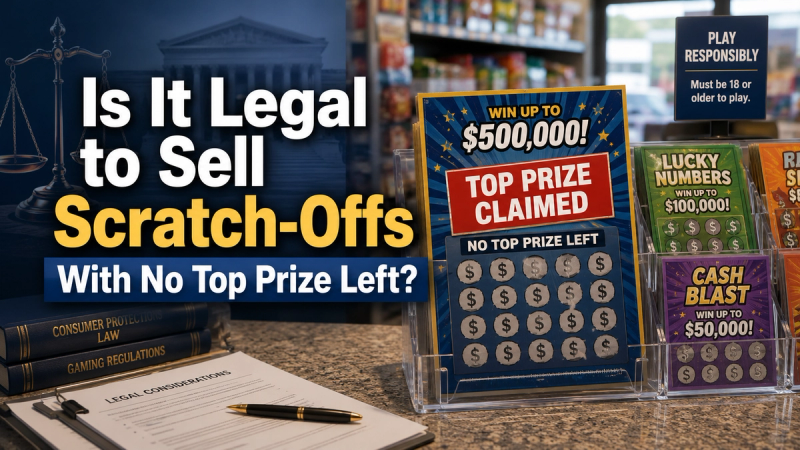
Is It Legal to Sell Scratch-Offs With No Top Prize Left?
6/14/2026
By Doug Moeller | Professional Gambler & Founder of Savvy Scratch June 14, 2026
You can walk into a store today, pay twenty dollars for a scratch-off splashed with a half-million-dollar headline prize, and walk out holding a ticket that cannot pay that prize, because the last one was claimed months ago. The state knows. The retailer's terminal knows. The marketing photo on the front gives you no hint. So the question players eventually ask is the right one: is it legal to sell scratch-offs after the top prize is gone? The answer is yes, in nearly every state, and the rules that allow it are looser than almost anyone buying tickets would guess.
I've spent more than fifteen years making my living off games of chance, poker, blackjack card counting, and casino advantage play, with over $500K in lifetime winnings. The thing that edge always came down to was knowing the current state of a game, not the version printed on a sign. Scratch-offs are the rare consumer gambling product where that current state is published, ignored by most players, and where the gap between "still for sale" and "still worth buying" is perfectly legal to keep open.
You don't need a subscription to stop buying dead games. A free Savvy Scratch account shows you the Bad and New tabs for your state, which is enough to spot the games to walk past. Sign up free.
The short answer, and the part nobody puts on the ticket
A scratch-off game is a closed print run. A fixed number of tickets, a fixed number of prizes at each level, all locked in at the factory before the game ships. Once it launches, every prize that gets claimed is gone for good, but the losing tickets keep coming off the roll at the same price. Nothing about a top prize being claimed pulls the game off the shelf automatically. The ticket still costs the same. The big number on the front still flashes the same. The only thing that changed is that the prize that pulled you in is no longer inside the pack.
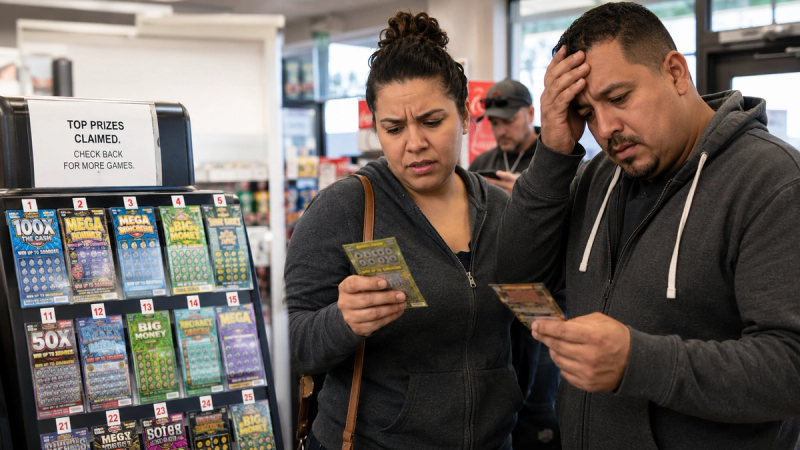
There is a distinction the lottery leans on here, and it matters. A top prize being claimed is not the same as a top prize being available. Winners often have up to a year to come forward, so a game can have every top-prize-winning ticket already sold and sitting in someone's glovebox while the official claimed count still reads zero. From your side of the counter, the effect is identical. The jackpot you are chasing is already out of the pack whether or not the paperwork has caught up.
What the law actually requires, and mostly doesn't
Most states have no rule forcing a game off the rack the moment its top prizes are claimed. The lottery is free to keep the game live, keep shipping it to retailers, and keep collecting revenue right down to the last ticket. Retailers are generally allowed to sell whatever inventory they have. Some post a small notice that top prizes may be gone. Most do not.
A few states put guardrails on this, and Texas is the cleanest example. After years of public criticism for selling tickets long after the jackpots were gone, the state passed a law requiring the commission to begin closing a game once all top prizes are claimed, and prohibiting sales past a set number of days after that closing process starts. Even there, the practical reality is baked into the wind-down. The Texas Lottery's own game rules state that during the closing window, tickets may still be sold after all top prizes have been claimed. So even in the state with the strictest version of this rule, you can legally buy a ticket whose jackpot is already gone. The law caps how long that window stays open. It does not close it on day one.
Other states handle it through disclosure rather than closure. New York drops a game from its public prizes-remaining list once all the first-tier prizes are claimed, which is a quiet signal if you know to look for it, but tickets for that game may still be sold across the state. Minnesota explains that it ends games based on warehouse and retailer inventory, sales patterns, and dispenser space, not strictly on whether a top prize has been hit, and it reminds players that an unclaimed top prize does not mean a top-prize ticket has not already been sold. Different mechanisms, same outcome. The game keeps selling, and the job of knowing what is left lands on you.
This is familiar territory if you have ever worked casino promotions for an edge. I spent years doing exactly that, hunting promos where the math briefly tilted toward the player and pressing them until the casino adjusted. The casino was never doing anything illegal by leaving a gutted promotion advertised on the floor after they had quietly cut its value. It was legal, it was posted, and it was a trap for anyone who did not check whether the edge was still there. A scratch-off with its top prizes gone is the same artifact. Fully legal to sell, still advertised, and worth nothing at the tier you actually cared about. Legal and available has never meant fair or worth it. The house knows the difference. Most players do not.
Why a dead game is still a real product to the state
Put yourself in the lottery's seat for a second and the logic is obvious. The program exists to raise revenue. A losing ticket from a depleted game generates the same revenue as a losing ticket from a brand new one. Pulling games early costs money and shelf space. The marketing was paid for up front and still works. The clerk ringing you up has no idea which games are alive and which are hollowed out, and is not required to. None of this is a conspiracy. It is a system built around its own incentives, and those incentives do not include warning you that the jackpot left the building in March.
This is the entire reason Savvy Scratch exists. It pulls the prize-remaining data your state already publishes, compares what is left against how far the game has sold, and sorts every active game into live and dead buckets so you are not doing PDF math at the counter. See which games in your state still have their top prizes.
Still running is not the same as still worth playing
The best lesson I ever learned about this did not come from a scratch-off. It came from poker table selection. A table can be running, legal, sanctioned, dealt by a professional, and still be the worst seat in the room. When I would sit down at a juicy table and watch the loose players slowly bust out and leave, the game did not end. The dealer kept dealing. The blinds kept going up. But the money that made the table worth playing had walked out the door, and the only players left were the ones who would take mine. Nobody tapped me on the shoulder to tell me the good game was over. Recognizing it and standing up was my job. A scratch-off whose top prizes are gone is that same dry table. Still dealing, still legal, still happy to take your action. The reason to be there left months ago.
That is the shift that matters. You are not asking whether a game is legal to buy. Of course it is. You are asking whether the prizes you would actually be excited to win are still in the pack, and how that compares to how far the game has sold. Those numbers move on their own, independent of the friendly "1 in 4" overall odds printed on the back, which count every small refund as a win and never update after launch. A game can hold its overall winning rate while quietly shedding every prize worth chasing.
How to check before you hand over money
Every state lottery publishes prizes-remaining data. It is public, it is buried, and it is usually formatted like it was built to discourage you from reading it. If you want to do it by hand, find the prize tier you actually care about, see how many of those prizes remain compared to how many were printed, and compare that to roughly how far through the print run the game has sold. If a healthy share of the top prizes are still in the pack relative to how many tickets are gone, the game is alive. If the top tiers are picked clean while the game keeps selling, it is dead at the level that matters, no matter how good the front looks.
If you would rather not spend an evening in a state lottery PDF, that is the work Savvy Scratch does automatically. The dressing-up that keeps depleted games looking exciting gets a fuller treatment in the breakdown of the design tricks scratch-offs use on buyers, and if you want the longer argument on why states are allowed to do any of this in the first place, the piece on the biggest legal lie in scratch-offs goes straight at it. The same discipline that keeps you from piling money into a game right after it pays out a jackpot applies here too. And if you play in a high-volume state, the sheer number of games on the rack makes the dead ones easier to miss, which is part of why sorting the live games out in California is a skill of its own.
So the next time a flashy ticket catches your eye, legality is not the question worth asking. It is legal. It will stay legal. The question is whether the prize on the front is still inside the pack, or whether you are paying full price for a souvenir of a jackpot somebody else already collected. Ten seconds of checking is the whole difference, and it is the same ten-second habit that separated my winning sessions from my losing ones at every table I ever sat at.
Savvy Scratch tracks every active game across 21 states and tells you which ones still have their top prizes and which ones are finished. Start with a free account to see the games to avoid, or unlock every live game for $5/month or $50/year, with a 30-day worry-free guarantee. Get started at savvyscratch.com.
Frequently asked questions
Is it legal to sell a scratch-off ticket after all the top prizes are claimed? Yes. In most states there is no rule requiring a game to be pulled when its top prizes are gone, and retailers can keep selling existing inventory. A few states, such as Texas, require closing procedures to begin once all top prizes are claimed, but even those allow sales to continue for a limited window during the wind-down.
Does the lottery have to tell me the top prize is gone? Generally no. Some states drop depleted games from their public prizes-remaining lists or post a small notice, but there is usually no requirement to warn you at the point of sale, and the clerk typically has no way of knowing.
If the claimed count says zero, does that mean the jackpot is still available? Not necessarily. Winners often have up to a year to claim, so a top-prize ticket can already be sold and sitting in a drawer while the official claimed count still reads zero. A game can be effectively dead at the top before the records show it.
How do I find out if a scratch-off still has its top prize? Check your state lottery's prizes-remaining data and compare the top prizes left against how far the game has sold, or use a tool like Savvy Scratch that runs that comparison for every active game automatically.
Do the printed odds on the back change when the top prize is gone? No. The overall odds printed on the ticket are calculated at launch and never update, and they count small refunds as wins. The odds on the specific prize you care about can get dramatically worse while that printed number stays exactly the same.
About the Author: Doug Moeller is a professional gambler with over 15 years of experience in poker, blackjack card counting, and casino advantage play, with over $500K in lifetime winnings. He built Savvy Scratch to bring the same current-state thinking that wins at casino tables to scratch-off lottery tickets. Follow Doug on X | YouTube