Knowing Your Game Before You Reach the Counter
8/6/2025
By Doug Moeller | Professional Gambler & Founder of Savvy Scratch
You're standing in line at the gas station. The guy in front of you is staring at the scratch-off display like he's trying to read the menu at a restaurant in a country where he doesn't speak the language. He squints. He tilts his head. He asks the cashier something about "the red and gold one." The cashier pulls out a ticket. The guy looks at it, changes his mind, asks for a different one. The line behind him grows. The whole thing takes two minutes and ends with a purchase based on color preference and whatever the cashier happened to grab.
Then it's your turn. You step up and say, "Two of game 2599, please." Thirty seconds. Done. You're out the door before the next person has even started browsing.
The difference between those two transactions isn't just speed. It's that one player is gambling on his choice of ticket, and the other player already made that choice before walking in, based on which games have the best remaining prize structures right now. The first player is guessing twice: once about which ticket to play and again about whether it'll pay. The second player eliminated the first guess entirely. And in any form of gambling, reducing the number of things you're guessing about is the closest thing to a real edge that exists.
I learned this principle at poker tables, and it applies to scratch-offs in a way that most players never think about.
Savvy Scratch shows you which games have the best remaining jackpot odds in your state so you can walk up ready. Plans start at $5/month or $50/year with a 30-day money-back guarantee.
The Poker Player Who Did His Homework
There's a distinction in poker between two types of players that's visible from across the room within about fifteen minutes. The first type sits down, looks at their cards, and decides what to do. They react to what's in front of them. Every decision is improvised. They might play well on any given hand, but their process is entirely reactive.
The second type sits down already knowing how they plan to play before they see a single card. They've studied the table. They know which players are loose, which are tight, which ones tilt after losing a big pot. They've already decided their opening ranges for each position, their bet sizing for different board textures, and their plan for the most likely scenarios. When the cards come, they're not making decisions from scratch. They're executing a plan they built before the session started.
I spent the first year of my poker career as the first type. I was decent at reacting, but I was constantly improvising, which meant I was constantly expending mental energy on decisions that should have been automatic. When I shifted to preparing before sessions, studying my opponents' tendencies, and walking in with a plan, my win rate improved meaningfully. Not because my in-the-moment skills changed, but because I'd moved a huge portion of my decision-making to a calm, analytical environment instead of making those decisions under pressure at the table.
The scratch-off counter is your table. And right now, most players are sitting down without any preparation at all. They're looking at the display, making real-time decisions under mild social pressure (the line behind them, the cashier waiting, the time crunch), and choosing tickets based on whatever catches their eye in that moment. Every part of that environment is working against thoughtful decision-making. The lighting is designed to make tickets look exciting. The packaging is designed to trigger impulse purchases. And the social pressure of a line discourages the kind of careful comparison that would actually serve your interests.
The fix is absurdly simple: make your decision before you get there.
What the Display Doesn't Tell You
The scratch-off display behind the counter is a marketing tool. It shows you the game name, the price, and the artwork. That's what the lottery commission wants you to see, because those are the elements designed to trigger a purchase. A bold "$1,000,000" printed across a shiny gold ticket creates an emotional response that has nothing to do with your actual odds of winning that money.
Here's what the display doesn't show you. It doesn't tell you how many of those million-dollar prizes are still available. It doesn't tell you how many total tickets were printed or how many have already been sold. It doesn't tell you whether the game sitting right next to it, the one with less flashy packaging, actually has dramatically better odds for comparable prizes.
Two $20 games can sit side by side in the same display and represent completely different propositions. One might have most of its top prizes remaining with heavy ticket depletion, meaning the odds for those prizes have improved significantly since launch. The other might have its jackpots claimed early while a large portion of tickets remain unsold, meaning you're paying $20 for a shot at prizes that no longer exist in the pool. The display treats them identically. They're both $20 tickets with exciting artwork. But the math underneath couldn't be more different.
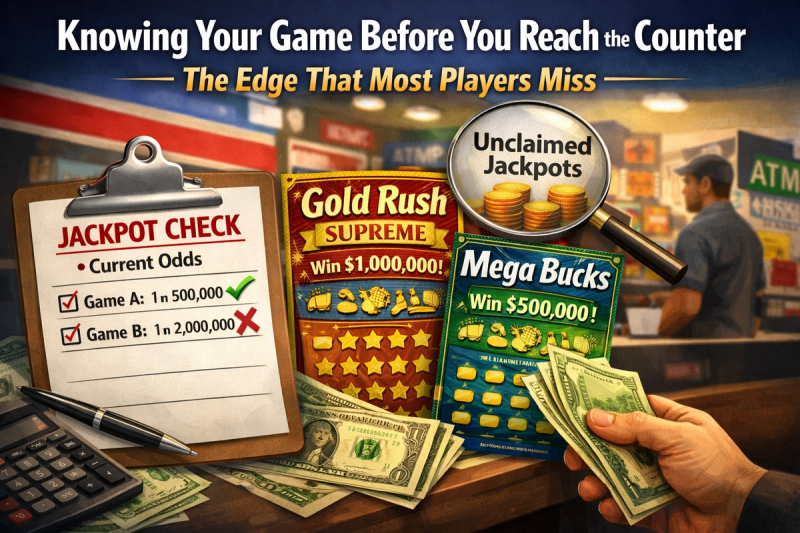
This is the information gap that preparation closes. When you check remaining prize data before walking into the store, you're seeing through the marketing to the actual product underneath. You know which games still have top prizes. You know the rough relationship between remaining tickets and remaining prizes. And you can compare across all the games in your price range to find the one where your money has the best chance of producing something meaningful.
The Savvy Scratch blog post on lottery analysis walks through exactly how this evaluation works and why the games with the best value are almost never the ones with the most prominent display position.
The Two-Minute Edge
The amount of preparation required to walk into a store with a plan is almost comically small relative to the advantage it gives you. We're talking about two minutes on your phone before you leave the house or while you're sitting in the parking lot.
Check which games in your state still have top prizes available. Compare the remaining prize counts across games in your price range. Identify the one or two games with the best remaining ratios. That's it. Now you know what you're buying and why, and the entire counter interaction takes thirty seconds.
What you've done in those two minutes is something the vast majority of scratch-off players will never do. You've moved your purchase decision from an environment optimized for impulse (the store, the display, the line, the time pressure) to an environment optimized for analysis (your phone, your couch, your car, silence). Professional gamblers call this "making decisions at the easy table." When you have the option to make a decision in a calm, information-rich environment rather than a pressured, information-poor one, you always choose calm. Always.
In blackjack, I did most of my real work away from the casino. I'd study shoe compositions, practice counting speed, memorize deviation tables, and build spreadsheets analyzing different rule sets. By the time I sat down at the table, the hard thinking was done. The session itself was execution, not analysis. I wasn't trying to figure out basic strategy while the dealer waited and the pit boss watched. I'd figured all of that out in advance, in an environment where I could think clearly and take my time.
Your two minutes of checking scratch-off data before walking into the store serves the same function. It moves the thinking to where thinking is easy and reduces the buying moment to pure execution. Walk up, ask for your game by number, pay, leave. No browsing. No impulse. No pressure.
Savvy Scratch organizes real-time prize data across 16 states so that two-minute check takes even less time. $5/month or $50/year with a 30-day money-back guarantee.
Impulse Is the Lottery Commission's Best Friend
It's worth understanding who benefits when you browse at the counter instead of walking in with a plan. It's not you.
State lotteries invest heavily in point-of-sale marketing because they know that a large percentage of scratch-off purchases are impulse decisions. The display placement, the ticket artwork, the "new game" signage, the printed odds on the front of the ticket (which are the launch-day odds, not the current odds) are all calibrated to make you buy in the moment without doing any comparison. This isn't a conspiracy. It's just standard retail marketing applied to lottery products. Grocery stores put candy at the checkout for the same reason. The impulse purchase point is the most profitable real estate in any retail environment.
When you make your decision in advance based on data, you're opting out of that entire system. You're not responding to the artwork. You're not influenced by the new-game signage. You're not comparing based on the printed launch-day odds, which may be months out of date. You're buying based on the current state of the game, which is information the display was never designed to give you.
This doesn't mean the lottery commission is trying to trick you. The data is publicly available. State lotteries publish remaining prize information on their websites. But they don't put it on the display, and they don't train cashiers to share it, because their business model depends on volume, not on informed consumers making optimal selections. The more people buy on impulse, the more evenly distributed the sales are across all games, including the ones with depleted prize pools. An informed buyer concentrates their spending on the best available games. An impulse buyer spreads it randomly.
The post about not letting the cashier pick your ticket covers the cashier side of this dynamic. The post about the lucky store myth covers the location side. This post completes the picture: the display itself is a marketing tool, not an information tool, and treating it as a source of decision-making data is one of the most common mistakes scratch-off players make.
What "Knowing Your Game" Actually Feels Like
There's a secondary benefit to walking in prepared that goes beyond the math, and it's something I experienced consistently in professional gambling.
When you know what you're doing and why, the entire experience changes. You're not anxious about whether you're making the right choice. You're not second-guessing yourself. You're not looking at the ticket after you buy it and wondering if the one next to it would have been better. You made a decision based on available information, you executed it, and now you scratch the ticket knowing you gave yourself the best shot the data allowed.
That feeling of quiet confidence isn't just pleasant. It actually protects you from the emotional spending traps that drain other players' budgets. When you're confident in your selection process, you don't feel the urge to buy "one more just in case." You don't succumb to the flashy new game on the end of the display because you know the numbers on the game you chose are better. You don't ask the cashier for a recommendation because you already have better information than they do.
I felt the same shift in poker when I moved from improvising to preparing. Before preparation, every session had moments of uncertainty where I didn't know if I was making the right play. Those moments created stress, and stress led to bad decisions. After I started preparing, those uncertain moments mostly disappeared, because I'd already worked through the most common scenarios in advance. The session felt calmer, more controlled, and more enjoyable, even on nights when the cards didn't cooperate.
The scratch-off counter version of this is smaller in scale but identical in principle. Two minutes of preparation turns a stressful, impulse-driven shopping experience into a calm, intentional thirty-second transaction. You feel different walking out of the store when you know you made the right choice versus when you're already wondering if you should have picked something else.
The Quiet Edge
In professional gambling, the biggest edges are rarely dramatic. They don't look like the movies where someone makes a brilliant read and pushes all their chips in with a knowing smile. Real edges are boring. They're the card counter who sits at a table for four hours, makes tiny adjustments to bet size, and walks out with a modest profit. They're the poker player who folds 80% of their hands and only plays when the math is clearly in their favor. The edge is in the discipline and the preparation, not in the moment.
Knowing your scratch-off game before you reach the counter is that kind of edge. Nobody in line notices. The cashier doesn't know. It's invisible. But over the course of months and years, the player who consistently buys into games with the best remaining prize structures is playing a fundamentally different game than the player who grabs whatever looks good in the moment.
You can't control whether your ticket is a winner. Nobody can. But you can control whether you're buying a ticket from a game with favorable remaining odds or a game that's been picked clean. That control is your edge. And it takes two minutes to exercise it.
Check current scratch-off odds on Savvy Scratch and walk into the store knowing exactly what you want before you get in line.
See which scratch-offs have the best odds in your state right now. Savvy Scratch tracks real-time prize data across 17 states for $5/month or $50/year, backed by a 30-day worry free guarantee.
About the Author: Doug Moeller is a professional gambler with over 15 years of experience in poker, blackjack card counting, and casino advantage play, with over $500K in lifetime winnings. He built Savvy Scratch to bring the same data-driven approach that works at casino tables to scratch-off lottery tickets. Follow Doug on X | YouTube