You Wouldn’t Play Poker Blind — So Why Do It With Scratchers?
8/1/2025
By Doug Moeller | Professional Gambler & Founder of Savvy Scratch
Every poker player in the world knows the same thing before they put a single chip in the pot: what cards they're holding. Blackjack players track the count. Sports bettors study the line. But most scratch-off players? They walk up to the counter, point at whatever catches their eye, and hand over their money without any idea what the actual scratch-off odds look like on that ticket right now.
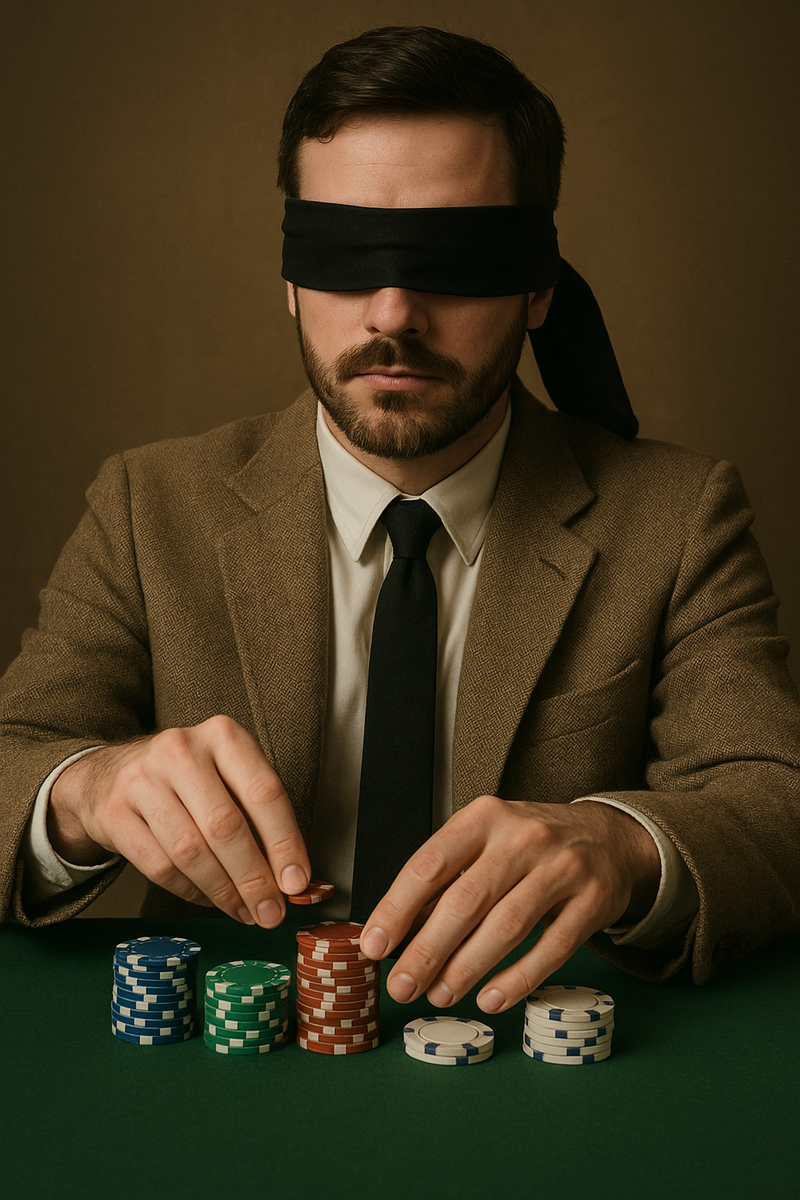
That's the equivalent of sitting down at a Texas Hold'em table, covering your hole cards with your hands, and shoving all-in every hand. Nobody would do that. But that's what millions of people do every single week with scratch-offs, and most don't even realize it.
I spent over 15 years as a professional gambler. Poker, blackjack card counting, casino advantage play. Over half a million dollars in lifetime winnings. And the one thing every profitable gambler understands is this: you never put money at risk without knowing your edge. That same principle applies to scratch-offs, and the fact that most players ignore it is the single biggest reason they keep losing.
The Counter Is Designed to Keep You Blind
Walk into any gas station, convenience store, or grocery store in America. You'll see a rack full of scratch-off tickets. Flashy designs, bold prize amounts, new releases with eye-catching themes they even have their own specialized vending machines.
What you won't see is any of the information that actually matters.
Those tickets don't tell you how many jackpots have already been claimed. They don't tell you what percentage of the game has already been sold. And they definitely don't show you what your real odds are at this moment compared to when the game launched.
This isn't an accident. The lottery is a business. They make more money when players buy without thinking. The packaging is designed to sell on impulse, not to inform your decision. I wrote about this in detail in The Marketing Tricks Scratch-Off Tickets Use (And How to Outsmart Them), and once you see these patterns, you can't unsee them.
Think about it this way. If you walked into a poker room and the house refused to show you your cards, you'd walk out. If a blackjack table banned card counting and then also refused to tell you how many decks were left in the shoe, you'd laugh and leave. But scratch-off tickets do exactly this, and people just accept it because that's how it's always been.
It doesn't have to be.
Scratch-Offs Work Like a Finite Deck (And That Changes Everything)
Here's the concept that changed how I think about the lottery, and it comes straight from my card counting days.
A scratch-off game is a closed system. When the state prints a game, they print a fixed number of tickets with a fixed number of prizes. As tickets sell and prizes get claimed, the composition of what's left in the "deck" changes. This is the same fundamental principle behind card counting in blackjack. When enough low cards come out, the remaining deck favors the player. When enough prizes get claimed, the remaining tickets may become more or less valuable depending on what's still out there.
The critical question is: are the big prizes still available, or have they already been claimed?
If a game launched with three $1,000,000 jackpots and two have already been claimed, the game is nearly dead at the top. But the ticket still looks the same on the rack. The packaging still says "$1,000,000" in big letters. The only way to know the difference is to check the data. I break this concept down fully in Card Counting for Lottery? Here's How It Actually Works for Scratch-Offs.
On the flip side, when a game has sold through most of its tickets but still has jackpots remaining, the math can shift in a meaningful way. Fewer tickets in the pool means each remaining ticket has a better shot at those top prizes. That's not a guarantee of winning. It's a mathematical reality about probability in a shrinking pool.
The Difference Between Printed Odds and Real Odds
This is where most players get tripped up. Every scratch-off ticket shows you the "overall odds of winning" on the back. Something like "1 in 3.84" or "1 in 4.45." And most people look at that number and think they understand their chances.
They don't.
Those printed odds are calculated at launch, based on the full pool of tickets. They never update. So when you're looking at a game that's 85% sold through, the printed odds on the back are essentially a snapshot from months ago. They don't reflect the current reality of that game.
Here's a concrete illustration. Say a game launches with initial odds of hitting the $5,000,000 prize at 1 in 1,310,895. After the game sells through most of its tickets but that jackpot is still unclaimed, the current odds might shift to something like 1 in 382,557. That's a massive change, from over 1.3 million to under 400,000, but the ticket still shows the old number. A player who checks the data knows this. A player who doesn't has no idea.
The reverse is even more dangerous. When all the top prizes are gone but the game keeps selling, you're buying tickets where the ceiling on your potential win has dropped dramatically. You're essentially playing a dead hand, and you wouldn't know it without checking.
I go deeper on why this matters so much in Why Top Prizes Are the Only Thing That Actually Matters in Scratch-Offs. The short version: the small prizes are mathematically irrelevant to your overall outcome. What matters is whether the game still has a meaningful top prize available.
The Five Mistakes That Cost Scratch-Off Players the Most Money
After years of analyzing scratch-off data and watching how people play, the same patterns come up again and again. These are the five habits that drain lottery budgets fastest.
Buying based on appearance. The flashiest ticket on the rack is not the best ticket on the rack. It's the one the lottery commission spent the most marketing dollars on. Design has zero correlation with odds quality. A boring-looking $2 game with all its jackpots remaining is objectively better than a shiny $30 game with none left. I covered this and more in 5 Ways People Waste Money on Scratch-Off Tickets (And How to Stop).
Letting the cashier choose. The person behind the counter doesn't know the odds. They don't know which games are hot or cold. They're just handing you whatever's convenient. If you let someone else pick your poker hand for you, you'd at least want them to know the game. The cashier doesn't. Read more about this in Stop Letting the Cashier Pick Your Lottery Ticket.
Playing the same game every time out of loyalty. This is one of the biggest leaks in any gambler's game. A scratch-off isn't a relationship. When the math goes bad, you move on. Sticking with a game because you "always play it" is the definition of playing with emotion instead of data. I wrote about this pattern specifically in Playing the Same Ticket Every Time? Here's Why That Might Be Costing You.
Chasing losses. You lose $50 on scratchers, so you buy $100 more trying to get it back. Professional gamblers call this "going on tilt." In poker, it's how you blow your bankroll in a single session. With scratch-offs, it's how you spend twice what you planned. The discipline to walk away when the math isn't there is what separates recreational players from strategic ones. For more on managing this, check out Scratch-Off Bankroll Management: The Tournament Pro's Guide to Surviving Variance.
Ignoring game state entirely. This is the umbrella mistake that covers all the others. If you're not checking which games have prizes remaining, what the current odds look like, and how far the game has sold through, you're playing blind. And we already established what playing blind gets you.
Stop guessing. Check the real-time odds before your next ticket purchase at SavvyScratch.com
What Smart Scratch-Off Strategy Actually Looks Like
Good scratch-off strategy doesn't require you to be a mathematician or a professional gambler. It requires one thing: information.
Before you buy a ticket, you should know three things. First, does the game still have its top prizes available? If not, you're buying into a dead game regardless of what the packaging says. Second, how far through its lifecycle is the game? A game that's 90% sold through with a jackpot still on the board is in a very different spot than a game that's 20% sold with everything still intact. Third, how do the current odds compare to the printed odds? Are things trending in your favor, or have the best opportunities already passed?
This is exactly what a scratch-off odds tracker does. It pulls the same data that state lotteries are required to publish but buries deep in their websites, and puts it in front of you in a way you can actually act on. Think of it as your hole cards. The data doesn't guarantee you'll win, just like seeing your cards in poker doesn't guarantee you'll win the hand. But it tells you whether the hand is worth playing.
I built Savvy Scratch specifically because this tool didn't exist in a usable form. I got tired of manually digging through state lottery websites, cross-referencing prize claim reports, and doing the math in spreadsheets. The app does all of that automatically, across 16 states, updated regularly. It rates every active game, flags the ones where the math is favorable, and warns you about the ones where the top prizes are gone.
For a deeper walkthrough of what data-driven play looks like in practice, read Scratch-Off Tickets With the Best Odds: A Practical, Data-Driven Guide.
The Near-Miss Trap (And Why Data Protects You From It)
There's a psychological layer to this that goes beyond math, and it's worth understanding if you play regularly.
Scratch-off tickets are designed to create near-misses. You scratch off four matching symbols when you needed five. You get two of the three winning numbers. These moments feel like you were "so close," and they make you want to buy another ticket immediately. But a near-miss on a scratch-off is meaningless. The outcome was determined when the ticket was printed. You weren't close to anything.
Professional poker players train themselves to ignore emotional reactions and focus on the math. The same discipline applies here. When you have data in front of you showing which games are mathematically favorable and which aren't, it's much harder for the near-miss trick to pull you back into a game that doesn't deserve your money. Data is the antidote to impulse buying. I explain this psychological trap in detail in The Near-Miss Trap: How Scratch-Offs Keep You Playing After You Lose.
The Bottom Line: Play Like a Pro, Even If You're Not One
You don't need to be a professional gambler to think like one. You just need to adopt one simple habit: check the data before you buy.
That's it. Before you walk up to the counter, spend 30 seconds looking at which games in your state still have top prizes. See which ones Savvy Scratch rates as "Good." Skip the dead games. Play the ones where the math still has something to offer.
The game is built on chance. That part doesn't change. But the decision about which game to play? That's 100% in your control. And making an informed choice versus a blind one is the difference between gambling and strategy.
The smartest player at the counter isn't the one spending the most money. It's the one who checked the odds first.
See your state's best scratch-off odds right now at SavvyScratch.com
Doug is the creator of Savvy Scratch and a professional gambler with over 15 years of experience in poker, blackjack card counting, and casino advantage play. He built Savvy Scratch to give everyday players the same data-driven edge he uses in every game he plays.