
How to Use an Odds Calculator to Pick Better Scratch-Offs
7/9/2025
By Doug Moeller | Professional Gambler & Founder of Savvy Scratch
Ever look at a scratch-off and wonder whether it was actually a smart buy, or whether you just grabbed another dead-end ticket because it looked good behind the counter?
That’s the right question.
Because the biggest thing most players miss is this: scratch-off odds do not stay frozen. They move. They change as prizes get claimed and tickets sell. Which means the ticket you’re holding might be better than it was at launch, worse than it was at launch, or already past its prime and not worth your money at all.
That is exactly what an odds calculator is trying to solve.
I’ve spent over 15 years in professional gambling, from poker to blackjack card counting to casino advantage play, and the principle is always the same. You are not looking for certainty. You are looking for better spots than the average player sees. If the math improves even a little, that matters. If the math gets worse and you buy anyway, that matters too.
That’s the whole reason this topic is so important.
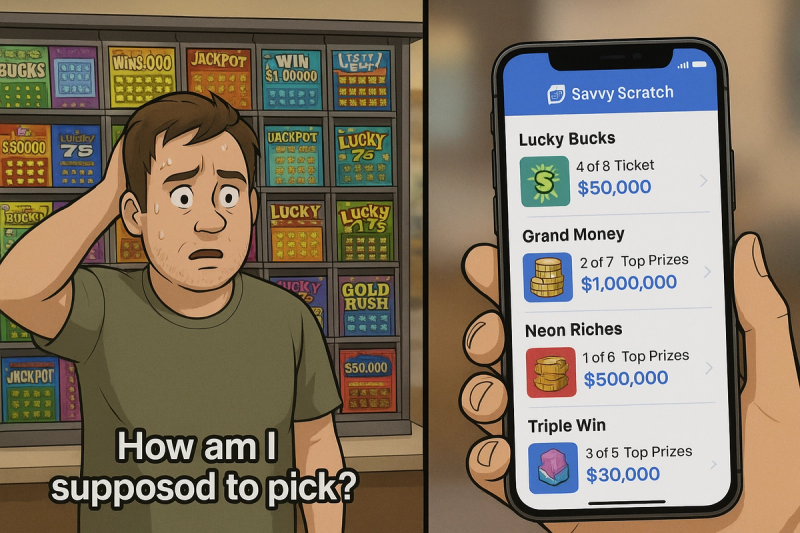
If you want to sign up free, see the bad games and new games in your state, and stop doing this math by hand, try Savvy Scratch free here.
What an Odds Calculator Is Actually Doing
A scratch-off odds calculator is not predicting a winner.
It is not telling you the next ticket is “the one.”
It is doing something much simpler and much more useful than that.
It is looking at how many meaningful prizes are still left, how much of the game is likely still out there, and how the current condition of that game compares to what it looked like on launch day.
That’s it.
And that matters because scratch-offs are not static. They are what gamblers would call dependent games. The condition of the game changes over time. Your blog already makes that point in other live posts, especially the one explaining that scratch-offs behave more like strategy games than most players think.
That’s why Scratch-Offs Aren’t Just Luck — They’re Built Like Strategy Games fits this piece so naturally.
Because once you understand that the game is moving, the next obvious question becomes:
how do I measure that movement?
That’s where the calculator comes in.
Why the Printed Odds Are Not Good Enough
The odds printed on the back of the ticket are launch-day odds.
They reflect what the game looked like when it first came out. Full ticket pool. Full prize structure. No time has passed yet.
That is not the game you are usually buying.
By the time you’re standing at the counter, tickets have sold. Some prizes are gone. Some games got stronger. Some got gutted. And the printed number on the ticket has not kept up with any of it.
That’s why The Truth About Lottery Odds is such a natural companion post here. It lays the foundation for what odds actually mean before you even get into how they shift over time. Your live site currently summarizes that post with the basic launch-odds example of jackpot tickets divided by total printed tickets.
The short version is simple:
launch odds are history.
Current odds are what matter now.
How to Do the Math Yourself
Let’s keep this simple.
Say a game launched with 8 million total tickets and 4 jackpots.
At launch, your jackpot odds are 1 in 2 million.
Now fast forward. A lot of the game sold, but not all the jackpots disappeared. Let’s say 4 million tickets are gone and only 1 jackpot was hit. That means there are 3 jackpots left in the 4 million tickets still floating around.
Now your current jackpot odds are closer to 1 in 1.33 million.
That is a real improvement.
Same ticket. Same price. Better current shot.
That’s the kind of thing the average player never sees because they are still buying based on packaging, price point, or whatever game is sitting at eye level.
That’s also why Lottery Data: How to Use Numbers to Spot Winning Tickets belongs right here. Your live blog positions that piece around the handful of numbers that actually matter: total ticket population, top prizes at launch, top prizes remaining, and what’s left in the middle tiers.
That is the raw material the calculator is using.
What You’re Really Looking For
This is the part people overcomplicate.
You are not hunting for magic.
You are looking for games where the ratio between remaining prizes and remaining tickets has improved enough to matter.
That’s it.
That’s why How Jackpot Ratios Can Make or Break Your Scratch-Off Ticket Choice is one of the best internal links for this article. Your live version of that post already frames the issue exactly the right way: if doing that math for every game sounds like a lot of work, that’s because it is.
A good odds calculator is really just helping you compare ratios faster.
Which games still have meaningful top-end life?
Which games improved since launch?
Which ones are already thin?
Which ones are bad enough that you should skip them completely?
That is the real job.
Why Most Lottery Apps Get This Wrong
A lot of “lottery apps” are not built for this kind of thinking at all.
They are built to scan tickets, check results, and maybe show you some draw numbers.
That is fine for telling you what already happened.
It does almost nothing to help you decide what to buy next.
The same goes for apps or sites that push hot-ticket nonsense, lucky patterns, or “winning number” gimmicks. That is not analysis. That is marketing wrapped around superstition.
That’s why 13 Lottery Myths That Are Draining Your Wallet (And What to Do Instead) fits naturally into this post. Your live blog already uses that piece to separate pattern fantasy from actual odds-based thinking.
A real scratch-off odds calculator should do the opposite.
It should help you compare current game conditions, not sell you a story.
Where People Twist This the Wrong Way
This part matters a lot.
An odds calculator does not guarantee wins.
It does not make a game positive expectation.
It does not tell you a ticket is due.
It does not mean that because nobody hit in a while, a jackpot must be coming soon.
That kind of thinking is exactly what gets gamblers in trouble everywhere else too.
The right mindset is much simpler:
“This game gives me a better shot than average right now. If I’m going to play anyway, this is a cleaner spot.”
That’s it.
You are trying to improve decision quality, not invent certainty.
And if you want the broader version of that mindset applied across games, Lottery Strategies That Actually Work (and Which Don’t) is another very natural companion read from your live strategy catalog. Your blog is already using it to sort superstition from actual edge-seeking behavior.
A Real Comparison Makes This Obvious
Imagine two tickets at the same price.
Ticket A is a brand-new game with 4 jackpots across 8 million tickets. Launch odds: 1 in 2 million.
Ticket B is an older game with 3 jackpots still alive and only 3.3 million tickets left out there. Now your odds are closer to 1 in 1.1 million.
Same price.
One game gives you almost double the top-prize shot.
That is the kind of decision an odds calculator helps you make.
Not by predicting a winner.
By showing you where the current math is stronger.
That’s also why Best Scratch-Off Tickets: What Data Tells You About Your Odds belongs naturally here. Your live blog already tees that article up as the practical guide to comparing tickets instead of pretending they’re all basically equal.
Why This Matters Even More Than People Think
Better odds do not just mean “slightly better odds.”
Sometimes they mean a lot less waiting.
That’s one of the deeper things people miss.
If a game’s current jackpot ratio improves meaningfully, then the wait between meaningful outcomes gets shorter in a real way. Your blog already has a live post built exactly around that idea: Why Better Lottery Odds Actually Mean Less Waiting Between Jackpots.
That is a powerful way to think about this.
Because scratch-off players are not just buying a ticket.
They are buying a shot.
And some shots are a lot cleaner than others.
Why I Built Savvy Scratch Around This
I built Savvy Scratch because doing this by hand is useful but annoying.
You can absolutely go to the state lottery site, pull the prize tables, compare games, estimate what’s left, and run your own math.
You can do it.
Most people won’t.
That is the whole gap.
Savvy Scratch is basically the shortcut version of everything in this article. It handles the ugly part. You sign up free, see the bad games and new games, and get a cleaner view of which games in your state are actually worth looking at before your next store stop.
That is the point.
Not luck. Not predictions. Just cleaner decisions made faster.
If you want the raw framework, the blog already has it. If you want the tool that makes it usable in real life, that’s what Savvy Scratch is for.
The Whole Thing Comes Down to This
If you are going to play scratchers anyway, you have two options.
You can buy off the wall and hope.
Or you can check whether the game you’re about to buy is actually in decent condition right now.
That is the difference between gut-feeling play and data-driven play.
And once you see that difference, it becomes really hard to unsee.
If you want the faster version of that process, Savvy Scratch is free to try. You can sign up free, see the bad games and new games, and get a much clearer read on which scratch-offs in your state are actually worth your money today.
About the Author: Doug Moeller is a professional gambler with over 15 years of experience in poker, blackjack card counting, and casino advantage play, with over $500K in lifetime winnings. He built Savvy Scratch to bring the same data-driven approach that works at casino tables to scratch-off lottery tickets. Follow Doug on X | YouTube