
Card Counting for Lottery? Here’s How It Actually Works for Scratch-Offs
7/18/2025
By Doug Moeller | Professional Gambler & Founder of Savvy Scratch
That $30 scratch-off you just bought? The top prize was claimed three weeks ago. The lottery commission knows it. The gas station clerk knows it. You don't.
I spent 15 years as a professional gambler. Poker, blackjack, casino advantage play. Over $500,000 in lifetime winnings. And the single most valuable skill I ever learned wasn't reading opponents or memorizing strategy charts. It was tracking what's been removed from a system so I could calculate what's left.
That's card counting. And it works for scratch-offs too.
Not in some vague, metaphorical way. The actual math is almost identical. You track what's gone, you calculate what remains, and you only play when the numbers tilt in your favor.
Let me show you exactly how.
What Card Counting Actually Is (and Why It Matters for Lottery Players)
Most people hear "card counting" and picture Rain Man mumbling numbers at a blackjack table. The reality is far simpler.
Card counting is tracking what's been removed from a closed system to better understand what's left. In blackjack, that means watching which high and low cards have already been dealt. When the remaining deck is heavy with high cards, the odds shift toward the player. A counter bets big in those moments and bets small (or walks away) when the deck favors the house.
Here's what most lottery players never consider: scratch-off games work on the exact same principle.
Every scratch-off game launches with a fixed number of tickets and a fixed number of prizes at each level. As tickets sell and prizes get claimed, the odds shift. Sometimes they get better. Sometimes they get dramatically worse. And unlike blackjack, where the deck resets after every shuffle, scratch-off odds keep moving in one direction until the game ends.
The lottery commission publishes this data. They just don't make it easy to find or understand. And they definitely don't put a sign at the counter that says "Hey, this game's big prizes are all gone."
That's where counting comes in.
How to "Count Cards" with Scratch-Off Tickets
In blackjack, a card counter tracks the ratio of high cards to low cards remaining in the deck. In scratch-offs, you're tracking something even more straightforward: how many jackpots remain versus how many tickets are still unsold.
Step 1: Check which prizes have been claimed.
Every state lottery publishes updates showing how many top prizes have been claimed for each active game. This is your starting point. If a game launched with 4 jackpots and 3 are gone, that tells you something critical about whether this game is worth your money.
Step 2: Factor in remaining tickets.
This is where most players stop, and it's exactly where the real edge begins. Knowing that 3 of 4 jackpots are claimed means nothing without context. What matters is how many tickets are left in circulation.
If a game printed 10 million tickets and 9.5 million have sold with 1 jackpot remaining in 500,000 unsold tickets, that's actually a much better shot than the original odds at launch. The odds calculator math gets interesting fast.
Step 3: Identify "positive counts."
In blackjack, a positive count means the remaining deck favors the player. In scratch-offs, a positive count means the remaining prize pool is disproportionately rich compared to the remaining ticket pool.
Here's a real example from the data I track: Texas's $400 Million Mega Bucks game launched with $5,000,000 jackpot odds of 1 in 1,310,895. After millions of tickets sold and prizes claimed, the current odds improved to 1 in 382,557. That's a 3.4x improvement. The deck got "hot."
A card counter at a blackjack table would be licking their chops at a 3.4x improvement. Most scratch-off players walk right past it because they never check.
The "Dead Game" Trap: When the Count Goes Negative
Here's the flip side that costs lottery players real money every single day.
When all the top prizes in a game have been claimed, that game is dead. Done. The jackpot you're hoping to win literally doesn't exist anymore. But the lottery commission keeps selling those tickets. The game stays on the shelf. The flashy display stays up. Nothing changes at the counter.
You're paying full price for a ticket that can never win the top prize.
In blackjack terms, this is like sitting down at a table where someone removed all the aces from the deck. You'd never play. But millions of lottery players do this every week because they don't check the data.
I've seen games where every single $100,000 prize was gone and the lottery kept selling tickets for months. Players kept buying. The lottery kept profiting. Nobody told the buyers at the counter.
This is exactly why I built Savvy Scratch. Not because I wanted another app in the world, but because this data should be easy for any player to access before they spend a dime.
Why Scratch-Off Odds Change (and Why That's Your Edge)
Let me walk through the math with a concrete scenario so this clicks.
A $20 game launches with these specs:
- 5 million total tickets
- 4 jackpots worth $1,000,000 each
- Initial jackpot odds: 1 in 1,250,000
Six months later, 3 million tickets have sold. One jackpot has been claimed. Here's where it gets interesting:
- 3 jackpots remain in 2 million unsold tickets
- New jackpot odds: 1 in 666,667
- That's an 87.5% improvement over launch odds
The game just got significantly better, and nobody at the convenience store mentioned it. No announcement. No price change. No special signage.
Now flip the scenario. Same game, but this time 3 of the 4 jackpots have been claimed in those first 3 million tickets:
- 1 jackpot remains in 2 million unsold tickets
- New jackpot odds: 1 in 2,000,000
- That's 60% worse than launch day
Same ticket. Same price. Same display case. Completely different odds. The only difference is whether you checked the data before buying.
This is card counting for lottery tickets. It's not mystical. It's not complicated. It's just math that the lottery commission hopes you never bother to look at.
The Difference Between This and Lottery "Systems"
Let me be blunt about something: there are a lot of scams in the lottery space. "Hot number" generators, "pattern prediction" tools, lucky number algorithms. All garbage. Mathematically impossible. Anyone selling you a system to predict which ticket will win is lying to your face.
Card counting for scratch-offs is not that.
I'm not telling you which ticket will win. Nobody can do that, and anyone who says otherwise is trying to take your money, not help you win it. What I'm telling you is which games still have prizes worth winning and which ones don't. There's a massive difference between predicting a winner and avoiding a dead game.
Think about it this way. A card counter doesn't know which specific card is coming next. They know the composition of the remaining deck favors certain outcomes. They bet accordingly. That's all this is.
You can check state lottery websites yourself and do the math manually. It takes time, the data isn't always presented clearly, and you'd need to cross-reference ticket sales estimates with prize claim data. Or you can use a lottery analysis tool that does it automatically.
How I Use This Strategy Every Time I Buy a Ticket
I never buy a scratch-off without checking the data first. Ever. Same way I'd never sit at a blackjack table without knowing the rules and the count.
Here's my actual process:
I open Savvy Scratch, select my state, and look at which games are rated "Good." That rating means the remaining prize pool is favorable compared to remaining tickets. Jackpots are still available. The odds have shifted in the player's direction.
Then I look at the specific game data. How many top prizes started? How many are claimed? What are the current odds compared to launch odds? If a game's $5,000,000 jackpot odds went from 1 in 1.3 million to 1 in 382,000, that's a game I'll play. If all the top prizes are gone? I walk past it no matter how good the ticket design looks.
That's it. No superstition. No gut feelings. No "this ticket feels lucky." Just data.
It takes about 30 seconds. And it prevents me from ever putting money into a dead game.
The Part Most People Get Wrong About Scratch-Off Strategy
Here's something I need to be straight with you about. Card counting in scratch-offs won't turn the lottery into a profitable venture. The house edge on scratch-offs is real, and it's significant. Every game is designed for the lottery commission to make money overall.
But there's a massive difference between playing a game where your jackpot odds are 1 in 400,000 and one where they're 1 in 4,000,000. Both are long shots. But one of them is ten times more likely to change your life.
If you're going to play scratch-offs (and millions of people do every week), wouldn't you rather play the games where your shot at the big prize is dramatically better? Where the "count" is in your favor?
That's not about guaranteed wins. It's about making smarter plays with the money you're already spending.
Stop Playing Blind
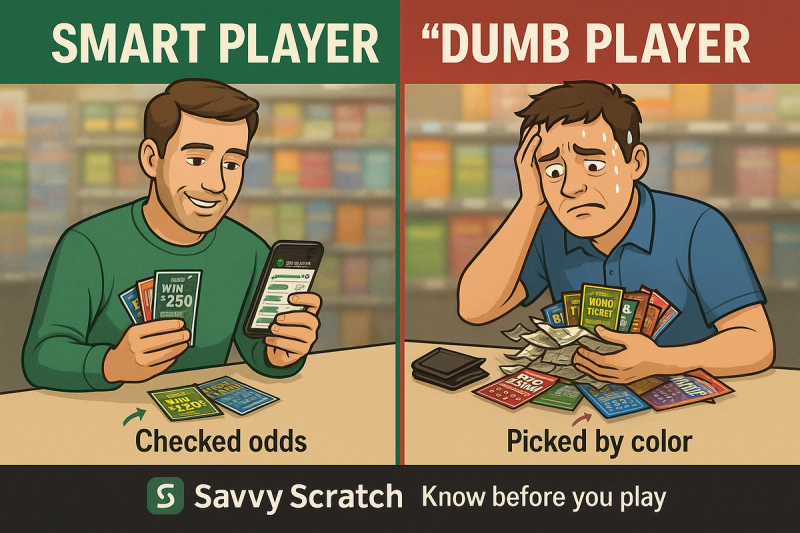
Most scratch-off players are making decisions with zero information. They pick tickets based on the design, the price, or whatever's at eye level behind the counter. That's like sitting at a blackjack table blindfolded.
The data exists. The lottery publishes it. The only question is whether you're going to use it.
I've spent my career finding edges in games where the house is supposed to win. Poker, blackjack, scratch-offs. The principle is always the same: track the data, do the math, and only act when the odds are as good as they're going to get.
Savvy Scratch tracks real-time odds across 12 states, rates every active game, and shows you exactly which tickets have the best remaining jackpot odds. $5/month or $50/year. 30-day money-back guarantee.
See Which Games Have the Best Odds in Your State →
Because whether it's cards or scratchers, the player who counts always has the edge.
About the Author: Doug Moeller is a professional gambler with over 15 years of experience in poker, blackjack card counting, and casino advantage play, with over $500K in lifetime winnings. He built Savvy Scratch to bring the same data-driven approach that works at casino tables to scratch-off lottery tickets. Follow Doug on X | YouTube