
The Complete Guide to Lottery Analysis: How a Lotto Ticket Analyzer Can Transform Your Scratch-Off Strategy
10/9/2025
By Doug Moeller | Professional Gambler & Founder of Savvy Scratch
I've won over $500,000 playing poker, counting cards at blackjack, and finding edges in casino games over the past 15 years. Every dollar of that came from the same basic principle: find the games where publicly available information gives you an advantage, and put your money there instead of everywhere else.
That principle is why I built Savvy Scratch. Because scratch-off lottery tickets are one of the only consumer gambling products where the math changes after the game launches, and where that changing math is published publicly by every state lottery commission. The data is sitting right there. Most players just don't know it exists, don't know how to read it, or don't bother checking it before they buy.
This guide is going to change that. By the time you finish reading, you'll understand exactly how scratch-off analysis works, why the odds printed on the back of your ticket stopped being accurate the moment the first ticket sold, and how to use current data to make better decisions every time you walk up to the counter.
What Lottery Analysis Actually Is (And What It Isn't)
Lottery analysis, at least the kind that matters for scratch-offs, is the process of evaluating current game data to determine which tickets are worth buying right now. Not at launch. Not last month. Right now.
It's not a prediction system. Nobody can tell you which specific ticket holds the jackpot. Anyone claiming otherwise is selling you something that doesn't work. It's not a pattern-recognition scheme. Scratch-off outcomes are predetermined at the print facility, and there are no exploitable patterns in ticket serial numbers, store locations, or purchase timing. If someone on YouTube tells you to look for patterns in the barcode, they're confusing noise with signal.
What lottery analysis actually does is much simpler and much more powerful: it reads the publicly available data that state lotteries are required to publish and calculates what that data means for the tickets still on the shelf.
Every state lottery publishes information about their scratch-off games. Total tickets printed. Prizes at each tier. Which prizes have been claimed. When the game launched. This is the same category of public information that I used to find edges in other forms of gambling. In poker, it's reading the board and your opponents' betting patterns. In blackjack, it's tracking which cards have left the shoe. In scratch-offs, it's tracking which prizes have left the game.
The players who use this information make fundamentally different buying decisions than the players who don't. That's the edge. Not a guarantee. An edge.
Why the Odds on Your Ticket Are Wrong
This is the most important concept in scratch-off analysis, and it's the one that most players have never heard of.
Every scratch-off ticket has odds printed on the back. "Overall odds: 1 in 3.84" or whatever the number is. Those odds were calculated on the day the game was designed, based on the total number of tickets printed and the total number of prizes across all tiers. They're accurate at launch, when every ticket is still in play and every prize is still available.
The moment the first ticket sells, those printed odds begin drifting from reality.
Here's why. Scratch-offs are what mathematicians call dependent games. Unlike Powerball, where every drawing is independent and the odds reset every time, scratch-offs are played from a finite pool. There are a set number of tickets and a set number of prizes. Every ticket that sells, every prize that gets claimed, changes the composition of what remains. The odds for the remaining tickets are determined by the remaining prizes divided by the remaining tickets, not by the original numbers printed on the back.
If you've ever played blackjack, you already understand this intuitively. A fresh six-deck shoe has a known composition. But after 100 hands, the remaining shoe has a different composition based on which cards have already been dealt. A card counter tracks this shift and adjusts their bets accordingly. More money when the remaining deck favors the player, less money when it doesn't.
Scratch-offs work the same way. As a game progresses, the "composition" of the remaining ticket pool changes based on which prizes have been claimed. When tickets sell but top prizes survive, the remaining pool becomes richer in jackpots relative to total tickets, like a blackjack shoe getting rich in high cards. When top prizes get claimed early, the remaining pool becomes depleted, like a shoe going cold.
The printed odds on the back of the ticket never update to reflect this. They can't. They're printed on cardboard at a factory before the game even ships. So every player relying on those printed numbers is making decisions based on information that stopped being accurate months ago.
See what the actual current odds are for every game in your state. Get started with Savvy Scratch for $5/month or $50/year and use code 20PERCENT for 20% off.
The Data That Actually Matters
When you analyze a scratch-off game, you're looking at four pieces of information and the relationship between them.
The first is total tickets printed versus tickets remaining. This tells you how far the game has progressed through its run. A game that's 85% sold is in a very different place than one that's 30% sold, and those positions create very different mathematical situations depending on what's happened to the prizes.
The second is prizes remaining at each tier. Not just the jackpot. Every tier matters because different tiers tell you different things about how the game is evolving. A game where the jackpots survived but the mid-tier prizes got hammered is a different play than a game where both levels are still healthy.
The third is the current odds per prize tier. This is the calculated number you get when you divide remaining tickets by remaining prizes at each level. These are the real odds, the ones that reflect what's actually happening in the game right now, not what was printed on the ticket at launch.
The fourth is the trajectory. Is the game getting better or worse over time? A game that's been improving steadily for months as tickets sell without jackpots being claimed is in a different category than a game that just lost its last top prize yesterday. The snapshot matters, but the direction matters too.
Let me show you what this looks like with real numbers.
Texas "$400 Million Mega Bucks" is a $100 ticket that launched with 5,243,580 total tickets. The $5 million top prize started with odds of 1 in 1,310,895. After approximately 4,478,465 tickets sold (about 85% of the run), with top prizes still available, those odds improved to roughly 1 in 382,557. That's a 3.4X improvement. The game got dramatically better for the remaining players because the ticket pool shrank while the big prizes survived.
But the story doesn't stop at the jackpot. Look at the $50,000 prize: it went from 1 in 249,694 to 1 in 191,279. The $2,500 prize improved from 1 in 2,041 to 1 in 1,792. The $1,000 prize improved from 1 in 149 to 1 in 137. Across almost every tier, this game got better as it aged. That's a game worth playing right now.
Now compare that to California's "Set for Life," a $2 ticket with 12,169,500 total tickets. The $1.2 million top prize started at 1 in 6,084,750 and improved to 1 in 3,811,564 after 8.3 million tickets sold. Sounds decent until you look at the mid-tier prizes. The $200 prize went from 1 in 19,983 to 1 in 27,032, which is 35% worse. The $100 prize went from 1 in 8,001 to 1 in 9,723. The $75 prize went from 1 in 6,042 to 1 in 7,138. The $40 prize went from 1 in 753 to 1 in 893. For the prizes most players actually have a realistic chance of winning, this game deteriorated significantly while the headline jackpot number improved modestly.
A player looking only at the top prize might think Set for Life is getting better. A player running full analysis across every tier sees the real picture: the prizes that matter most for regular play are getting harder to win. That's the difference between surface-level analysis and the kind that actually saves you money.
The Five Mistakes That Cost Scratch-Off Players the Most Money
After years of analyzing scratch-off data and talking to players, the same mistakes come up again and again. Every one of them is avoidable with basic analysis.
Playing dead games. A dead game is one where all the top prizes have been claimed but the tickets are still on the shelf. The packaging still shows the jackpot amount. The clerk still sells it to you without blinking. But you're paying for a ticket where the best possible outcome is a fraction of what the marketing promised. This is the most expensive mistake in scratch-off play, and it's completely invisible without checking the data. States don't pull tickets off the shelf when the jackpots are gone. They let them sell until the entire print run is exhausted.
Trusting printed odds. As I explained above, the odds on the back of your ticket are from launch day. They might be months or years old by the time you're reading them. Making buying decisions based on printed odds is like checking last week's weather forecast before deciding what to wear today. The information was accurate once, but conditions have changed.
Buying based on packaging. Bright colors, holographic foil, exciting game names, branded tie-ins. All of it exists to trigger impulse purchases, not to signal better odds. I covered the full psychology of scratch-off marketing tricks in a separate post. The games getting the most shelf space and the flashiest designs are often the newest releases with baseline odds, while older games with plainer packaging might have dramatically better current numbers.
Chasing near misses. When you scratch a ticket and two out of three jackpot symbols match, your brain lights up with a feeling that you were close. You weren't. That ticket was printed as a loser at the factory. The near-miss layout is a deliberate design feature that exploits your brain's reward circuitry to make you buy another ticket. I wrote an entire deep dive into the near-miss trap because it's one of the most powerful psychological tools lottery commissions use, and understanding it can save you hundreds of dollars a year.
Ignoring mid-tier prizes. Most players fixate on the jackpot and ignore everything else. But the prizes you're most likely to actually win are in the $50 to $500 range. A game with a healthy jackpot but depleted mid-tier prizes is a worse play for most budgets than a game with modest top prizes but strong mid-tier availability. Full analysis looks at every tier, not just the headline number.
How Savvy Scratch Does the Analysis for You
I built Savvy Scratch because I got tired of doing this math by hand.
The manual process works. You can visit your state lottery's website, find the prize claim data for each active game, cross-reference it against the total tickets printed, calculate the current odds per tier, compare across every game at your price point, and make an informed decision. I did this for months before building the app. It takes about 30 to 45 minutes per state if you're thorough, and you'd need to redo it every few days because the data changes as prizes get claimed.
Almost nobody is going to do that. I know because I barely wanted to do it myself, and I've been doing math-heavy gambling analysis professionally for over a decade.
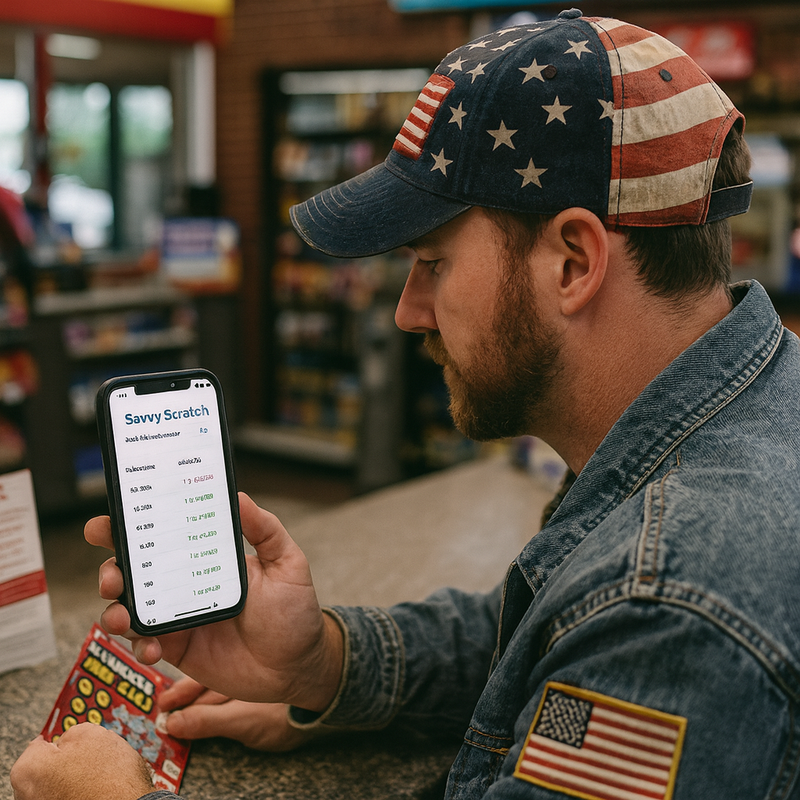
Savvy Scratch automates the entire process. It pulls current prize data from official state lottery sources across 17 states (Arizona, California, Florida, Illinois, Louisiana, Massachusetts, Maryland, Michigan, Missouri, North Carolina, New York, Ohio, Oklahoma, Oregon, Texas, Virginia, and Washington). It runs the calculations that determine how each game's odds have shifted since launch. It rates every active game as "Good," "Neutral," or "Bad" based on the current prize-to-ticket ratios. And it presents all of this in a format where you can filter by state, sort by best odds, and see the answer in seconds.
You open the app, pick your state, and you're looking at every active scratch-off game ranked by current data. The games rated "Good" are the ones where the math has moved in the player's direction. The games rated "Bad" are the ones where the jackpots are gone or the prize structure has deteriorated. You pick from the "Good" list at your price point, and you walk into the store already knowing what to ask for.
That's it. No spreadsheets. No manual calculations. No statistics degree required. Just current data, clearly presented, updated whenever the state lottery publishes new prize information.
See every active game in your state, ranked by current odds. Plans start at $5/month or $50/year. Use code 20PERCENT for 20% off. 30-day money-back guarantee.
How to Use Lottery Analysis in Practice
The analysis is only useful if it changes your behavior at the counter. Here's how to make it practical.
Before you buy, check the ratings. This is the single most impactful habit you can build as a scratch-off player. It takes less than 30 seconds on the app, and it replaces the guessing game that most players go through at the display case. Know what you're going to buy before you walk in. The display case is a merchandised sales environment designed to make you buy on impulse. Don't give it the opportunity.
Match the game type to your goals. Some games are jackpot-heavy, concentrating the prize value in a few massive payouts with long dry spells between meaningful wins. Others are prize-dense, spreading value across thousands of smaller payouts that keep your bankroll alive between big hits. Neither is inherently better. They serve different goals. If you're chasing life-changing money and you're comfortable with extended losing streaks, jackpot-heavy games with surviving top prizes are your play. If you want to stretch your entertainment budget and see frequent small wins, look for prize-dense games with healthy mid-tier numbers. The bankroll management guide goes deeper on matching game structure to your budget.
Rotate games instead of buying the same ticket every week. Game conditions change as prizes get claimed and tickets sell. The game that was the best play last Tuesday might not be the best play this Friday. Checking current ratings and adjusting your selection is the scratch-off equivalent of poker table selection. The best players don't sit at the same table every session. They evaluate conditions and sit where the edge is.
Track your results. Date, game, price, result. Four columns in a notebook or a note on your phone. After a month of data-informed buying, you'll have an objective record of how your spending compares to your previous approach. Every professional gambler I know tracks their results religiously. Not because it's fun. Because the data keeps you honest about whether your approach is working.
Set a budget and stick to it. Lottery analysis helps you get better value from whatever you spend. It doesn't change the fundamental reality that the lottery keeps a percentage of every dollar. Treat your scratch-off spending like entertainment, decide the number in advance, and stop when it's gone. The January timing analysis showed that some of the best buying windows happen at specific times of year. Patience and discipline are as important as data.
What Lottery Analysis Can and Cannot Do
I want to be direct about this because credibility matters more to me than sales.
Lottery analysis cannot guarantee wins. No tool, no system, no strategy, and no amount of data can guarantee that a specific ticket is a winner. Anyone who tells you otherwise is lying. Scratch-off outcomes are predetermined at the print facility, and no analysis can identify which specific ticket holds which prize.
Lottery analysis cannot change the house edge. The lottery keeps a percentage of every dollar spent on scratch-offs. That percentage varies by game and state, but it's always significant. Analysis doesn't change that math. You're still playing a game where the operator takes a cut.
What lottery analysis does is ensure that every dollar you spend goes into the best available situation at the time you're buying. You avoid dead games. You find games where the odds have improved since launch. You compare options at your price point and pick the one with the strongest current data. Over hundreds of purchases, the player doing this consistently will put their money into better situations than the player buying blind.
That's the same edge, applied at a different scale, that I've used to win over $500K in professional gambling. It's not magic. It's not a guarantee. It's discipline, information, and the willingness to check the data before making a decision. In poker, that edge compounds over tens of thousands of hands. In blackjack, it compounds over thousands of shoes. In scratch-offs, it compounds over hundreds of purchases.
The players who check win smarter than the players who guess. Not every time. Over time.
That's what Savvy Scratch was built for. Get started today for $5/month or $50/year. Use code 20PERCENT at signup for 20% off. If it doesn't change how you play, there's a 30-day worry free guarantee.
About the Author: Doug Moeller is a professional gambler with over 15 years of experience in poker, blackjack card counting, and casino advantage play, with over $500K in lifetime winnings. He built Savvy Scratch to bring the same data-driven approach that works at casino tables to scratch-off lottery tickets. Follow Doug on X | YouTube