Why Top Prizes Are the Only Thing That Actually Matters in Scratch-Offs
12/19/2025
By Doug Moeller | Professional Gambler & Founder of Savvy Scratch
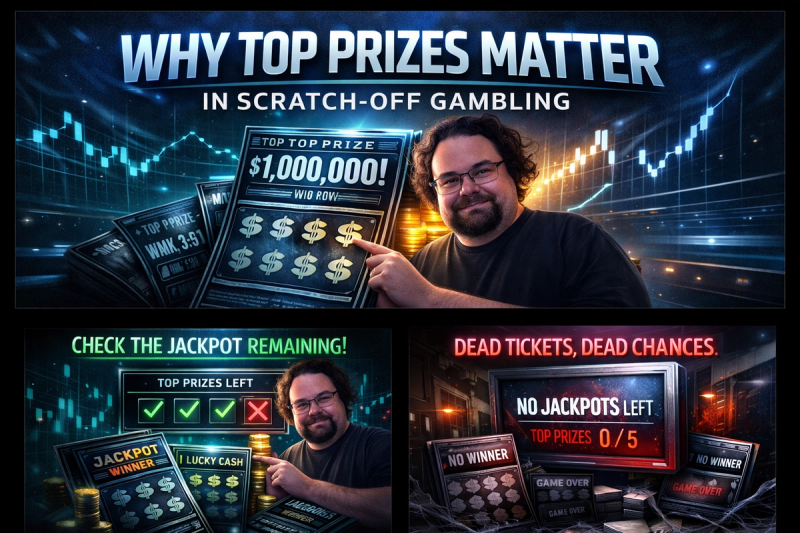
When you walk into a gas station and buy a $20 scratch-off, you're looking at a big flashy "$500,000 TOP PRIZE" on the front. What you're not seeing is that all three of those top prizes were claimed four months ago. The lottery is still legally selling that ticket. The signage still shows the jackpot. The clerk has no idea. You just paid $20 for a mathematically dead game.
This happens every single day across every state that sells scratch-offs. And it's the single biggest reason most players lose more money than they need to.
I've played tens of millions of hands of poker. I've counted cards in blackjack casinos. I've chased casino promotions across state lines. I spent over 15 years as a professional gambler with more than $500K in lifetime winnings, and across every one of those disciplines, the edge always came down to the same thing: knowing the current state of the game, not what it looked like when it started. The difference between a casual scratch-off player and someone who actually understands this game comes down to one question: how many top prizes are left right now?
That's it. That's the whole game.
The Math Is Brutally Simple
Every scratch-off follows the same economic structure. The lottery takes the majority of your money off the top for revenue and overhead. What's left gets distributed as prizes across multiple tiers. And here's the part most players miss: the only prizes that meaningfully influence your long-term outcome are the top two or three tiers.
If you win $50 here and there, that's a dopamine hit and a story to tell. But you didn't change anything. You're still down over time. Those small wins are designed to keep you engaged. They're the scratch-off equivalent of a poker player who celebrates winning a $15 pot while slowly bleeding out in every significant hand. You can win a lot of small pots and still go broke if you never win a big one. The math works the same way with scratch-offs. Those $10 and $20 refunds feel like victories, but they don't move the needle on your lifetime results. They just slow the rate at which your budget erodes.
The only wins that actually shift your financial reality are the big ones. The $100,000 prize. The $500,000 prize. The million-dollar jackpot. And because those prizes are extremely rare, the entire practical value of a scratch-off ticket comes from your mathematical chance of hitting one. This is why tracking top prizes isn't a nice-to-have. It's the foundation of everything.
Mid-Tier Prizes Don't Save You
I see this mistake constantly. Players think winning $100 or $200 occasionally means they're "doing okay" with scratch-offs. They're not doing okay. They're losing slower.
Winning small prizes doesn't improve your lifetime outcome. It doesn't move you toward profit. It doesn't give you an edge. It just delays the inevitable while creating the psychological illusion that the game is treating you well.
In blackjack, there's a concept called "the long run." Over any given session, you might win or lose regardless of how well you play. But over thousands of sessions, the math asserts itself. Players who make +EV decisions consistently end up ahead. Players who chase small wins and ignore the big picture end up behind. It's not dramatic. It's not cinematic. It's just math applied over enough volume.
Scratch-offs work the same way. The only way to improve your positioning over a lifetime of playing is to increase your chance of hitting the rare prizes that actually change something. Those prizes are always at the top of the tier structure. This is why Savvy Scratch focuses exclusively on jackpots and second-tier prizes when ranking games. The dozens of small outcomes below that don't influence your long-term trajectory.
Your Odds Change Even When the Ticket Price Doesn't
Here's something most players never think about: scratch-offs are a dependent game. Your odds today are different than they were yesterday, even though the ticket still costs $20.
If you've ever watched a blackjack shoe get dealt down, this concept will feel immediately familiar. At the start of the shoe, every card is equally likely to appear. The house edge is whatever the rules dictate, and you play basic strategy because you don't have enough information to do anything else. But as cards come out and you track the running count, the composition of what's left changes. A shoe rich in tens and aces favors the player. A shoe depleted of those cards favors the house. The entire discipline of card counting is built on recognizing these compositional shifts and adjusting your bet size accordingly.
Scratch-off games have the same dependent structure. A game launches with a fixed number of tickets and a fixed distribution of prizes. As tickets sell and prizes get claimed, the composition of what's left shifts. If a game launched with five $100,000 top prizes and six months later half the tickets have sold but all five top prizes are still available, your personal odds of hitting one are dramatically better than they were on launch day. If only one top prize remains at the same point, your odds have gotten significantly worse. If zero remain, the ticket is functionally worthless at the top tier regardless of what the printed odds say on the back.
The printed odds on a scratch-off ticket are launch-day odds. They were calculated before a single ticket was sold. They never update. They're the equivalent of telling a blackjack player the house edge on a freshly shuffled shoe and expecting them to use that number after half the cards are already dealt. A card counter would laugh at that. And yet, that's exactly what happens every time a player flips a scratch-off over, reads the "1 in X" odds, and uses that number to decide whether the ticket is worth buying.
The Only Number That Matters
Strip away all the noise. Win rates, prize counts, dollar distributions, overall odds. There's one metric that correlates most strongly with whether a scratch-off game currently favors the buyer or not: the percentage of top prizes remaining relative to how far the game has sold.
Imagine a game where 90% of tickets have been sold but 100% of the top prizes are still available. That's unusual. That's a game where the remaining ticket pool is compressed but the jackpot density within that pool is exceptionally high. Smart players notice situations like that.
Now compare that to a game where only 20% of tickets have been sold but all top prizes are already gone. That game has most of its life ahead of it and nothing left at the top tier worth chasing. It's a trap, collecting money from people who see the jackpot number on the front of the ticket and assume it's still possible.
Casual players see "$1,000,000" on the front and assume it's real. They don't know that lotteries can legally advertise that jackpot even when every single one has been claimed. The signage stays up. The tickets stay on the wall. Nobody warns you. This is why understanding remaining top prizes versus game progression is the foundation of any serious approach to scratch-offs.
Why the Lottery Doesn't Advertise This
Lotteries can legally advertise top prizes, continue selling games, display jackpot numbers, and keep tickets on shelves long after all top prizes have been claimed. Most consumers have no idea. The signage promotes the dream. The website shows the ticket design. No clerk is going to tell you the game is dead because the clerk doesn't know either.
It's not illegal. It's just how the system works. The prize data is technically public. State lottery websites publish reports showing how many prizes have been claimed at each tier. But the reports are buried in PDFs, updated on irregular schedules, and require cross-referencing multiple data points to draw useful conclusions. The information is available, but it's not accessible in any practical sense for someone standing at a gas station counter with sixty seconds to decide.
That's where Savvy Scratch fits. We pull the official prize data from state lottery commissions daily, clean it up, and surface the one thing that actually matters: which games still have healthy top-prize counts relative to how far they've sold, ranked by price tier so you can compare the best scratch-offs at your price point without guessing.
Timing Windows Are Created by Top Prizes
Scratch-offs are dependent games, just like blackjack. Your odds are influenced by outcomes you'll never see directly, but you can infer them from the data.
When top prizes remain at unusually high levels after significant ticket sales, that signals something. Maybe the game is underplayed in certain regions. Maybe distribution was uneven. Maybe awareness is low. Whatever the reason, hidden value can appear, and the players who are watching for it are the ones positioned to benefit.
Most players ignore these timing windows entirely. They buy the same ticket week after week out of habit, regardless of whether the top prizes are intact or depleted. You're putting money in without evaluating the conditions, and over time that costs you far more than you realize.
Advantage-focused players use timing differently. They sit out bad games. They pay attention when a game's top-prize composition becomes favorable. They wait until the ratio of remaining jackpots to estimated sold-through actually warrants putting money in. And they only buy when the opportunity at their price point is statistically superior to the alternatives. This strategy mirrors the principles I used in blackjack and poker for over 15 years. It works because the math supports it. Top prizes create these timing windows. Without them, there's nothing to time.
The Biggest Mistake Scratch-Off Players Make
The biggest misunderstanding in scratch-off gambling is assuming all tickets have the same odds as printed on the back. They don't.
The printed odds are launch-day odds. Games evolve. Prizes get claimed. Winners shift the distribution. Jackpots disappear quietly. New games overshadow older ones. Some games sit untouched in certain regions while flying off shelves in others.
If you ignore top prizes, you're blind to all of this. Without knowing how many top prizes remain, you can't evaluate risk, judge opportunity, compare games accurately, or avoid dead games that should have been pulled from circulation weeks ago. Top-prize tracking isn't optional if you want to play smart. It's the foundation that everything else builds on.
This is also where the near-miss trap does its worst damage. Scratch-off games are designed to deliver frequent small "wins" that make you feel like you're close to something big. A $20 win on a $20 ticket isn't a win. It's a refund dressed up as excitement. But that feeling of being "close" drives you to buy another ticket, and another, even when the top prizes that would actually make the game worthwhile are long gone. The near-miss design only works on players who aren't checking the data. Once you know the top prizes are depleted, the near-miss illusion breaks. You can see the game for what it is and walk away.
What Actually Matters (In Order)
Everything else in scratch-offs is secondary to top-prize health. Win rates, small prize counts, overall odds, prize tier depth. Nice to know, but they don't fundamentally shift your trajectory.
Top prizes remaining is the first thing to check. If the jackpot tier is gone, the game is dead regardless of what else is happening in the prize structure. The percentage of top prizes relative to how far the game has sold is the second thing. This is what tells you whether conditions have improved or deteriorated since launch. And second-tier prize distribution is the third thing, because strong second-tier health can make a game with average top-prize counts worth considering.
If you get the first two right, you're already better positioned than the vast majority of players walking into a gas station. You're picking based on the current composition of the prize pool, which is the only thing that determines whether a game is worth your money today.
Savvy Scratch ranks every active game across 17 states using exactly this hierarchy. Arizona, California, Florida, Illinois, Louisiana, Maryland, Massachusetts, Michigan, Missouri, New York, North Carolina, Ohio, Oklahoma, Oregon, Texas, Virginia, and Washington are all live right now. The tool costs $5/month or $50/year with a 30-day worry-free guarantee. If you're spending money on scratch-offs without checking the data first, you're making the same mistake as a blackjack player who bets without looking at the count. The information exists. It's just a question of whether you use it.
The scratch-off world is full of noise, myths, and marketing. But the math is simple. Top prizes determine whether a game is worth playing. Top prizes determine whether timing matters. Top prizes determine whether opportunity exists. Everything else is entertainment.
It starts with one question: how many top prizes are left today? Savvy Scratch makes answering it effortless. Get started at savvyscratch.com/register.
Play smarter. Time your tickets. Let the numbers lead.
About the Author: Doug Moeller is a professional gambler with over 15 years of experience in poker, blackjack card counting, and casino advantage play, with over $500K in lifetime winnings. He built Savvy Scratch to bring the same data-driven approach that works at casino tables to scratch-off lottery tickets. Follow Doug on X | YouTube