Lottery Budget Tips: Play More Without Overspending
7/7/2025
Lottery Budget Tips: How to Play More Scratch-Offs Without Blowing Your Bankroll
Let's be honest. It's way too easy to overspend on the lottery.
A ticket here. Another one at the gas station. Maybe two more because you "feel lucky." Before you know it, you've spent $60 this week chasing wins with nothing to show for it.
I've been there. Most players have.
But here's what separates smart lottery players from everyone else: they have a budget, and they use data to stretch every dollar. That's not just good advice. It's the only sustainable way to play this game long-term.
This post breaks down everything you need to know about building a lottery budget that actually works, playing smarter within that budget, and avoiding the traps that drain most players' wallets.
Why Your Lottery Budget Matters More Than You Think
The lottery is entertainment. Full stop. It's not a retirement plan, and it's definitely not a strategy for income. Anyone who tells you otherwise is selling something (and probably not something you want to buy).
That means you should only spend what you're comfortable losing. If you wouldn't drop $50 a week on movie tickets, don't spend it on scratchers either.
A solid lottery budget does a few critical things for you. It prevents impulse buying, which is one of the biggest mistakes lottery players make. It lets you enjoy playing over time instead of burning through cash in one frustrated weekend. It protects your overall financial health. And maybe most importantly, it forces you to make strategic decisions instead of emotional ones.
If you're playing blind with no spending cap, you're playing into the lottery's hands, not beating it. The lotteries design their games to encourage emotional spending. A budget is your first line of defense.
Step 1: Figure Out What You Can Actually Afford
Before you buy another ticket, look at your monthly expenses. Decide what amount, if any, can safely go toward lottery tickets without cutting into bills, savings, food, or emergency funds.
Here's what that might look like in practice:
$20/month gets you one $5 ticket per week. Tight, but totally workable if you're picking the right games.
$40/month gives you room for two $10 tickets biweekly, or you could spread it thinner with more $5 plays.
$100/month opens up more flexibility. Maybe four $5 tickets a week, with some room to adjust based on which games have better odds that particular week.
The key here? Pick a number that feels like fun money, not rent money. If losing it would hurt, it's too much.
Step 2: Stretch That Budget with Smarter Plays
Let's say your budget is $20 a week. Here's where most people go wrong: they walk into a gas station and grab whatever looks cool in the display case. Random $10 tickets. No research. No strategy.
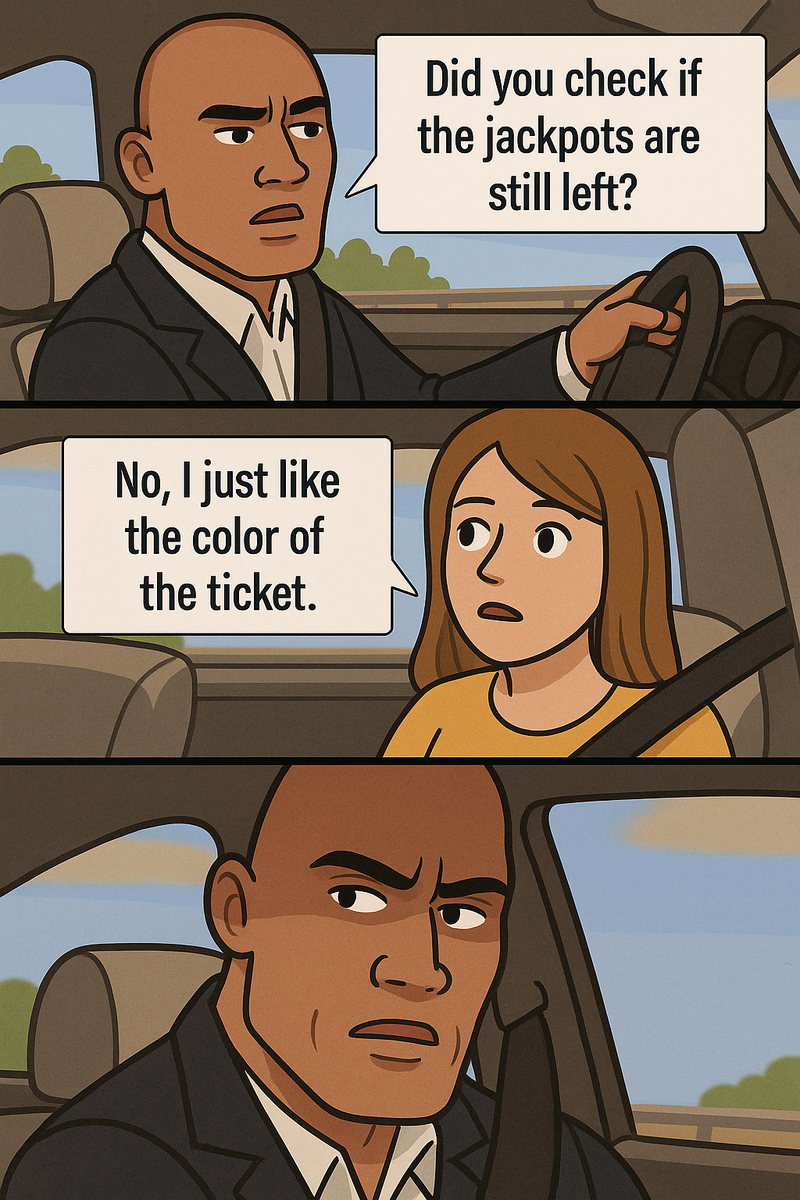
That's Option A: Playing Blind. You buy 2 random $10 tickets at a gas station. You don't know the odds. The jackpots might already be gone. You're just hoping.
Option B looks different. You use real-time data to find a $5 ticket with improved jackpot odds. Instead of 2 random plays, you get 4 informed plays from games that still have prizes worth winning.
Same budget. Smarter plays. Better potential outcome.
This is what I mean when I talk about treating scratch-offs like strategy games instead of pure luck. The math matters.
Ready to find the best plays in your state right now? Try Savvy Scratch with a risk-free trial and see which games still have top prizes available. If it's not for you, just ask for a full refund.
Step 3: Avoid the Rebuy Spiral
This is where most budgets die. Here's how it usually goes:
You buy a $10 ticket. You win $5. Instead of pocketing it, you use it to buy another ticket. You lose. Then you pull out your card "just in case" and buy one more.
Now you're $25 down from what was supposed to be a $10 play.
Sound familiar? This is classic loss-chasing behavior, and it's one of the most common ways players blow their budgets. The lottery industry actually designs games to trigger this response with "near miss" experiences that make you feel like you're close to winning.
Here's how to break the cycle:
Treat winnings as winnings, not fuel for more play. If you budgeted $10, stop after your first play regardless of the result. Save small wins until your next scheduled play day.
Discipline is what separates players who last from players who bust. Sometimes the smartest play is sitting out entirely and waiting for better opportunities.
Step 4: Use Data to Find Better Value Per Dollar
Here's what most players never realize: not all $5 tickets are created equal.
Some $5 tickets have 3 jackpots left, a better-than-average ratio of prizes to tickets remaining, and were released recently enough that all top prizes are still unclaimed.
Other $5 tickets have zero jackpots left, terrible remaining value, and are only still being sold because they haven't officially closed the game yet.
Same price. Vastly different upside.
This is exactly why lottery data matters. The lottery commissions publish this information. They're required to. But they don't make it easy to find or understand. Your $5 can go a lot further when you know how to use an odds calculator to spot the better games.
Understanding why top prizes are the only thing that actually matters changes the way you look at every ticket in that display case. A game with no jackpots left is basically a donation to your state lottery.
How Savvy Scratch Helps You Stay on Budget
Savvy Scratch isn't just about finding the best tickets. It's about helping you avoid the bad ones too.
When you open the app, you see exactly which tickets in your state have improved odds and which ones you should skip entirely. No digging through lottery websites. No spreadsheets. No guesswork.
You'll know which tickets have improved odds. You'll skip games with no big prizes left. You'll get more value from your budget. And you'll avoid throwing money into losing games that are just waiting to close.
Open the app. See today's best plays. Stick to your budget. That's it.
You don't have to do the math yourself. You just follow the signals. That's the real benefit of using a scratch-off app instead of going in blind.
Want to see how it works? Check out Savvy Scratch and browse your state's games right now.
A Real Budget Example (The Smart Way)
Let me show you what disciplined play actually looks like in practice.
Monthly budget: $60
Weekly budget: $15
Week 1: You use Savvy Scratch to find three solid $5 tickets in your state. Two of them have better-than-original jackpot odds because tickets have been sold but the top prizes are still out there. The third has strong mid-tier prize density. You buy one of each.
Week 2: You win $20 on one of your plays. Nice. But instead of immediately spending $35 next week, you pocket the $20 as actual profit. You stick to your $15 weekly plan and stay in control.
Winning doesn't have to lead to overspending. Treat your wins like bonuses, not reasons to chase more action. That's how you maximize wins without spending more.
The Responsible Play Reminder
Look, I spent over 15 years as a professional gambler. Poker, blackjack card counting, casino advantage play. I've seen what happens when people lose discipline.
Even with the best tools and insights, there are no guarantees in scratch-off games. The lottery still has an edge. What we're doing is finding spots where that edge is smaller, where the math tilts slightly more in your favor.
Your budget is your protection. Data is your edge. Consistency is your strategy.
Don't try to win the most. Try to play the smartest.
If you want to learn more about building simple scratch-off habits that compound over time, or you're new and want beginner tips for playing smarter, check out those guides next.
Bottom Line
The lottery wants you to play emotionally. They want you to chase losses, ignore the math, and let the cashier pick your ticket.
You're smarter than that.
Set a budget. Use data. Stay disciplined. That's the whole playbook.
Ready to start playing smarter? Try Savvy Scratch and see exactly which games in your state are worth your money right now.