The Near-Miss Trap: How Scratch-Offs Keep You Playing After You Lose
8/31/2025
By Doug Moeller | Professional Gambler & Founder of Savvy Scratch
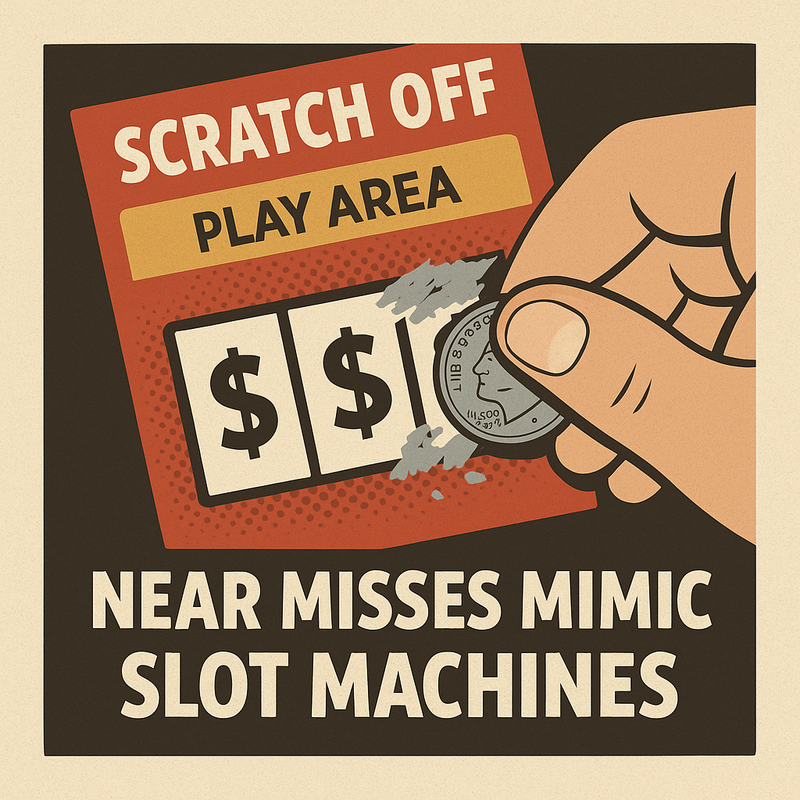
You scratch a ticket. Two jackpot symbols show up, but not the third. A row of $500 prizes lines up perfectly, but your number is one digit off. You didn't win anything, but something in your chest tightens and your brain whispers: you were so close.
So you buy another ticket.
I know this feeling intimately, not from scratch-offs, but from thousands of hours at poker and blackjack tables. I've been on the wrong end of enough bad beats and near-miss hands to fill a warehouse with the chips I almost won. The difference between me and the player who goes broke chasing that feeling is that I learned, over 15 years of professional gambling and over $500K in lifetime winnings, to recognize the near-miss response for exactly what it is: a psychological trick that your brain plays on itself, amplified by game designers who understand it better than you do.
The near miss is the most powerful tool in a game designer's arsenal. Casinos have known this for decades. Lottery commissions know it too. And once you understand how it works, you'll never look at a scratch-off ticket the same way again.
Your Brain Can't Tell the Difference
Neuroscience research on gambling has produced one finding so consistent that it barely qualifies as controversial anymore: a near miss activates the brain's reward circuitry almost identically to an actual win. The dopamine surge you feel when two jackpot symbols land and the third one barely misses is neurochemically similar to what you'd feel if all three had matched.
Read that again. Your brain processes "almost winning" and "actually winning" through nearly the same chemical pathway.
This is why the near miss feels so different from a total loss. When you scratch a ticket and nothing matches at all, you shrug and move on. But when the ticket is tantalizingly close to a big payout, something shifts inside you. You feel energized, not defeated. Your mind starts rationalizing: that was so close, the next one could hit. You're not making a logical decision to buy another ticket. You're responding to a neurological event that you didn't choose and can barely control.
I saw this play out at poker tables constantly. A player would get their money in with pocket aces, watch the board run out with four cards to a flush, and lose when the river completed it. That's a bad beat, but it's not the dangerous moment. The dangerous moment is the next hand, when that player is still running hot with frustration and confidence mixed together, convinced that the universe owes them a win because they were so close. That's when they start playing too many hands, calling too many bets, and hemorrhaging chips. Poker players call it tilt. Psychologists call it the near-miss effect. Same mechanism, different table.
Scratch-Offs Are Engineered for This
Here's what separates the near-miss effect in scratch-offs from the near-miss effect in poker: in poker, near misses happen naturally because the game involves genuine randomness within a strategic framework. In scratch-offs, the entire ticket is printed before you ever touch it. The game designers know exactly what you're going to see when you scratch it, and they can control the frequency of near-miss outcomes.
This isn't conspiracy theory. It's public information if you know where to look. Game manufacturers design scratch-off tickets with a specific ratio of total losses, small wins, medium wins, big wins, and near misses. The near-miss outcomes, those tantalizing "almost" moments, are a deliberate part of the ticket's architecture. They're placed there because decades of research have shown that players who experience near misses play longer and spend more money than players who experience clean losses.
Think about the structure. A scratch-off game might require you to match three symbols to win the jackpot. The ticket could easily be designed so that misses distribute randomly across zero, one, two, or three matching symbols. But if you weight the design so that two-out-of-three matches happen more frequently than pure randomness would suggest, you create a playing experience that feels like you're constantly on the verge of a breakthrough. You're not. Each ticket's outcome was determined at the print facility. But the feeling is real, and the feeling drives additional purchases.
I learned to recognize this same dynamic at slot machines during my years doing casino advantage play. Modern slots are programmed to show near misses at rates far higher than what pure randomness would produce. Two sevens land on the pay line and the third one stops one position away? That's not bad luck. That's a programmed outcome designed to keep you pulling the lever. The first time I understood this, I stopped seeing slot machines as games and started seeing them as behavior modification devices. Scratch-offs with high near-miss rates are the same thing, just printed on cardboard instead of displayed on a screen.
Want to make decisions based on data instead of ticket design tricks? Savvy Scratch shows you which games have the best remaining odds right now, across 17 states. $5/month or $50/year, with code 20PERCENT for 20% off.
The "Just One More" Spiral
The near-miss effect doesn't just make you buy one extra ticket. It creates a behavioral loop that can stretch a $10 impulse buy into a $50 or $100 session without you ever making a conscious decision to spend that much.
Here's how the loop works. You buy a ticket. It's a near miss. The dopamine hit tells your brain you were close, which reframes the loss as progress rather than a setback. So you buy another one. If that ticket is a clean loss (nothing close), you might walk away. But if it's another near miss, the loop intensifies. Now you've been "almost there" twice in a row. Your brain constructs a narrative: the wins are clustered around this spot, or this game is running hot, or you're due. None of that is mathematically real, but the feeling is so strong that it overrides the logical part of your brain that knows better.
This is the exact same pattern that makes bad poker players go broke. They lose a big hand, feel like they were close, and start playing more aggressively to "get it back." In poker, we call this revenge tilt. The player isn't making strategic decisions anymore. They're responding to an emotional need to vindicate the near miss. Every professional poker player has learned to recognize this pattern in themselves and shut it down before it costs real money. The ones who didn't learn it are the ones who stopped being professional poker players.
The difference with scratch-offs is that there's nobody sitting across the table to remind you that you're tilting. There's no clock, no hand history, no session tracker telling you that you've been at it for too long. It's just you, a display case full of tickets, and a brain that keeps telling you the next one is going to hit.
The Math Doesn't Care About Almost
This is the part that matters most, and it's the part your brain works hardest to ignore in the moment: a near miss is mathematically identical to a complete miss. Your odds on the next ticket are exactly the same whether the previous ticket was close to a jackpot or nowhere near one.
Scratch-offs are independent events within a finite game. Each ticket's outcome is predetermined at the print facility. The ticket you just scratched that showed two matching jackpot symbols has no relationship to the ticket sitting next to it on the roll. That next ticket could be a winner or a loser, and the probability of either outcome is determined entirely by how many winning tickets remain in the pool versus how many total tickets remain. Your previous near miss doesn't change that math by a single decimal point.
This is actually one of the most useful things about understanding how scratch-off odds actually work. Once you internalize that each game is a closed system with a known number of prizes and a known number of tickets, the near-miss illusion loses a lot of its power. The ticket wasn't "almost" a winner. It was always a loser. It was printed as a loser. The near-miss layout was part of the design, not evidence that you're close to hitting something.
In blackjack, when I'm counting cards and the count goes negative, I reduce my bets or walk away regardless of what the last few hands looked like. It doesn't matter if I just lost three hands in a row by a single card. The count tells me the remaining shoe is unfavorable, so I act on that information, not on the emotional residue of those close losses. The same discipline applies here. The data tells you whether a game is worth playing. The near-miss feeling on your last ticket doesn't.
How to Break the Loop
The near-miss trap is powerful because it operates below conscious awareness. You don't decide to feel excited about almost winning. Your brain does it automatically. So the counter-strategy isn't willpower. It's systems.
The first system is a hard budget, decided before you walk into the store and written down somewhere you'll see it. I don't mean a vague mental note like "I'll spend around twenty bucks." I mean a specific dollar amount that you commit to in advance, with no flexibility for "just one more." Professional poker players use stop-loss limits for exactly this reason. When the session hits a predetermined loss threshold, you leave. Not because you're out of money, but because continuing to play after sustained losses puts you in the emotional state where bad decisions happen. Scratch-off players should do the same thing. Decide the number. Spend the number. Leave.
The second system is a simple results log. Date, game, price, result. Four columns. Takes ten seconds per ticket. After a month of logging, you'll have an objective record of how much you actually spent versus how much you think you spent. In my experience, players who track their results are consistently surprised by the gap between their perception and reality. The near-miss effect doesn't just make you buy more in the moment. It distorts your memory of sessions, making you remember the close calls more vividly than the total losses, which creates the false impression that you're doing better than you are.
The third system is making your buying decisions before you're standing at the counter, not while you're there. Check which games have the best current odds before you leave the house. Know what you're going to ask for. Walk up, name the game, pay, leave. The display case full of colorful tickets and the adrenaline from your last near-miss scratch are both working against you in that moment. The fewer decisions you make at the counter, the fewer opportunities the near-miss effect has to hijack your judgment.
Take the emotion out of the equation. Savvy Scratch rates every active game in your state so you can decide what to buy before you're standing in front of the display case. Plans start at $5/month with a 30-day worry free guarantee.
The Players Who Win More Aren't Luckier. They're More Disciplined.
After 15 years of professional gambling, the single most important thing I've learned isn't about math or odds or game theory. It's about emotional discipline. The players who sustain winning records over time, across poker, blackjack, sports betting, any game with an analytical component, are the ones who make decisions based on information rather than feelings.
That doesn't mean they don't feel the pull. Every card counter has felt the urge to increase their bet after a string of losses, even when the count says to stay small. Every poker pro has felt the desire to play a marginal hand because the last three folds "should have" been calls. The difference is that they recognize the feeling for what it is, a biological response that evolved for environments very different from a casino floor, and they override it with a system.
Scratch-offs are designed to make this harder than it needs to be. The near-miss layouts, the flashy packaging, the giant printed numbers, the whole experience is engineered to keep you in an emotional state where impulse spending feels justified. You can't change that. You can't redesign the tickets. But you can build a system that puts data between the stimulus and the response.
Check the current game ratings before you buy. Set a budget and track your results. Make your decisions with your rational brain at home, not your emotional brain at the counter. And when you scratch a ticket and feel that rush of "so close," recognize it for what it is: a design feature, not a signal.
The lottery will always be a game of chance. But whether you play it on their terms or yours? That's the one decision the near-miss trap can't make for you.
Get started with Savvy Scratch today for $5/month or $50/year. Use code 20PERCENT at signup for 20% off. Play with data, not dopamine.
About the Author: Doug Moeller is a professional gambler with over 15 years of experience in poker, blackjack card counting, and casino advantage play, with over $500K in lifetime winnings. He built Savvy Scratch to bring the same data-driven approach that works at casino tables to scratch-off lottery tickets. Follow Doug on X | YouTube