Why Emotional Buying Is Your Lottery Budget’s Worst Enemy
8/11/2025
By Doug Moeller | Professional Gambler & Founder of Savvy Scratch
It's Friday evening. You had a great week at work, you're feeling good, and you stop at the gas station on the way home. You planned to grab a single $10 ticket. But you're riding high, so you think: why not two? Actually, make it three. You deserve it.
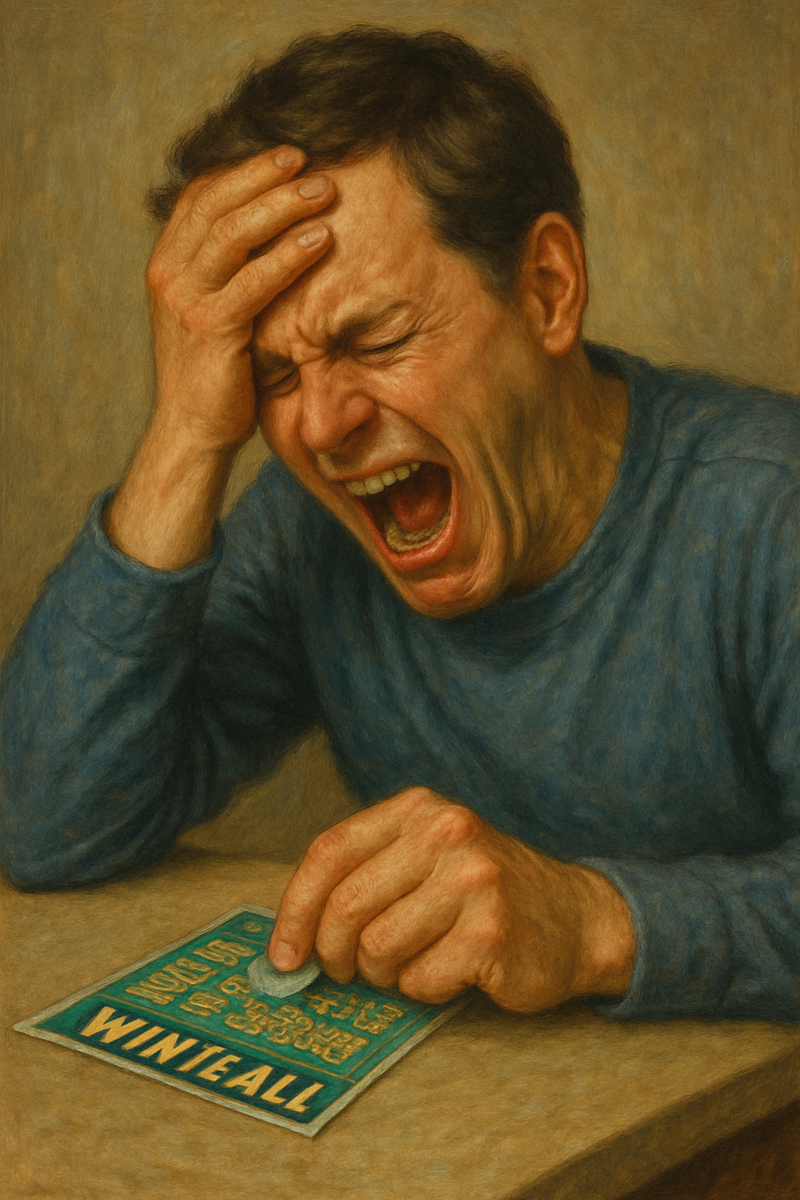
Or flip the script. It's been a terrible week. Everything went wrong. You're stressed, you're tired, and you just want five minutes of something that feels like possibility. So you grab $40 worth of scratchers instead of the $10 you budgeted because right now, the dopamine hit of scratching a ticket sounds better than thinking about your actual plan.
Both of these scenarios end the same way. You spend more than you intended, the extra tickets don't perform any better than the ones you planned to buy, and Monday morning you're looking at your bank account wondering where the discipline went.
This is emotional buying. And after 15 years of professional gambling, I can tell you from hard experience that it's the single fastest way to destroy a bankroll, whether you're sitting at a poker table or standing at a lottery counter.
Savvy Scratch helps you pick scratch-off tickets based on real odds data, not feelings. Plans start at $5/month or $50/year with a 30-day money-back guarantee.
Tilt Isn't Just a Poker Problem
In poker, there's a concept called "tilt." Tilt is when your emotions take over your decision-making. Maybe you just lost a big hand you should have won. Maybe you're up and feeling invincible. Either way, you start making bets that have nothing to do with the math and everything to do with how you feel in that moment. I've watched players who were up thousands of dollars give it all back in an hour because they got emotional. They stopped playing the odds and started playing their feelings. The cards didn't change. The probabilities didn't shift. But their behavior did, and that's all it took.
I've been on tilt myself. Early in my career, I lost a big pot on a bad beat and immediately pushed all-in on the next hand with garbage cards because I was angry. It wasn't a strategy. It was revenge against the universe. The universe didn't care. I lost that hand too, and the one after it, and the one after that. By the time I calmed down, I'd burned through three buy-ins that I'd spent weeks grinding to earn.
That same emotional pattern shows up at the scratch-off counter in ways most players never recognize. You're not calling it tilt. You're calling it "treating yourself" or "blowing off steam" or "feeling lucky." But the mechanism is identical. Your emotions override your plan, you spend money you didn't intend to spend, and the tickets you bought on impulse have the exact same odds as the ones you would have picked with a clear head. The only difference is your bank balance is lighter.
Good Moods Are Just as Dangerous as Bad Ones
Most people assume emotional buying only happens when you're down. That's half the picture. In my experience, both at casino tables and watching how lottery players behave, the "hot streak" mindset is just as destructive as the "I need a pick-me-up" mindset.
When you're feeling good, your brain tells you that this is the moment. You're on a roll. The energy is right. So you buy more tickets, or you upgrade to a higher price point than usual, because it feels like the stars are aligned. But scratch-off odds don't know about your promotion at work. They don't care that you found a twenty in your jacket pocket this morning. The mathematical composition of the remaining prize pool is the same whether you walk in whistling or sobbing.
Card counters learn this lesson early or they don't survive. The count doesn't care how you feel. If the deck is cold, you bet small, even if you just won the last five hands and your confidence is through the roof. If the deck is rich, you bet big, even if you just lost eight hands in a row and you want to crawl under the table. Discipline means doing the right thing based on the information, not based on the emotion. Every time I broke that rule at a blackjack table, it cost me. Every time.
The same discipline applies to scratch-offs. A good day to buy a ticket is a day when you've checked the data, found a game with favorable remaining odds in your price range, and you have the budget for it. A bad day to buy a ticket is a day when you haven't done any of that but your mood is telling you to go for it anyway.
The "I Deserve This" Tax
There's a specific phrase that should set off alarm bells every time it crosses your mind at the lottery counter: "I deserve this."
You might deserve it. That's not the point. The point is that "I deserve this" is a justification, not a strategy. It's the story your brain tells to give yourself permission to break your own rules. In professional gambling, we call this type of self-talk a "rationalization leak." It sounds reasonable in the moment, and it always costs you money over time.
Here's how it typically plays out. You set a weekly scratch-off budget, say $20. You've been disciplined for three weeks. Then something happens, good or bad, and you hear that voice: "I've been so good with my budget. One extra ticket won't hurt." So you spend $30 that week. Next time something triggers you, the new baseline is $30, not $20. The ratchet only moves in one direction.
Over a year, this adds up fast. If your emotional overages average even $15 per month, that's $180 gone on tickets you bought because of how you felt, not because of what the data showed. That's nearly four years of a Savvy Scratch subscription that could have been telling you which games actually had better odds during those same trips.
Revenge Buying Is the Costliest Mistake
The most expensive version of emotional buying is what I call revenge buying. You scratch a losing ticket, and instead of walking away, you immediately buy another one. Then another. You're not chasing a prize anymore. You're chasing the feeling of getting something back from a game that just took your money.
I've seen this identical pattern destroy poker players. They lose a pot, and instead of resetting mentally, they start playing every hand. They're not selecting good opportunities. They're just trying to win something to erase the sting of the loss. The technical term in poker is "steaming," and it's the fastest way to go from a small loss to a catastrophic one.
With scratch-offs, revenge buying usually looks like upgrading to more expensive tickets after a loss. You bought a $5 ticket and lost? Now you're buying a $10 ticket because your brain thinks a bigger bet will fix the problem. But the $10 ticket doesn't know about your $5 loss. Its odds are whatever they are, completely independent of what just happened to you. You're not making a strategic upgrade. You're throwing money at an emotion.
The pros who survive long enough to make a living at gambling all share one trait: they can lose money and not change their strategy because of it. They feel the frustration, they acknowledge it, and then they make the next decision based on the math anyway. That separation between feeling and action is what makes professional gambling professional.
Savvy Scratch removes the guesswork by showing you which games have the best remaining odds in your state. When you know the data before you walk in, there's nothing to guess about and nothing to chase. $5/month or $50/year with a 30-day money-back guarantee.
Building a System That Survives Your Moods
The fix for emotional buying isn't willpower. Willpower is unreliable. It works great on Tuesday morning and collapses on Friday night. The fix is building a system that removes emotions from the decision before you walk into the store.
Set a weekly or monthly number and treat it like a bill, not a suggestion. The amount doesn't matter as much as the consistency. Whether that's $10 a week or $50 a month, the discipline comes from treating your scratch-off budget as a fixed entertainment expense with hard boundaries, not a flexible line item that adjusts based on your mood.
Know your game before you walk in. When you already know which ticket you're buying and why, there's no browsing, no impulse, and no moment where the shiny new game in the display catches your eye. You walk up, you ask for your ticket by number, and you walk out. The whole interaction takes thirty seconds and zero emotional processing. This is exactly what the previous post about not letting the cashier pick your ticket was about. A plan beats a feeling every time.
If you lose, you're done for the day. This is the hardest rule and the most important one. Walking away after a loss feels wrong in the moment. Your brain wants resolution. But the resolution it's looking for doesn't exist in the next ticket. It exists in the discipline of sticking to the plan. Every professional gambler I know, from poker grinders to sports bettors to blackjack teams, treats their stop-loss like a non-negotiable line. When you hit it, you leave. Period. The game will still be there tomorrow when you have a clear head and fresh budget.
Use cash if you need the physical constraint. There's research showing that people spend differently when they can feel the money leaving their hands versus tapping a card. If you find yourself consistently overspending at the lottery counter, pull out your budgeted cash at the beginning of the week, put it in an envelope, and that's what you have. When the envelope is empty, you're done until next week. It's crude, but it works because it takes the decision away from your emotional brain and hands it to an envelope that doesn't care about your feelings.
The Data Doesn't Have Feelings, and That's the Point
This is the fundamental advantage of making scratch-off decisions based on actual prize data rather than instinct. Data doesn't get excited. It doesn't get sad. It doesn't feel lucky. It just tells you which games have the best remaining prize structures right now, at this moment, in your state.
When you check the current odds before you buy, you're doing something that short-circuits the entire emotional buying cycle. You're replacing "I feel like playing" with "the data says this specific game is the best option in my price range." The feeling might still be there. You might still be riding high from a great week or dragging from a bad one. But the decision is insulated from the feeling because it's been made in advance, with numbers, not vibes.
I've tracked my own gambling decisions across hundreds of thousands of hands of poker. The sessions where I stuck to my strategy regardless of how I felt? Those were profitable. The sessions where I let my mood dictate my bet sizes or my game selection? Those were not. The pattern was so consistent it was almost boring. Emotion costs money. Discipline makes money. Every single time, across every single game, in every single context.
Scratch-offs are no different. You can't control whether you win or lose on any single ticket. But you can absolutely control whether you're buying the right tickets, in the right quantities, at the right times, for the right reasons. And "because I'm in a mood" is never the right reason.
Next Friday, when you feel that pull at the counter, whether it's celebration or consolation, pause for ten seconds. Ask yourself one question: "Am I buying this ticket because the data says it's a good play, or because of how I feel right now?" If the answer is feelings, put your wallet back in your pocket, check the current odds on Savvy Scratch, and come back tomorrow with a plan.
The ticket will still be there. Your budget will thank you.
See which scratch-offs have the best odds in your state right now. Savvy Scratch tracks real-time prize data across 17 states for $5/month or $50/year, backed by a 30-worry free guarantee.
About the Author: Doug Moeller is a professional gambler with over 15 years of experience in poker, blackjack card counting, and casino advantage play, with over $500K in lifetime winnings. He built Savvy Scratch to bring the same data-driven approach that works at casino tables to scratch-off lottery tickets. Follow Doug on X | YouTube