Scratch-Offs vs. Slots vs. Sports Betting: Which Actually Gives You a Shot at the Top Prize
7/25/2026
By Doug Moeller | Professional Gambler & Founder of Savvy Scratch
July 25, 2026
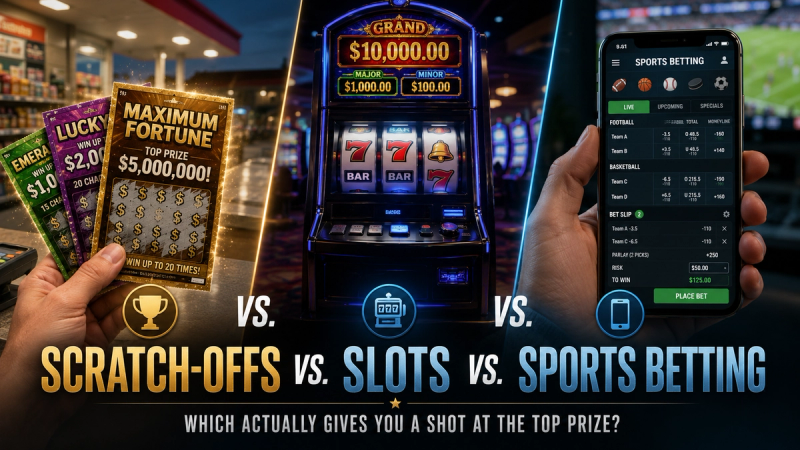
Three guys walk out of the same gas station on a Friday night. One is headed to the casino with two hundred dollars. One is opening a sportsbook app in the parking lot. One just bought four scratch-offs at the counter. Every one of them will tell you he is playing the smartest of the three.
Two of them are wrong about why, and the third is right for a reason he could not explain if you asked him.
I have spent more than fifteen years making a living off games of chance, mostly poker, with a long run of blackjack card counting and a stretch of casino advantage play, and north of $500K in lifetime winnings. Most of that came from one habit: refusing to put money into a game until I knew what the game was actually paying. So let's run these three side by side with real published numbers, and then get to the part nobody puts in these comparisons, which is that only one of the three tells you what condition it is in before you buy.
Want the short version for your own state? A free Savvy Scratch account shows you the Bad and New game tabs right now, no card required. Sign up free.
What each game actually keeps
Start with the honest scoreboard. Every gambling product keeps a slice of the money that flows through it, and in all three of these categories that slice is public.
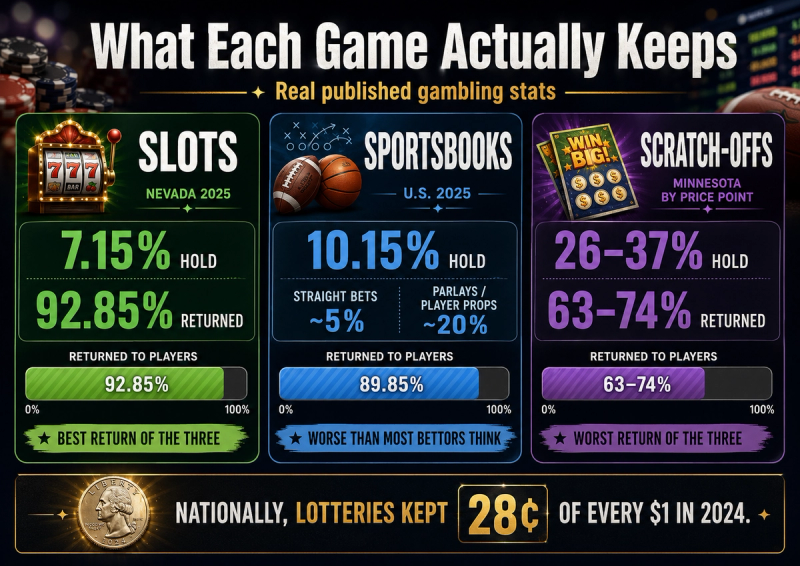
Slot machines are the friendliest of the three on paper. Nevada's Gaming Control Board publishes hold statewide, and in 2025 the statewide figure came in around 7.15 percent, which means the machines returned roughly 92.85 percent of what got played through them. That number moves by market, with downtown Las Vegas holding more than eight percent and Reno closer to five and a half. Ninety two cents back on the dollar sounds generous until you remember that slots recycle your money. You do not play two hundred dollars once. You play the same two hundred over and over as it cycles through the machine, and the hold takes a bite on every pass. A 7 percent hold on coin-in can quietly become the whole two hundred by the end of the night.
Sports betting is worse than most bettors think, and it has been getting worse fast. Regulated U.S. sportsbooks held roughly 10.15 percent of everything wagered in 2025, up from about 9.2 percent in 2024 and under 7 percent back in 2019. The reason is not that bookmakers got smarter about setting lines. It is that the product mix shifted toward parlays, same-game parlays, and player props, which carry hold rates in the neighborhood of 20 percent compared to about 5 percent on a straight spread or moneyline. The bettor who thinks he is playing a 4.5 percent vig game is usually playing a 20 percent one and calling it a hobby.
Scratch-offs are the worst of the three on this metric, and I am not going to pretend otherwise. Minnesota publishes its scratch game payouts by price point and puts them between 63 and 74 percent depending on the ticket, with the more expensive tickets paying back a higher share. That is a hold somewhere between 26 and 37 percent. Nationally, states kept roughly 28 cents of every lottery dollar as of 2024. Against a slot floor returning 92 cents, that is not close.
So if the question were only "which game keeps the least," this article would end here and the answer would be slots. But that is not the question anybody standing at a gas station counter is actually asking.
The question people are really asking
Nobody buys a $30 scratch-off because they want to grind out a 74 percent return. They buy it because there is a number on the front with a lot of zeros, and they want a shot at it.
Now the question is not what the game keeps. It is whether the prize you walked in for is genuinely reachable for the amount of money you are actually willing to risk.
On a slot floor, the life-changing money lives in wide-area progressives, and the jackpot odds on those are in the tens of millions to one. You can hit smaller line pays all night, which is exactly why the return percentage looks healthy, but the thing that would actually change your life is not meaningfully in play for a casual player with two hundred dollars.
In a sportsbook, there is no top prize at all. That is the part people miss. A sportsbook does not have a jackpot. It has a payout equal to your stake times the odds. The only way to manufacture a life-changing number is to stack a twelve-leg parlay, which is where the 20 percent hold lives and where the book makes its best margin. The "top prize" in sports betting is a product the book invented specifically because it is the most profitable thing on the menu.
A scratch-off is the only one of the three where a five or ten dollar buy-in puts you directly at a top prize measured in the hundreds of thousands or millions, at odds that are genuinely long but land in the range of a few million to one rather than a few hundred million to one. That is still a bad bet. It is also a fundamentally different kind of bad bet than the other two, because the thing you are chasing is actually the thing on the table.
The pay table nobody reads
Here is the advantage-play lesson that ties all of this together, and it comes from video poker rather than the games we usually talk about.
Walk any casino floor and you will find two Jacks or Better machines sitting side by side. Identical cabinets, identical game, identical artwork, identical button layout. One of them pays 9 coins for a full house and 6 for a flush. The other pays 8 and 5. To a recreational player they are the same machine, and he will sit at whichever one has the more comfortable chair. To anyone who has done the work, those are two completely different games with returns separated by roughly two percentage points, which over a night of play is the entire difference between a game worth sitting at and a game designed to grind you out. The pay table is printed right there on the screen. It is not hidden, it is not a secret, and it is not hard to read. Almost nobody reads it. That gap between "published" and "actually checked" is where I made a real chunk of my living for years, and it never required beating anybody. It only required looking.
A scratch-off rack is a wall of pay tables that nobody reads. Every state publishes prize-remaining data for every active game, showing how many top prizes were printed and how many are still out there. Two tickets at the same price on the same rack can be a live game and a picked-clean husk, and the packaging on both is identical. Same price, same art, same overall odds printed on the back. The difference is published. Almost nobody checks it. If you want the mechanical breakdown of how a game moves from live to dead while its printed odds stay frozen, the piece on whether scratch-off odds change walks through the three directions a game can drift.
The thing slots and sportsbooks can never give you
This is the actual answer to the headline, and it has nothing to do with hold percentages.
A slot machine's condition does not change based on what happened earlier. The RNG does not care that the machine went cold for six hours. There is no state to read, no count to keep, no published report that tells you this particular machine is in a better spot today than yesterday. It is an independent game, permanently.
A sportsbook line moves constantly, and there is real skill in beating it, but the information you would need is not published for you. It is priced against you by a trading desk that does this professionally, and the moment you find an edge the book limits your account. I have watched that happen to plenty of good bettors. The market is adversarial by design.
Scratch-offs are the strange exception. They are dependent games, meaning what got claimed earlier changes what is left now, and the state is legally required to publish the current condition. Nobody at the lottery is trying to hide it. It is just buried in a PDF on a website that looks like it was last redesigned when flip phones were current. The commission has no incentive to make it readable and no incentive to pull a game whose jackpots are gone, so the dead games stay on the rack at full price with the marketing intact.
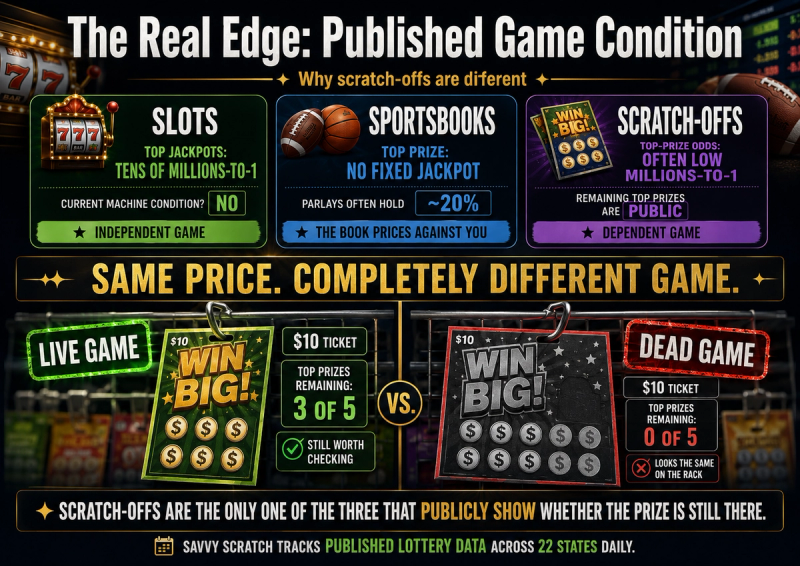
That is the entire pitch. Scratch-offs give up the most on return of the three products, and in exchange they are the only one of the three that tells you, publicly and daily, whether the prize on the front is still in the pack. If you never use that information, you are playing the worst-returning game of the three for no reason. If you do use it, you are at least buying the version of the game that still has what you came for. The full argument for why a professional gambler's playbook transfers to this product goes deeper on that framework.
Savvy Scratch pulls that published data for 22 states every day and sorts every active game so you can see the dead ones before you pay. Free account gets the Bad and New tabs. Start here.
The pit lesson about game selection
There is a second habit from the casino floor worth borrowing here, and it is simpler than counting anything.
Every table game in the pit has a different edge baked into it, and they are all sitting in the same room under the same lights with the same free drinks. The pass line at a craps table gives up something close to one and a half percent. The big six wheel spinning twenty feet away gives up something in the neighborhood of eleven to twenty four percent depending on which segment you bet. Same casino, same night, same customer walking between them. Nobody stops you at either one. Nobody posts a sign. The player who understands the floor spends his night at the good game and never touches the wheel, and he did not have to be clever to pull that off. He just had to know which was which before he sat down.
That is the correct way to look at these three products, and the correct way to look at the rack inside any one of them. You are not choosing between "gambling" and "not gambling." You are choosing which specific game inside which specific category you hand your money to, and the difference between the best and worst option in front of you is enormous. Most players never make that choice at all. They walk up to whatever is closest and start playing. Picking your price tier and then finding the live game inside it is the scratch-off version of walking past the wheel.
Where each one actually belongs
If you like slots, play slots. They return the most of the three and the entertainment per dollar is real, as long as you understand the jackpot is decoration and you are paying for hours of play, not for a shot at the sign above the machine.
If you like sports, bet sports, but understand the number. Straight bets cost you around 5 percent. Parlays cost you around 20 percent. If you are placing eight-leg same-game parlays every Sunday because the payout screenshot looks good, you have chosen the single most expensive product in American gambling and the book thanks you for it.
If what you want is a genuine long-shot swing at a life-changing number for the price of a coffee, scratch-offs are the only one of the three that offers it, and they are also the only one that will tell you whether the swing is still available. The catch is that you have to actually look. A depleted game and a live game cost the same and look the same. This is exactly the same trap as treating a bigger Powerball jackpot as a reason to buy more tickets, where the size of the prize hijacks the part of your brain that is supposed to be evaluating whether you can reach it.
And whichever of the three you pick, decide the number before you walk in. That part does not change across products, and it is the only variable fully under your control. The bankroll framework I use is built around exactly that, because the fastest way to lose money in any of these three games has never been the house edge. It has been the decision to keep going after a bad stretch.
The three guys leaving that gas station are all going to lose money on average. That is what these products are. The only one with any control over how much is the one who checked what he was buying first, and right now that is only possible in one of the three.
Frequently asked questions
Which has better odds, scratch-offs or slots? Slot machines return more of every dollar played. Nevada's statewide slot hold was around 7.15 percent in 2025, meaning roughly 92.85 percent came back to players, while state lottery scratch games typically pay back somewhere between 63 and 78 percent depending on the state and price point. Scratch-offs give up more on return, but they offer a direct shot at a fixed top prize at a low buy-in, and they publish prize-remaining data that slots do not have an equivalent for.
Do sportsbooks have a bigger edge than the lottery? No. Sportsbook hold in 2025 averaged around 10.15 percent of handle nationally, well below the roughly 26 to 37 percent the lottery keeps on scratch games. The gap narrows on parlays and player props, which carry hold rates near 20 percent, but sports betting remains the lower-cost product per dollar wagered.
Why play scratch-offs at all if the hold is the highest? Because it is the only one of the three where the top prize is reachable at a small buy-in and where the game's current condition is published. A slot machine will not tell you anything about its state. A sportsbook prices against you. A scratch-off game's remaining top prizes are public record, which means you can avoid the games where the prize you want is already gone.
Can you count cards on scratch-offs? Not in the literal sense, but the underlying idea transfers. Scratch-offs are dependent games, so prizes claimed earlier change what is left in the unsold tickets. Tracking which top prizes remain against how far a game has sold is the closest equivalent, and unlike a blackjack shoe, the data is published by the state.
Which gambling product has the best top prize odds for a small buy-in? Scratch-offs, by a wide margin over both a wide-area progressive slot jackpot and a stacked parlay. Top-prize odds on scratch games typically run in the low millions to one, compared to tens of millions to one on major progressives. All three are long shots. Only one is in the range where the outcome happens to real people with any regularity.
About the Author: Doug Moeller is a professional gambler with over 15 years of experience in poker, blackjack card counting, and casino advantage play, with over $500K in lifetime winnings. He spent years choosing which games on a casino floor were worth sitting at, and built Savvy Scratch to bring that same game-selection discipline to scratch-off lottery tickets across 22 states. Follow Doug on X | YouTube
Check the game before you buy it. Open Savvy Scratch, pick your state, and see which games still have their top prizes in the pack. Free account gets the Bad and New tabs with no card required. Full Good and Neutral rankings are $5/month or $50/year with a 30-day worry-free guarantee. Get started at savvyscratch.com