Do Scratch-Off Odds Change?
5/10/2026
By Doug Moeller | Professional Gambler & Founder of Savvy Scratch
Most people buy scratch-off tickets like the odds are frozen in time. They walk into a gas station, look at the display, pick a game that feels lucky or has the biggest number printed on the front, and hope. The number on the back of the ticket says one in three point seven four, so that must be the deal they are getting today. End of analysis.
It is not the deal they are getting today. It might not have been the deal six months ago either.
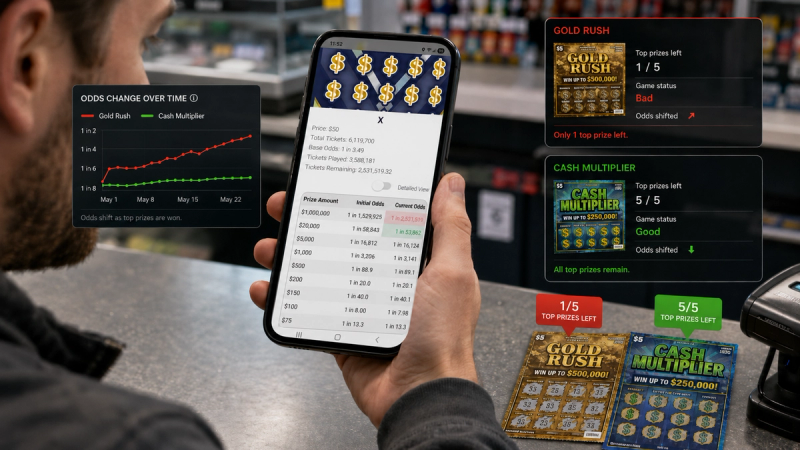
Scratch-off odds change. They start changing the moment the first ticket sells, and they keep moving in one direction until the last ticket is scratched. Some games drift into player-favorable territory. Most drift the other way. The number printed on the back of the ticket never updates to tell you which one you are looking at.
I have spent over fifteen years gambling for a living, mostly in poker, with a long stretch of blackjack card counting and a handful of casino advantage plays mixed in. Lifetime, I am north of half a million dollars in winnings. Almost none of that came from luck. It came from understanding which games still had a fair shot in them and which ones did not. Scratch-offs are the closest thing the everyday lottery player has to that same idea, and almost nobody plays them that way.
This post is about why.
The Printed Odds Are a Snapshot, Not a Live Feed
Every scratch-off has a number on the back. Something like overall odds of one in three point five. That number was calculated the day the game was designed, based on the full print run and the full prize pool. Every prize, every ticket, all of it intact, none of it claimed.
The printer locked that number into the cardstock and shipped the tickets out. From that point forward, the math underneath the number started moving. Tickets sold. Prizes got claimed. Some prize tiers got cleaned out fast. Others held steady. The number on the back stayed exactly the same the whole time, because it is printed on cardboard. It cannot update.
So a game that says one in three point five on the back today might genuinely still play like one in three point five. Or it might be a husk where most of the prizes you would actually want to win are already gone, and the remaining tickets are mostly two and five dollar refunds. The cardstock will not tell you. The clerk will not tell you. The lottery commission will not put a sticker on it that says half the jackpots claimed.
That gap between the printed number and the actual current state of the game is the entire reason this conversation exists. If you want the deeper dive on what those launch-day odds actually represent and where they break down, I wrote about it in The Truth About Lottery Odds.
Scratch-Offs Are Dependent Games (And That Word Matters)
Here is the technical version. Scratch-off games are what mathematicians call dependent games. What happens earlier affects what is left later.
Powerball is not a dependent game. The numbered balls go back in the hopper after every drawing. Tuesday's odds are identical to Friday's odds, no matter how many people played in between. That is an independent game, and the printed odds always describe reality.
Scratch-offs do not work that way. Each game is a closed printing run. A fixed number of tickets, a fixed number of prizes, distributed at the print plant before anybody bought anything. From the moment that game launched, every prize that got claimed is one less prize available, and the unsold tickets in front of you are drawing from a smaller and smaller pool of meaningful winners.
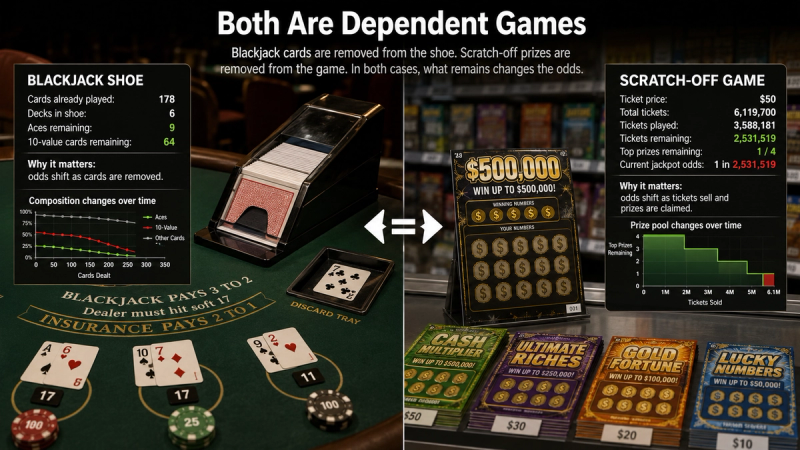
A blackjack shoe works the same way. Once you have played through it, every card that came out of it is gone until the dealer reshuffles. If most of the small cards have already been dealt and the shoe is rich in tens and aces, the next hand is wildly different from the first hand off a fresh shuffle. Same rules, same table, same dealer, completely different math underneath.
Scratch-off games are a closed shoe. The lottery just keeps selling tickets out of it long after the aces are gone. I broke down exactly how that comparison works at the math level in Card Counting for Lottery? Here's How It Actually Works for Scratch-Offs.
How a Game Can Drift Better, Worse, or Sideways
Now for the part most players have never thought about. Odds drift in three different directions, and which direction matters more than people realize.
A game can drift worse. This is the most common case. The top prizes get claimed early, often within the first few months, while plenty of tickets are still on the rack. Now the unsold tickets in front of you are drawing from a much weaker prize pool than the back of the ticket advertises. The game is still selling. The math underneath has gotten ugly.
A game can drift better. This sounds counterintuitive, but it happens regularly. A game launches, sells through a meaningful chunk of its print run, and the top prizes have not been claimed yet. Now there are fewer tickets out there competing for the same headline jackpots. The current odds on those top prizes have actually improved compared to the printed launch odds. A real example I track lives inside Texas's $400 Million Mega Bucks game, where one of the top prize tiers improved from one in roughly 1.3 million at launch to one in roughly 380,000 after a chunk of the run sold through. Same ticket. Same price. Same display case. Three and a half times better top-prize odds than the cardstock said.
A game can drift sideways. The top prizes claimed in rough proportion to how many tickets sold. Maybe a few tiers improved a little, a few got a little worse. The current state is close enough to the printed state that there is no meaningful edge in either direction.
The interesting thing is that you cannot tell which of these three buckets a game falls into without looking at the data. Two tickets sitting next to each other on the same rack at the same gas station can be in completely different buckets, and the average player has no way to tell them apart by looking. That is the core unfairness of how scratch-offs are sold, and it is also the entire opportunity if you bother to check.
Overall Odds Are Misleading on Purpose
Players who do glance at the back of the ticket usually look at the overall odds. One in three point five sounds reasonable. One in four sounds tighter but still playable.
That number is almost useless for making a real decision.
The overall odds count every prize tier in the game, including the two and five dollar refunds. In most games, the majority of the announced winning tickets pay back the cost of the ticket or close to it. You buy a ten dollar scratcher, you scratch it, you win ten dollars. Technically a winning ticket. Statistically a wash. That counts toward the one in three.
The prizes that actually move money, the four and five figure prizes and up, live in a different conversation entirely. A game can have great overall odds and a completely depleted top tier. You will hit the small refunds at the advertised rate. You will not hit the prize that pulled you in, because that prize was claimed eight months ago. The cardstock will keep telling you one in three point five. The bankroll will keep dripping out anyway.
This is the same reason a poker player who celebrates winning a lot of small pots while bleeding chips in the big ones eventually goes broke. Win rate looks fine on paper. Net result is a dead stack. I dug into why this matters more than almost any other metric in Why Top Prizes Are the Only Thing That Actually Matters in Scratch-Offs.
Two Identical-Looking Tickets, Two Completely Different Bets
Picture two scratch-offs at the same price point sitting on the same rack. Same five dollars. Same overall odds printed on the back. Same general structure of jackpot, mid-tier prizes, and refunds.
The first ticket comes from a game where the top prizes are mostly intact even though a chunk of the print run is gone. The remaining tickets are punching above what the cardstock claims. The current top prize odds are sharper than launch.
The second ticket comes from a game where the top prizes were claimed early and most of the meaningful mid-tier prizes are gone too. What is left in the unsold inventory is essentially refund tickets dressed up in the same colorful art the game launched with. The current top prize odds are dramatically worse than launch.
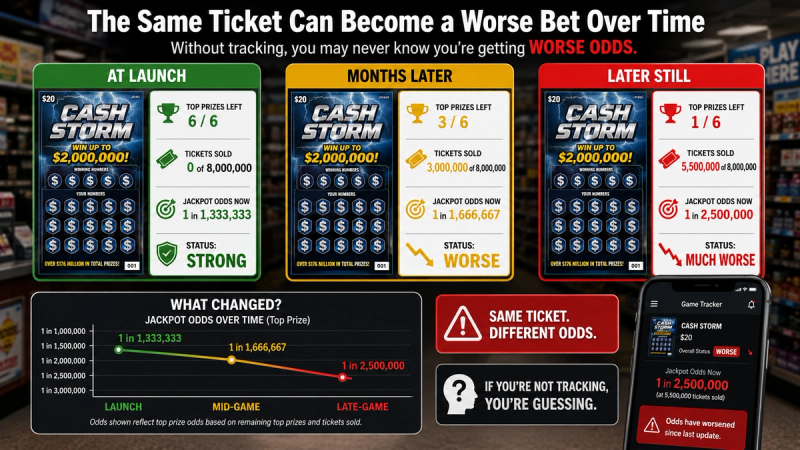
Same store. Same rack. Same five bucks. One is a fair fight. The other is funding the next state highway project. The cardstock will not tell you which is which. The cashier will not tell you. The marketing photo will not tell you, because the lottery's design department wants both games to look equally exciting right up until the last ticket sells.
That is the gap. Sign up free at savvyscratch.com and you can already see which games have been picked clean before you buy.
Why the Lottery Keeps Selling Dead Games
This part frustrates a lot of players when they first realize it. The lottery commission has no obligation to pull a game off the shelf when its top prizes are gone. From their point of view, the game is still generating revenue, the consolation prizes are still being paid out at the printed rate, and pulling tickets early would cost the state money.
So the rack stays full. The marketing photo stays bright. The big jackpot number stays printed in giant font on the front. The only thing that changed is whether that jackpot is actually still in the unsold inventory, which is exactly the piece of information the system is structured not to surface for you.
Every state lottery does publish prize-remaining data. They are required to. The information is sitting there in PDFs and tables on the state lottery website, usually three or four clicks deep into a page that looks like it was last updated in 2008. The data is not hidden. It is just buried, inconsistent across states, and annoying enough that almost no recreational player ever checks it.
I spent a long time pulling those PDFs apart by hand before I built a tool that did it automatically. It took roughly forty-five minutes per state to do it manually. If a guy who has been doing gambling math for a living for fifteen years finds it tedious, the casual player who buys a ticket on the way home from work is never going to do it. That asymmetry is the whole problem.
The Card Counter's Move
There is a moment in blackjack card counting where the running count crosses a threshold and the math tilts toward the player. The remaining shoe is rich enough in high cards that the next round of hands genuinely favors anyone willing to bet bigger. The casino does not announce it. The dealer does not pause the game and tell the table. The only people at the table who know are the ones doing the count.
This is the closest analogy to what is happening on a scratch-off rack right now. Some of the games in front of you have a positive count. The current odds on the top prizes are better than the cardstock advertises. Most of the games have a negative count. The current odds are meaningfully worse. The lottery commission is not going to flag either category for you. The clerk has no way to know. The packaging looks the same on both.
The card counter's job is not to win every hand. The card counter loses individual hands constantly. The job is to bet bigger when the count is positive and bet smaller, or walk, when the count is negative. Over thousands of hands, that single discipline is the difference between a winning year and a losing one.
The scratch-off version is simpler. You do not need to bet bigger. You just need to walk past the games where the count has gone negative and put your money into the games where it has not. That is it. That is the whole edge.
If you want the long-form version of how to systematize that thinking, Stop Playing Blind: How Smart Lottery Players Hunt Jackpots and Win More Often walks through the full framework.
So How Do You Actually Check Before You Buy
You have a few options.
You can do it manually. Go to your state lottery website. Find the prize-remaining page, which is usually labeled something like instant games or scratchers. Pull up each active game at your price point. Cross-reference the prizes remaining with the original print run, estimate how many tickets are still unsold, and calculate the current odds on the top tiers. Compare across the games you are considering. Pick the one with the strongest current ratio.
That works. It is also a real time investment, and the data shifts constantly, so you would need to redo it every few days for it to actually be useful. Most players are not going to do this consistently. I barely wanted to, and this is what I do for a living.
The other option is to use a tool that automates the whole thing. Savvy Scratch pulls the live prize data from official state lottery sources, runs the comparison between launch odds and current odds across every active game in nineteen states, and rates each game as Good, Neutral, Bad, or New. Open the app, pick your state, and the games rated Good are the ones where the math is currently favoring the buyer. The games rated Bad are the ones to walk past.
The Bad and New tabs are free. No credit card. The Good and Neutral tabs are five dollars a month or fifty for the year, with a thirty-day worry-free guarantee. I priced it where I priced it because I wanted it to cost less than a single losing ticket per month. If reading the Good tab keeps you out of one or two depleted games a month, the subscription pays for itself many times over. If it does not, you email and I refund it.
Try it free at savvyscratch.com.
The Habit That Actually Saves Money
If you take only one thing from this post, take this. Before you buy your next scratch-off, take ten seconds to ask whether you are buying it because the photo on the front caught your eye or because you actually checked whether the game is still alive.
If the answer is the photo, put the wallet back and check the data first. The photo is marketing. The data is reality. They are almost never aligned, because nothing about the marketing changes when the math underneath gets gutted.
That single ten-second check is the entire thesis of every word above this paragraph. It is the same check a card counter makes every shoe. It is the same check a poker player makes every table. It is the only thing standing between a recreational lottery player and the slow drip of buying tickets out of dead games for months without knowing it.
Scratch-off odds change. The cardstock does not. The data does. Read the data before you buy.
About the Author: Doug Moeller is a professional gambler with over fifteen years of experience in poker, blackjack card counting, and casino advantage play, with over $500K in lifetime winnings. He built Savvy Scratch to bring the same data-driven approach that works at casino tables to scratch-off lottery tickets. The app currently covers nineteen states and is the only scratch-off odds tool built by someone who has made a living beating games of chance. Follow Doug on X | Savvy Scratch on YouTube
Stop Playing Blind. Start Reading the Data.
Open Savvy Scratch, pick your state, and see which games still have their top prizes intact. The Bad and New tabs are free forever. The Good and Neutral tabs are $5/month or $50/year, with a 30-day worry-free guarantee.
Get Started Free at savvyscratch.com →
Currently covering: AZ • CA • FL • GA • IL • LA • MA • MD • MI • MO • NC • NJ • NY • OH • OK • OR • TX • VA • WA