The LottoEdge Alternative Built by a Professional Gambler
A straight Savvy Scratch vs LottoEdge comparison. Same idea — current scratch-off odds from public lottery data — two different ways of getting it into your hands. Here is which one fits how you actually play.
Free to start. No card required. 26 states covered.
LottoEdge is a legitimate, established tool, and if you play in one of its five paid states and love digging through rankings, it works well. Savvy Scratch runs the same current-odds analysis across 26 states, gives you a permanent free tier instead of a trial, and lives in a native app you check at the counter instead of a dashboard you read at home. Pricing is nearly identical, so the real question is state coverage and how you like to decide.
Savvy Scratch vs LottoEdge
Comparison reflects publicly listed details at time of writing. Pricing and state coverage can change — check each provider for current terms.
What LottoEdge does well
LottoEdge has been around since 2019, which is a long time in this niche, and it was built by Jared James, a former PricewaterhouseCoopers CPA and mergers-and-acquisitions specialist. That is a serious numbers pedigree and it shows. The product is built around daily game rankings calculated from public state lottery data, with real depth behind it. You get more than twenty rankings, filters to narrow to the ticket prices you actually buy, top-prize targeting, mid-tier prize rankings, and a flag for games where estimated sales say a top prize probably should have hit but has not. They strip out the break-even and free-ticket prizes so you see the odds to win more than the ticket cost, and they publish free overall-odds rankings across roughly forty states. If you enjoy slicing the data twenty ways and reading a guided email series, LottoEdge gives you plenty to work with.
The state question decides it for most people
LottoEdge publishes free overall-odds rankings across about forty states, which is broad. But the paid product — the part that tracks current odds daily and powers the top-prize targeting — currently lists state access on its pricing page for five states: California, Florida, North Carolina, New Jersey, and Texas. If you play in one of those five, you have a real choice to make on features and feel. If you play anywhere else, the deeper analysis you are paying for may not cover your state yet.
Savvy Scratch runs the full current-odds analysis across all 26 states below. All five of LottoEdge's paid states are in that list (marked in gold), so there is full overlap there, plus sixteen more states on top.
Gold = also covered by LottoEdge's paid product.
You can see the same data live for individual states in our state-by-state breakdowns.
A read is only worth something in the moment you act on it
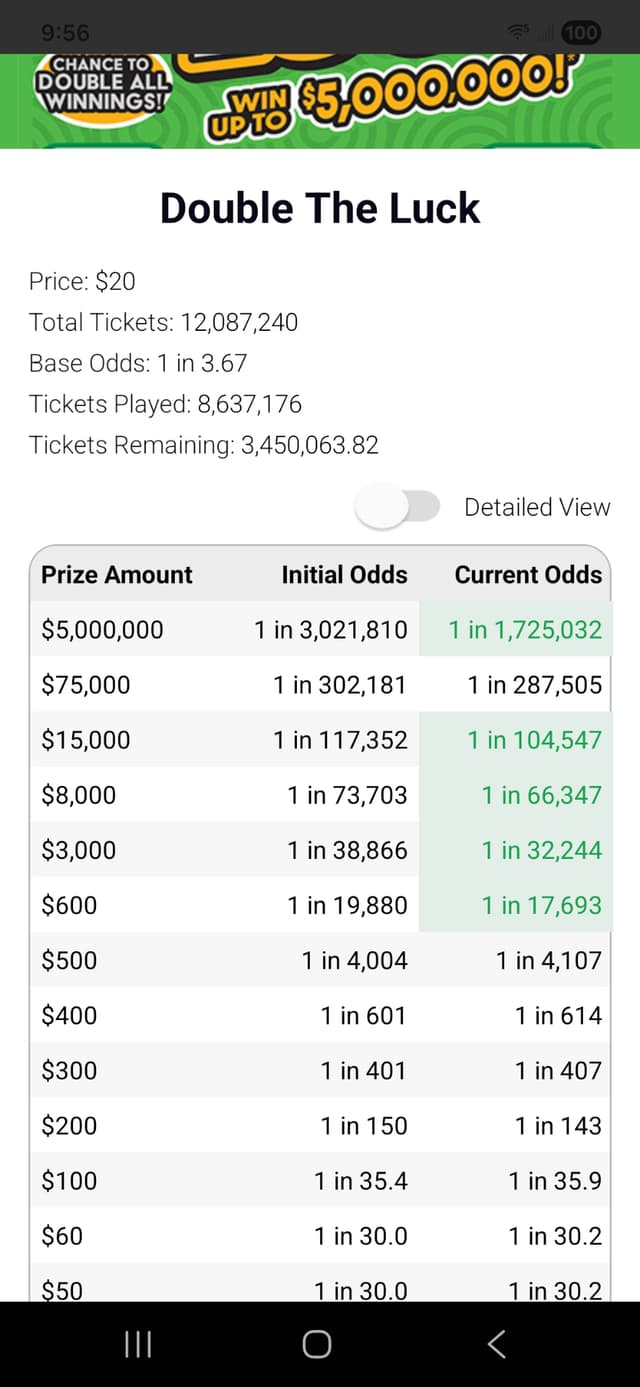
Every edge I ever pressed in a casino came down to having the right information at the exact moment I had to act, not an hour later. A shuffle-tracking or hole-carding play is worthless if you cannot process it live at the table. By the time you have gone home and done the math, the shoe has been reshuffled and the money is gone. Scratch-offs work the same way. The rack in front of you changes a little every day as prizes get claimed, so the value sits in checking the live data in the store, in your hand, before you pay. That is why Savvy Scratch is a native app you pull out at the counter, not a dashboard you read at home and try to remember later.
If you want the full breakdown of how that current-versus-initial-odds math works, it is in the complete guide to lottery analysis.
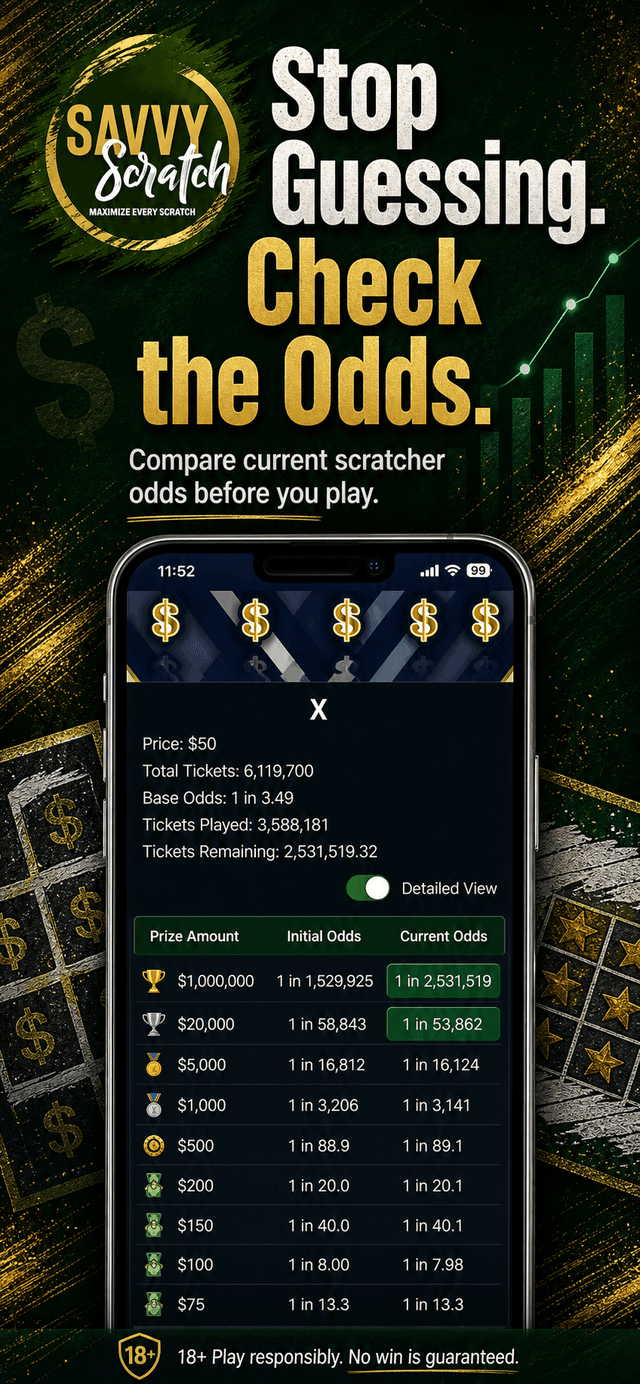
See it in your state free. Create a free account, pick your state, and the Bad and New tabs open immediately so you can spot played-out games before you spend a dime.
Create a free accountPricing is close to a wash, so it should not decide it
On price these two are basically even. LottoEdge runs about five dollars a month, or forty-eight dollars a year on the annual plan with its roughly twenty percent annual discount, after a fourteen-day free trial. Savvy Scratch is $5/month or $50/year with a 30-day worry-free guarantee. Two dollars a year apart is noise. The more meaningful difference is how you get in the door. Savvy Scratch has a permanent free tier, not a trial that converts to a charge. Anyone can sign up, pick a state, and use the Bad and New tabs forever without paying. The Bad tab alone tells you which games to walk past, which is half the battle. The paid subscription unlocks the Good and Neutral tabs, where the live games sit. LottoEdge offers free overall-odds rankings too, but the current-odds tooling you are paying for lives behind the trial.
Do you want to study the board, or just know which game to buy
At a poker table, the players losing money are usually the ones drowning in information. They track every stat, second-guess every read, and still make the wrong call because they never decided which numbers actually matter. A winning player is not tracking forty data points. They are tracking the two or three reads that change the decision in front of them. That is the split between these two tools. LottoEdge gives you twenty-plus rankings and a stack of filters, which is great if you enjoy the analysis. Savvy Scratch makes the call and shows its work, because the only question that matters at the counter is whether the top prizes you would be excited to win are still in the unsold tickets. If they are, the game is worth playing. If they are not, you walk.
I broke down why the jackpot tier is the only number worth chasing in the beginner's guide to jackpot hunting. Neither approach is wrong. They serve different players.
Which one should you use?
Pick LottoEdge if
You live in California, Florida, North Carolina, New Jersey, or Texas, and you enjoy digging through rankings and filters and following a guided email course. It is a solid, established choice and you will get value from it.
Pick Savvy Scratch if
You play in any of the other sixteen states it covers, you want a native app you can check in line at the store, or you want to start completely free and only pay once you have seen the live data work. It is also the only one of the two built by someone who made a living as an advantage player rather than analyzing the games from the outside.
Most players buy blind not because they are lazy, but because nobody handed them the data in a form they could use in the ten seconds they have at the counter, which is the quiet mistake that costs regular players the most.
LottoEdge Alternative — FAQ
Is LottoEdge legit or a scam?
LottoEdge is legitimate. It has operated since 2019, it was founded by a former PwC CPA, and it builds its rankings from publicly available state lottery prize data. Whether it is right for you comes down to whether it covers your state and whether you prefer its rankings-heavy approach.
What is the best LottoEdge alternative?
Savvy Scratch is the closest direct alternative. It runs the same current-versus-initial-odds analysis, covers 26 states with that paid analysis, offers a permanent free tier, and delivers it through a native iOS and Android app you can use at the store.
Does Savvy Scratch cover my state?
Savvy Scratch currently covers Arizona, Arkansas, California, Connecticut, Florida, Georgia, Iowa, Illinois, Kentucky, Louisiana, Massachusetts, Maryland, Michigan, Minnesota, Missouri, North Carolina, New Jersey, New York, Ohio, Oklahoma, Oregon, Pennsylvania, Texas, Virginia, Washington, and West Virginia, with more added over time.
How much do Savvy Scratch and LottoEdge cost?
Savvy Scratch is $5/month or $50/year with a 30-day worry-free guarantee. LottoEdge runs about $5/month or $48/year after a fourteen-day free trial. The pricing is close enough that it should not be your deciding factor.
Is Savvy Scratch free?
Yes. The free tier shows the Bad and New game tabs in every covered state, with no card required to start. A paid subscription unlocks the Good and Neutral tabs, where the live games with healthy remaining prizes show up.
Can any scratch-off tool guarantee a win?
No. The lottery is a game of chance and no app, system, or person can guarantee a scratch-off win. These tools keep you out of played-out games and into games where the prizes you want are still available. That is a better decision, not a sure thing.
See which games are live in your state
Open Savvy Scratch, pick your state, and look at the Good tab. The Bad and New tabs are free forever. The Good and Neutral tabs are $5/month or $50/year, with a 30-day worry-free guarantee.
Get started free
Doug Moeller is a professional gambler with over 15 years of experience in poker, blackjack card counting, and casino advantage play, with over $500K in lifetime winnings. He built Savvy Scratch to bring the same data-driven approach that works at casino tables to scratch-off lottery tickets.