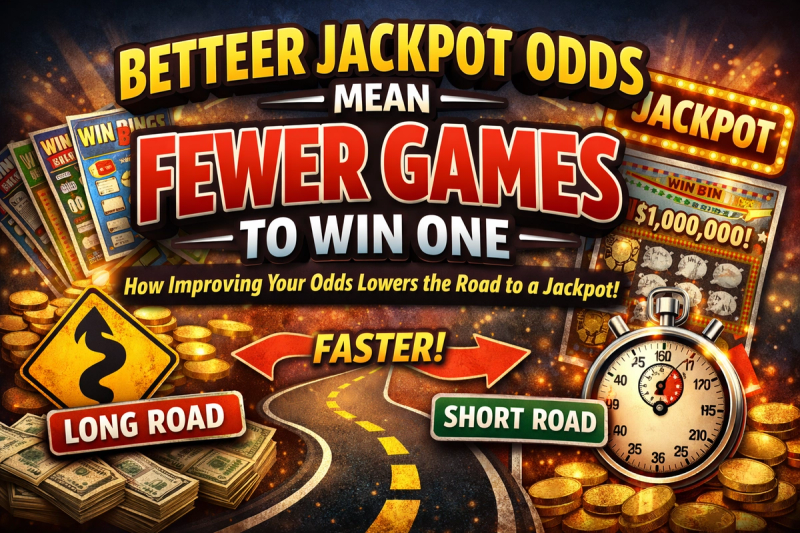
The Shorter Road: Why Better Jackpot Odds Mean Fewer Scratch-Offs Between You and a Top Prize
4/18/2026
By Doug Moeller | Professional Gambler & Founder of Savvy Scratch
Most scratch-off players ask the wrong question at the counter.
They ask, "can this ticket win." Of course it can. Every active ticket can technically win. That question does not actually tell you anything useful. It is the lottery equivalent of asking whether a slot machine is plugged in.
The question a professional gambler asks is different. How long is the road from here to a top prize on this particular game, compared to the other games sitting on the same rack. Because once you start thinking in terms of the road and not the individual ticket, something clicks. Two games at the same price point, in the same store, on the same day, can have wildly different roads in front of them. One might have a top-prize path that is twice as long as the other's. Same five dollars, same ten dollars, same twenty. Very different bets behind the glass.
That is the whole point of this post. Better jackpot odds are not a cosmetic improvement. They literally shorten the distance you have to travel before a top prize becomes statistically reachable. And scratch-off players who understand this stop buying tickets the way most people do and start picking them the way an advantage player would.
What Blackjack Players Figured Out a Long Time Ago
I spent years counting cards in blackjack before I ever built Savvy Scratch, and one of the first concepts a serious counter has to make peace with is that an edge by itself does not mean much. You can have the math on your side and still lose for hours. Variance does not care about your count.
What counters care about is something called N-zero. It is a formal number, but the plain-English version is simple. N-zero is the amount of play you need to put in before your edge has had a realistic chance to show up against the noise. If the edge is tiny, N-zero is huge. You have to grind through a mountain of hands before the math even starts to separate from luck. If the edge is bigger, N-zero shrinks. You still have variance, but the good situations compound faster, and the road to a meaningful result gets shorter.
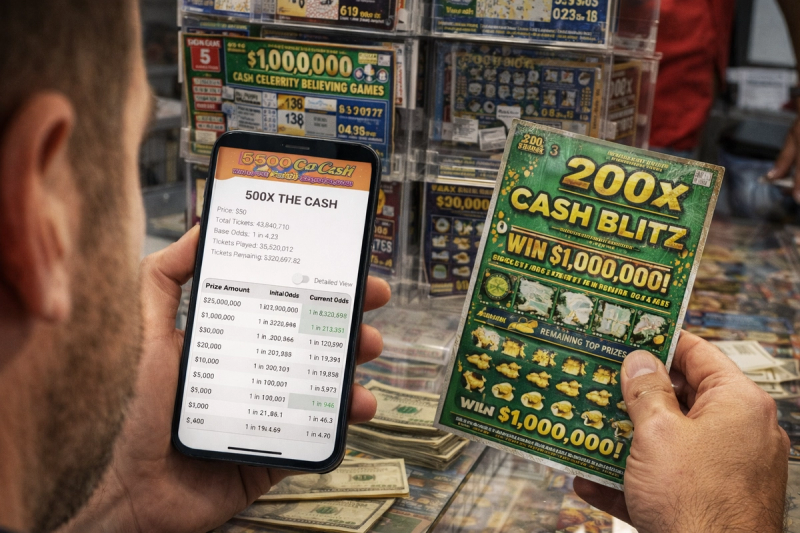
Scratch-offs are not blackjack. I want to be precise about that, because advantage players take precision seriously. You are not counting individual cards in a shoe. You are not getting a round-by-round measurable edge. You are playing a randomized, closed-shoe print run of tickets where the overall game still carries negative expected value.
But the underlying idea carries over, and it carries over cleanly. When you improve the underlying odds of the thing you actually care about, you reduce the amount of play it takes before that outcome becomes reasonably reachable. That is true whether the game is blackjack, poker, a casino advantage play, or a scratch-off sitting behind the convenience store counter.
And the thing you actually care about on a scratch-off is the top prize.
Top-Prize Odds, Translated Into Distance
The raw math on top prizes is unforgiving in both directions. If the current odds of hitting a top prize are one in five million, then on average it takes five million plays to expect a single top-prize hit. If those odds improve to one in two and a half million, the average expected number of plays gets cut in half. If they improve to one in one million, the road shortens by eighty percent.
Nobody is going to play five million tickets. That is not the point. The point is that the ratio translates directly into how far the typical player sits from a top-prize outcome. When the ratio shortens, the distribution shifts. Players who picked the shorter-road game are, on average, reaching for that outcome from closer up.
And here is the part most casual players miss entirely. Those ratios move. They move every time someone in your state walks into a store and claims a top prize, because that prize comes out of the unsold inventory. They move every time a chunk of tickets sells without a top-prize hit, because the remaining pool now has the same number of top prizes distributed across a smaller inventory. A scratch-off game at launch is not the same game six months later. It is not even the same game next Tuesday, if enough tickets moved over the weekend.
A game at launch might advertise one in four million on the top prize. Six months later, if the print run is half gone but only one of the top prizes has been claimed, the math under the hood might have improved to something closer to one in two million. Same artwork on the ticket. Same price. The road to the top prize is now half as long. If the top prizes got gutted first and the game is still sitting on the rack, the opposite is true. You are paying the same price for a road that might now be twice as long as the back of the ticket originally suggested.
This is exactly the kind of drift that the complete guide to lottery analysis is built around. The data is public. The state lottery commission has to publish it. Almost no one reads it.
The Game-Selection Moment
There is a concept in poker called table selection. It is the single most valuable skill a winning recreational player ever learns, and most players never bother to learn it. The idea is that your edge in poker is not primarily determined by how well you play. It is determined by how well you choose which table to sit at. A solid grinder at a soft table makes money. That same grinder at a table full of pros loses money. Same cards, same rules, same player. The seat is the asset, not the player.
Scratch-offs have exactly the same dynamic, and almost nobody treats them that way. Walk into a store and look at the rack. You have fifteen or twenty active games, many at the same price point, all dressed up with the best artwork the state's marketing team could commission. The game that most players buy is the one whose photo catches their eye. The game an advantage player buys is the one with the shortest road to the thing they want.
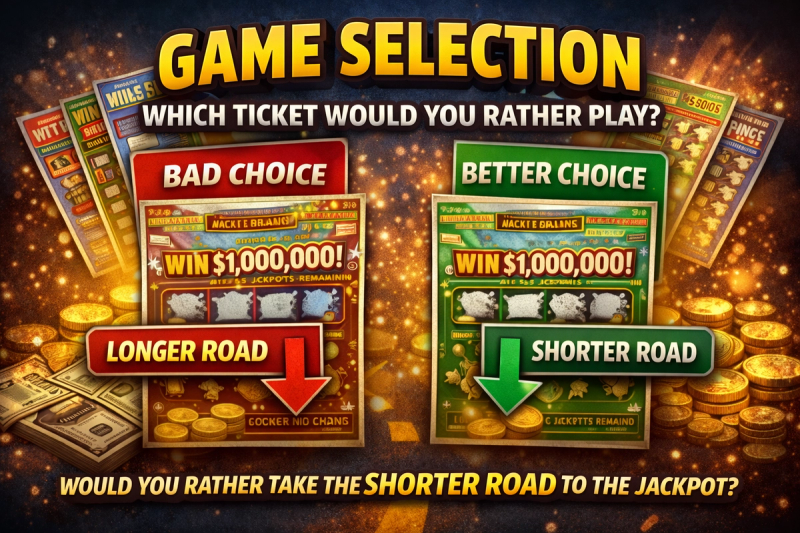
Those are almost never the same game. The prettiest ticket might be a dying one. The boring black-and-green design two slots over might be the live one. The back of the ticket tells you almost nothing about this, because the back of the ticket describes the game as it left the printer a year ago, not the game in front of you today.
That is game selection. That is the moment where the road either shortens or lengthens, and it happens before you ever hand money to the clerk. The practical data-driven guide to finding the best-odds scratch-offs walks through the full process if you want the longer version.
A Concrete Comparison
Let's take the hypothetical two games from earlier and think about what the choice really means.
Game A has a current top-prize probability of one in four million. Game B has a current top-prize probability of one in two million. Same price point, same ticket size, same rack at the same store. A lot of players look at those numbers and think Game B is "twice as lucky" or "twice as likely to hit." That is the wrong way to say it, because it implies a guarantee where none exists, and it invites the kind of magical thinking that scratch-offs are already designed to encourage.
The clean, accurate way to talk about it is that Game B puts you on a road that is half as long. Over a year of play, over hundreds of tickets, over whatever volume you decide your bankroll allows, you are measurably closer to a top-prize outcome at every step than the Game A player is. Neither player is guaranteed anything. Variance still owns both of them on any given ticket. But one of them is grinding a longer road for no reason other than that they never checked.
Now multiply that by every scratch-off purchase you make over a year. The player who checks, every time, picks the shorter road, every time. The player who does not check is rolling a die on which road they are on. Some days the artwork happens to line up with the math. Most days it does not, because the lottery commission has no reason to let the two correlate. Dead games sell revenue the same as live games do, right up until the last copy is gone.
Timing Is a Feature, Not a Nuisance
One of the hardest ideas to shake for most scratch-off players is the assumption that a game is either good or bad, period. It is not. The same game can cycle through multiple states during its lifespan. It can launch with mediocre odds, drift into genuinely favorable territory when a chunk of the inventory sells without the top prizes hitting, then fall off a cliff the week someone claims the last jackpot. That is not unusual. That is the normal life cycle of a scratch-off game. Most of them go through it.
Which means you are not just picking which game to play. You are picking when to play it. This is why Why Top Prizes Are the Only Thing That Actually Matters in Scratch-Offs keeps coming back to the current top-prize count instead of the advertised odds on the back of the ticket. The advertised odds describe a snapshot from the day the game went to print. The current top-prize count describes the actual game in front of you today, at this store, this afternoon.
Timing is not a bug in scratch-offs. It is where the only real edge lives. Ignore it and you are paying full price for whatever road the counter happens to be selling that day. Pay attention to it and you can consistently find games where the road has gotten shorter since launch.
Try Savvy Scratch free. The Bad games tab and New games tab are free forever, no credit card. The Good and Neutral tabs are five dollars a month or fifty dollars a year, with a thirty-day worry-free guarantee. Sign up free at savvyscratch.com.
Why "Can It Still Win" Is the Wrong Question
I want to come back to the question I started with, because it is the one every casual scratch-off buyer is actually asking, even if they do not put it in words. Can this ticket still win. Are there any prizes left. Is the game still alive.
The problem with that framing is that the answer is almost always yes. Games do not get pulled from the rack the moment a top prize is claimed. Games do not get pulled from the rack when eighty percent of the meaningful prizes are gone. Games get pulled from the rack when the state decides to replace them, which is often months after the game has effectively died. Until then, the ticket is still on sale, the price is still the same, and the marketing photo is still the same.
So "can this ticket win" is functionally always yes. It is a useless filter. It does not separate a game worth playing from a game worth walking past.
The useful question, the one the beginner's guide to lottery jackpot hunting spends time on, is shorter road or longer road. Out of the games I could buy right now, at the price point I have in mind, which one puts me closest to the outcome I actually care about. That is game selection. That is what an advantage player is doing when they stand in front of the counter longer than the clerk expects.
What This Looks Like Day to Day
In practice, shorter-road thinking does not require a spreadsheet or a math degree. It requires you to stop looking at the ticket art first and start looking at the data first. Open the app, pick your state, open the list of live games at your price tier, read the top prize column. If the current odds on the top prize have improved since launch, you are looking at a game where the road has gotten shorter. If they have gotten worse since launch, the road has gotten longer, and no amount of appealing artwork is going to change that.
Do it before every purchase. Not once a month. Not once a week. Every time, because the numbers move every day, and the game that was live on Monday might have cratered by Friday if a couple of top prizes came off the board. The lottery scratcher odds calculator guide goes into what consistent use looks like and what happens when people check data once and then autopilot for weeks. Short answer, it does not work. The discipline is checking, and the payoff is that the road in front of you is the shortest one the current board has to offer.
The Point That Most Lottery Advice Misses
Most generic lottery advice stops at "play responsibly, set a budget, don't chase losses." All of that is fine. None of it engages with the actual question of which game to play, because generic advice treats scratch-offs like a single undifferentiated category. They are not a single category. They are a rotating inventory of independent closed-shoe games, each with its own shifting state, each with its own road length from where you are standing right now to a top-prize outcome.
An advantage-play mindset does not replace the budget discipline. It adds to it. A disciplined budget with random game selection still costs you money, because half the games on any given rack are not worth playing at their current state. A disciplined budget with advantage-play game selection costs you meaningfully less over time, because every ticket you buy is deliberately on the shortest available road to the outcome you want. Same bankroll, same number of tickets, shorter road.
That is what better jackpot odds do for you. They do not promise anything. They shorten the road.
About the Author
Doug Moeller is a professional gambler with over fifteen years of experience in poker, blackjack card counting, and casino advantage play, with over $500K in lifetime winnings. He built Savvy Scratch to bring the same data-driven approach that works at casino tables to scratch-off lottery tickets. Savvy Scratch currently covers nineteen states and is the only scratch-off odds tool built by someone who has made a living beating games of chance. Follow Doug on X.
Ready to Play the Shorter Road?
Open Savvy Scratch free and see which games in your state are currently on a shorter road to a top prize. The Bad games and New games tabs are free forever. The Good and Neutral tabs are five dollars a month or fifty dollars a year, with a thirty-day worry-free guarantee. Sign up free at savvyscratch.com.
AZ • CA • FL • GA • IL • LA • MA • MD • MI • MO • NC • NJ • NY • OH • OK • OR • TX • VA • WA