Lottery Scratcher Odds Calculator: How I Finally Started Winning (Sometimes) on Scratch-Offs
10/26/2025
By Doug Moeller | Professional Gambler & Founder of Savvy Scratch
A few years ago, before I built Savvy Scratch, I was doing scratch-off analysis the hard way. I'd pull up a state lottery website, navigate to their prize claim data (usually buried three clicks deep in a page designed in 2004), copy the numbers into a spreadsheet, and manually calculate how the odds had shifted since launch day. For every game. At every price point. In every state I was tracking.
It took about 45 minutes per state. I did it because I'm a professional gambler with over 15 years of experience in poker, blackjack card counting, and casino advantage play, and I've won over $500K lifetime by doing exactly this kind of math-heavy analysis before putting money into any game. Checking the data before I spend is second nature. It's how I've approached every game I've ever played professionally.
But even I got tired of doing it by hand. And I knew that if a guy who's been crunching gambling math for a decade and a half found it tedious, there was zero chance a casual scratch-off player was going to sit down with a spreadsheet every week. Which meant that the single most useful piece of publicly available information in the entire lottery ecosystem, the current odds on every active scratch-off game, was going completely unused by the people who needed it most.
That's why I built an odds calculator. And that's what this post is about: what a scratch-off odds calculator actually does, why it matters, and how to use one to make better buying decisions every time you walk up to the counter.
What a Scratch-Off Odds Calculator Actually Does
At its core, a scratch-off odds calculator takes the raw data that state lotteries publish about their games and turns it into something you can actually use at the point of purchase.
Every state lottery is required to publish information about their scratch-off games. How many total tickets were printed. How many prizes exist at each tier. Which prizes have been claimed. This data gets updated periodically as winners come forward and cash in their tickets. It's public, it's free, and it tells you everything you need to know about whether a game is worth buying right now.
The problem is that raw data is useless to most people. It's spread across clunky government websites, formatted in dense tables, and requires actual math to interpret. You'd need to take the number of remaining prizes at a given tier, divide it by the estimated number of remaining tickets, and compare that result to the original launch-day odds to determine whether the game has gotten better or worse. Then you'd need to do that across every tier, for every game, at your preferred price point, in your state.
An odds calculator automates all of that. It pulls the current data, runs the calculations, and presents the results in a format where you can see at a glance which games have improved since launch, which ones have deteriorated, and which ones are dead.
Think of it like this. In blackjack, a card counter tracks the composition of the remaining shoe by keeping a running count of high cards versus low cards. They don't need to memorize every card that's been dealt. They just need a system that converts the raw information (cards leaving the shoe) into an actionable signal (bet more or bet less). The running count is the card counter's calculator. It takes complex, constantly changing data and reduces it to a single decision: is this shoe favorable or not?
A scratch-off odds calculator does the same thing for lottery tickets. It converts the raw prize data into a clear signal: is this game favorable right now, or should you be playing something else?
Why This Matters More Than You Think
Here's the concept that makes odds calculators valuable, and it's the same concept that underpins every profitable gambling strategy I've ever used: scratch-off odds change after launch day, and the printed odds on your ticket don't update to reflect that change.
Every scratch-off ticket has odds printed on the back. Those numbers were calculated when the game was designed, based on the full print run of tickets and the complete prize pool. They're accurate at the moment the game hits the shelf. After that, they begin drifting from reality with every ticket that sells and every prize that gets claimed.
If you've been buying a $10 game every week for six months based on the printed odds, there's a real possibility that the game you've been playing has changed dramatically since you started. Maybe the jackpots were claimed months ago and you've been paying for a ticket with a ceiling of a few hundred dollars. Maybe the opposite happened and the game's top-prize odds have improved 3X because tickets sold without jackpots being hit. Either way, the printed odds on the back of the ticket aren't telling you the current story.
I experienced this firsthand during my early scratch-off analysis. I was tracking a game in Texas, the "$400 Million Mega Bucks" $100 ticket. At launch, the $5 million top prize carried odds of 1 in 1,310,895. After roughly 4.4 million of the 5.2 million tickets sold, with top prizes still unclaimed, the calculator showed current odds of approximately 1 in 382,557. That's a 3.4X improvement that developed over the life of the game. Anyone buying that ticket on launch day and anyone buying it today are paying the same $100, but they're in completely different mathematical positions.
The reverse is equally important. California's "Set for Life" showed a different pattern. While the $1.2 million top prize improved modestly from 1 in 6,084,750 to 1 in 3,811,564, the mid-tier prizes that most players actually have a realistic shot at winning got significantly worse. The $200 prize went from 1 in 19,983 to 1 in 27,032. The $100 prize went from 1 in 8,001 to 1 in 9,723. A player looking only at the jackpot line would think the game improved. A player checking every tier on the calculator would see that the prizes they're most likely to win have become harder to hit.
Without a calculator showing you both sides of this equation, you're flying blind. And flying blind in gambling is how I've watched thousands of players lose money they didn't need to lose.
The Difference Between Overall Odds and Jackpot Odds
This is one of the most misunderstood concepts in scratch-off play, and it's where a good odds calculator earns its keep.
Every scratch-off advertises "overall odds of winning," usually something like 1 in 3.5 or 1 in 4.2. That number includes every single prize tier, from the jackpot all the way down to the break-even payouts where you win back exactly what you paid for the ticket. Winning $5 on a $5 ticket counts as a "win" in the overall odds calculation.
That's technically accurate and practically useless. When most people think about "winning," they're not thinking about getting their $5 back. They're thinking about meaningful prizes, the $100, $500, $1,000 and up tiers that actually make the purchase worthwhile. The overall odds lump these together with break-even outcomes in a way that makes every game look better than it actually is for the prizes that matter.
A quality odds calculator separates the tiers. Instead of one blended number, you see the current odds for each prize level independently. What are my odds of winning $100 or more? What are my odds of hitting $1,000 or more? What are my odds at the jackpot tier? These are different questions with very different answers, and they change at different rates as the game progresses.
I learned this distinction in poker years before I ever applied it to scratch-offs. In tournament poker, your "overall" results include every min-cash where you barely squeaked into the money. But the big paydays, the final table finishes that actually move your bankroll, happen at a completely different frequency. A player who min-cashes constantly but never reaches a final table has very different long-term results than a player who cashes less often but goes deep when they do. The blended "cash rate" hides this distinction. You have to look at the tiers separately to see what's really happening.
Scratch-off overall odds do the same thing. They hide the meaningful information inside a number that sounds better than reality. A calculator that breaks out the tiers shows you reality.
See every prize tier, every game, every state. Savvy Scratch breaks down the actual current odds per tier so you know exactly what you're buying. $5/month or $50/year, with code 20PERCENT for 20% off.
How I Actually Use the Calculator Before Buying
After years of doing this, my process is fast and consistent. It takes about two minutes before a purchase, and it replaces what used to be a 45-minute spreadsheet session.
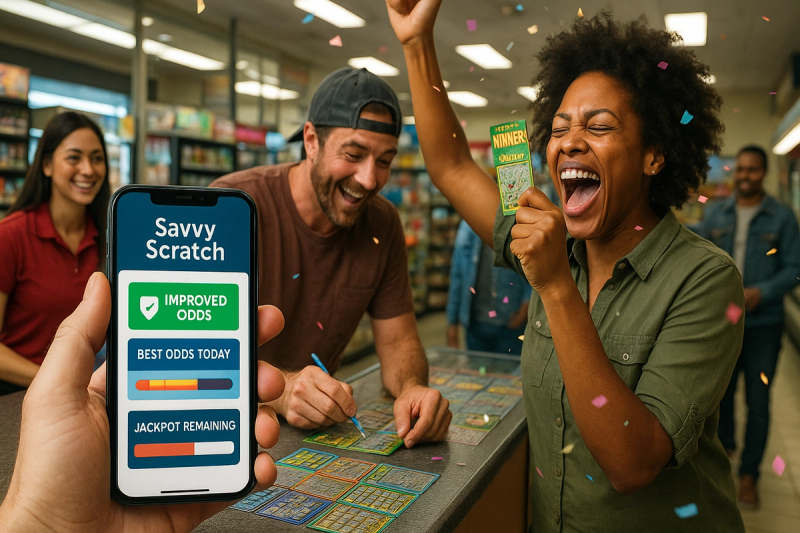
I open Savvy Scratch, select my state, and filter by the price point I'm planning to spend at. The app shows every active game at that price, rated "Good," "Neutral," or "Bad" based on current prize-to-ticket ratios across all tiers.
I look at the "Good" rated games first. Within that group, I compare two things: how many top prizes remain relative to the ticket pool, and how the mid-tier prizes ($100 to $1,000 range) have held up. A game with surviving jackpots but depleted mid-tiers is a different play than a game with strong numbers across the board. Neither is wrong, but they serve different goals. If I'm taking a shot at a big prize, I'll lean toward the game with the best jackpot ratio. If I want more frequent action and playing time, I'll pick the game with healthier mid-tier numbers.
I make my decision before I leave the house. By the time I'm standing at the counter, I already know the game name and number. I ask for it specifically, pay, and leave. No browsing the display case. No second-guessing. No impulse purchases triggered by flashy packaging or holiday-themed designs that have nothing to do with the math inside the ticket.
This discipline comes directly from my poker training. Before every session, I'd decide what stakes I was playing, what my stop-loss was, and what kind of game I was looking for. The decisions were made with a clear head, away from the table, before any chips were on the line. Making decisions at the table under emotional pressure is how players leak money. Making decisions at the counter under impulse pressure is how scratch-off players leak money. Same principle, different venue.
What a Calculator Can't Do (And Why That's Okay)
I need to be direct about this because I've seen too many tools in the gambling space overpromise and underdeliver.
A scratch-off odds calculator cannot tell you which specific ticket is a winner. Every ticket's outcome was determined at the print facility before the game shipped. No amount of analysis can identify which ticket on the roll holds the jackpot. If anyone claims otherwise, they're lying.
A calculator cannot guarantee you'll win. Even when you're buying from the game with the best current data in your state, you're still more likely to lose on any individual ticket than to win. The lottery keeps a percentage of every dollar spent. That's how lotteries work. No tool changes that fundamental reality.
What a calculator does is ensure that every dollar you spend goes into the best available game at the time of purchase. You avoid dead games where the jackpots are gone. You find games where the odds have improved since launch. You compare options at your price point and pick the one with the strongest current math. Over hundreds of purchases, the player doing this consistently will put their money into better situations than the player grabbing tickets at random.
That's the same edge, scaled differently, that I've used across every form of professional gambling. Card counting doesn't guarantee you'll win the next hand. Table selection in poker doesn't guarantee you'll have a profitable session. But both practices put you in better positions more consistently than the alternative, and over enough volume, that consistency compounds into real results.
The complete guide to lottery analysis goes deeper on the full framework of how data-driven scratch-off play works. But the calculator is the engine that makes the framework practical. Without it, you're doing math by hand or guessing. With it, you're making informed decisions in seconds.
Common Mistakes Even Calculator Users Make
Having access to data doesn't automatically mean you'll use it well. After watching players use Savvy Scratch for months, I've seen a few patterns that cost people money even when they have the right tools.
The first is checking the data once and then autopiloting for weeks. Game conditions change constantly. A game that was rated "Good" two weeks ago might have lost a jackpot yesterday and dropped to "Neutral" or "Bad." If you're not checking before each purchase, you're making decisions on stale information, which is only marginally better than not checking at all. The whole point of a calculator is that it reflects current conditions. Use it currently.
The second is focusing exclusively on the jackpot tier while ignoring everything else. Most players will never hit a jackpot on any scratch-off game regardless of the odds. The prizes you're statistically most likely to win are in the $50 to $500 range. A game with great jackpot odds but depleted mid-tiers is a worse play for most budgets than a game with decent jackpot odds and strong mid-tier availability. Check the full picture, not just the headline number.
The third, and this is the one I feel strongest about, is using better data as justification to spend more money. "The odds are good, so I should buy more tickets" is a rationalization, not a strategy. The calculator helps you spend your existing budget more efficiently. It does not mean your budget should increase. I set a monthly scratch-off budget the same way I set poker session buy-ins: the number is fixed in advance, and no amount of favorable conditions changes it. The bankroll management guide covers this principle in detail.
The fourth is falling for the near-miss trap even after checking the calculator. You use the data to pick a good game, scratch a ticket, and two out of three jackpot symbols match. Your brain lights up. You feel close. You want to buy more from that same game right now. Stop. The near miss was a designed outcome printed at the factory. It has no bearing on the next ticket. If you've hit your budget for the session, walk away. The data will still be there next time.
Getting Started
If you've been buying scratch-offs without checking current data, the shift is simple and immediate.
Before your next purchase, look up the current game ratings for your state on Savvy Scratch. Pick the game with the best current odds at your price point. Buy that game specifically. Track what you spend and what you win in a notebook. Do this for a month.
After 30 days, look at your log. Compare your results to what you remember from previous months of random buying. You'll see the difference in your spending patterns, in the types of games you're choosing, and most likely in the frequency and size of your wins. Not because the calculator is magic, but because you've stopped putting money into dead games, stopped trusting outdated printed odds, and started making every purchase from the best available option.
That's what an odds calculator does. It takes the guesswork out and replaces it with current math. It's the same thing I've done with every game I've played professionally for 15 years. The only difference is that now, you don't need a spreadsheet and 45 minutes to do it. You need a phone and 30 seconds.
The data is public. The math is straightforward. The tool is built. The only variable left is whether you check it before you buy.
Get started with Savvy Scratch today for $5/month or $50/year. Use code 20PERCENT at signup for 20% off. 30-day worry free guarantee. Stop guessing. Start calculating.
About the Author: Doug Moeller is a professional gambler with over 15 years of experience in poker, blackjack card counting, and casino advantage play, with over $500K in lifetime winnings. He built Savvy Scratch to bring the same data-driven approach that works at casino tables to scratch-off lottery tickets. Follow Doug on X | YouTube