Savvy Scratch is Live in Michigan
11/8/2025
By Doug Moeller | Professional Gambler & Founder of Savvy Scratch
Michigan is officially live on Savvy Scratch. If you buy scratch-offs anywhere from Detroit to Traverse City, Grand Rapids to the Upper Peninsula, you now have access to current odds data on every active game in the state before you walk up to the counter.
This has been one of the most requested states since we launched, and when I started pulling Michigan's scratch-off data, I understood why. Michigan runs a deep, fast-rotating scratch-off catalog with games cycling in and out at a pace that makes it nearly impossible to keep up manually. The players who asked for Michigan coverage weren't casual buyers. They were people who already suspected the games on the shelf weren't all created equal, and they wanted the data to prove it.
Now they have it.
Why Michigan's Scratch-Off Market Rewards Data-Driven Players
I've spent over 15 years as a professional gambler. Poker, blackjack card counting, casino advantage play. Over $500K in lifetime winnings. And across every game I've played professionally, the markets that reward analysis the most are the ones with the most action and the fastest turnover.
Michigan fits that description. The state has a loyal scratch-off player base, a steady pipeline of new releases, and enough ticket volume that game conditions can shift meaningfully from one week to the next. A game that looks mediocre on Monday can look strong by Thursday if a batch of tickets sold without any top prizes being claimed. Or it can crater overnight if a jackpot gets hit early in a new release.
In poker, the games with the most table turnover are usually the most profitable to analyze. When players are constantly rotating in and out, the table dynamics change fast, and the player who reads those changes in real time has an edge over the player who's still playing the conditions from two hours ago. Michigan's scratch-off market has that same energy. Conditions move. The question is whether you're moving with them or buying the same ticket you bought last month without checking whether the math still supports it.
Most Michigan players aren't checking. They're buying based on habit, packaging, or whatever the clerk suggests. That's fine for entertainment, but it means they're frequently putting money into games where the best prizes are already gone, or passing over games where the odds have quietly improved to their most favorable position.
What Michigan Players Can See Right Now
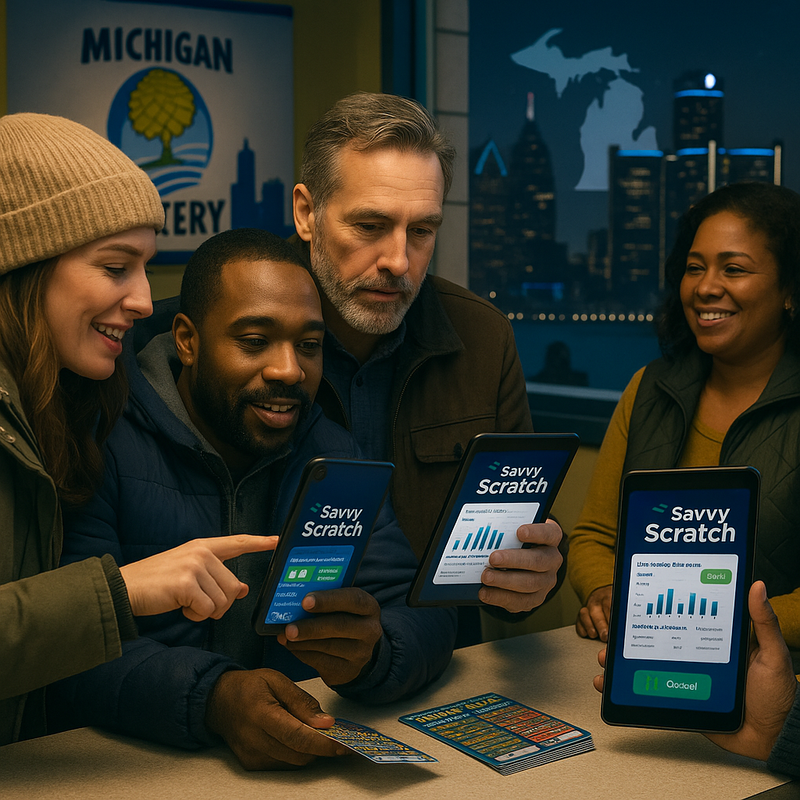
When you open Savvy Scratch and select Michigan, you'll see every active scratch-off game in the state ranked and rated based on current prize data. Each game gets an evaluation of "Good," "Neutral," or "Bad" that reflects the current mathematical position of the game, not the printed odds from launch day.
The ratings are calculated from the same type of analysis I used to find edges at casino tables: remaining prizes at each tier divided by remaining tickets in circulation, compared against where those numbers started at launch. When a game has burned through most of its tickets while retaining its jackpots, the rating improves. When the jackpots are gone but tickets remain on the shelf, the rating drops.
This isn't opinion. It's arithmetic applied to publicly available data that the Michigan Lottery publishes. The only thing Savvy Scratch adds is the calculation and the presentation, turning raw tables of numbers into a clear signal you can act on in seconds.
The ratings update as the Michigan Lottery updates their prize claim data. So the board you see today might look different from the board you see next week. That's the point. Game conditions change, and the players who check before they buy consistently put their money into better situations than the players who don't.
See every active Michigan scratch-off game ranked by current odds. Get started with Savvy Scratch for $5/month or $50/year and use code 20PERCENT for 20% off.
The Concept That Changes Everything for Michigan Players
If you take away one thing from this entire post, make it this: the odds printed on the back of your scratch-off ticket are from launch day, and they stopped being accurate the moment the first ticket sold.
Every scratch-off game starts with a fixed number of tickets and a fixed number of prizes. As tickets sell and prizes get claimed, the composition of what remains changes. This makes scratch-offs what mathematicians call dependent games, meaning each event (each ticket sold, each prize claimed) affects the probabilities for everything that follows.
This is the exact same principle that makes card counting work in blackjack. A fresh six-deck shoe has a known composition. As cards are dealt, the remaining shoe changes. When the shoe gets rich in high cards (tens and aces), the player's odds improve. A card counter tracks this shift and bets accordingly: more money when the count is favorable, minimum bets when it's not. They can't predict which specific card comes next, but they can identify when the conditions favor them and adjust.
Michigan scratch-offs work identically. When a game has sold 70% of its tickets but retained most of its top prizes, the "count" has shifted in the player's favor. The remaining ticket pool is smaller, but the big prizes are still in there. When a game has lost its jackpots early while millions of tickets remain, the count is negative. The printed odds on the back still show the launch-day numbers, but the reality underneath has moved.
The complete guide to lottery analysis explains this framework in full detail. The odds calculator walkthrough shows how to read the specific numbers. For most Michigan players, the practical takeaway is simple: check the current ratings before you buy, every time, because the game you've been playing might not be the game you think it is.
How to Get the Most Out of Savvy Scratch in Michigan
If you're new to data-driven scratch-off play, here's how to approach it.
Start by deciding what kind of player you are. If you're chasing a big jackpot and comfortable with longer stretches between meaningful wins, filter for Michigan games that still have multiple unclaimed top prizes and favorable jackpot-to-ticket ratios. If you'd rather stretch your budget and see smaller wins more regularly, look for prize-dense games with healthy mid-tier numbers in the $50 to $500 range. The bankroll management guide breaks down how to match your game selection to your goals and spending tolerance.
Next, pick two or three games and rotate between them. Don't lock into one game for weeks without rechecking the data. Game conditions in Michigan move fast enough that your best option this Friday might not be your best option next Friday. Checking takes 30 seconds. It's the scratch-off equivalent of a poker player scanning the table lineup before sitting down. The best players don't commit to a seat without evaluating the conditions first.
Set a budget before you buy, not after. Write it down. When it's gone for the week, it's gone. I've set session stop-losses in poker for over a decade. Not because the game necessarily got worse, but because the longer you play after sustained losses, the more likely you are to make emotional decisions. The near-miss trap explains exactly how scratch-off ticket design exploits this tendency, making you feel like you were "close" when you weren't, which fuels the impulse to buy just one more.
Finally, track what you buy and what you win. Date, game, price, result. Four columns. Do it for a month and you'll have a clearer picture of your Michigan scratch-off spending than you've ever had. Every professional gambler I've met tracks their results. The players who don't track are the ones who tell stories about their big wins and can't explain where the rest of the money went.
What Savvy Scratch Doesn't Cover (And Why)
Savvy Scratch focuses exclusively on scratch-off games. It doesn't cover Michigan's draw games like Powerball, Mega Millions, Lotto 47, or Fantasy 5. Those are independent games with fixed odds that reset every drawing. No data analysis changes the probability of picking the right numbers from a fresh pool. If you want to play Powerball, a single $2 ticket gives you the same per-ticket shot as any other, and there's no informational advantage to find.
Scratch-offs are different because they're dependent games where the math changes as the game progresses. That's where data creates an actual informational gap between the player who checks and the player who doesn't. That's where Savvy Scratch lives, and it's the only part of the lottery ecosystem where a tool like this provides genuine value.
I wrote a detailed comparison of why scratch-offs offer something Powerball never can if you're curious about the full reasoning.
A Note on What This Tool Can and Can't Promise
I'm going to be direct because my credibility matters more to me than a signup.
Savvy Scratch does not improve your odds on any individual ticket. Each ticket's outcome was determined at the print facility before it shipped. No tool, no system, and no amount of analysis can identify which specific ticket is a winner.
What Savvy Scratch does is ensure that every dollar you spend goes into the best available game at the time you're buying. You avoid dead games where all the jackpots have been claimed. You find games where the odds have improved since launch. You compare options at your price point and pick the one with the strongest current math.
Over hundreds of purchases, the player doing this consistently puts their money into better mathematical situations than the player buying blind. That's not a guarantee of winning. It's the same kind of edge, applied at a different scale, that I've used to win over $500K across 15 years of professional gambling. Small, consistent, data-driven decisions that compound over volume.
The Michigan Lottery will keep a percentage of every dollar you spend. That's how lotteries work. Savvy Scratch doesn't change that reality. It changes whether you're spending that money on the best or worst game on the shelf. For most players, that distinction is worth knowing.
Michigan, the Counter Looks Different Now
Every Michigan scratch-off player has stood at that gas station counter or party store display, scanning the wall of tickets, wondering which one to grab. Before today, that decision was a guess dressed up as a choice. You picked based on the name, the design, the price, or whatever felt right in the moment.
Now you can walk up already knowing which games have surviving jackpots, which ones are dead, which ones have improved since launch, and which ones have gotten worse. You can compare every active game at your price point and choose the one backed by the best current data. Not the flashiest ticket. Not the newest release. The one where the math is most favorable today.
That's what I do with every game I play, whether it's poker, blackjack, or scratch-offs. Information first, decisions second. The lottery will always involve luck. But whether you're playing informed or playing blind is the one variable you actually control.
Get started with Savvy Scratch today. Use code 20PERCENT at signup for 20% off. Welcome to Michigan.
About the Author: Doug Moeller is a professional gambler with over 15 years of experience in poker, blackjack card counting, and casino advantage play, with over $500K in lifetime winnings. He built Savvy Scratch to bring the same data-driven approach that works at casino tables to scratch-off lottery tickets. Savvy Scratch now covers 17 states, with Michigan among them. Follow Doug on X | YouTube