
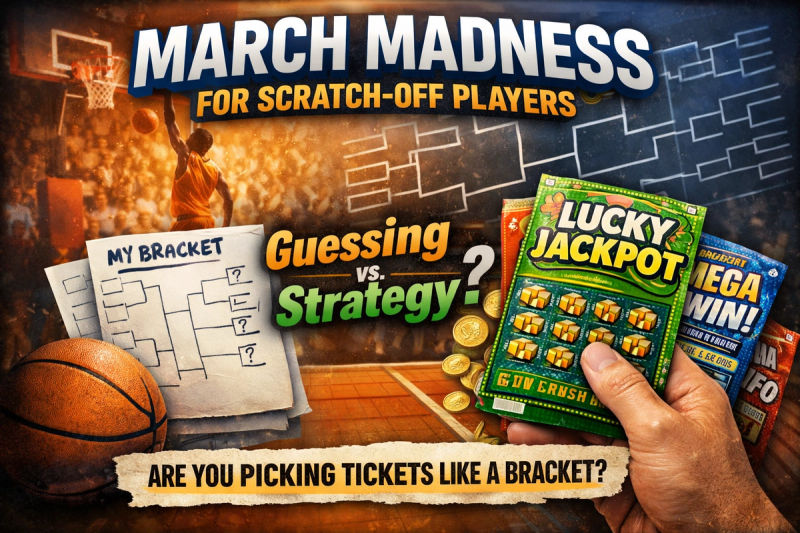
March Madness for Scratch-Off Players: Stop Picking Tickets Like a Bracket
3/14/2026
By Doug Moeller | Professional Gambler & Founder of Savvy Scratch
March Madness is one of the only times of year when millions of people proudly guess with confidence. They study mascots, jersey colors, social media hype, and whatever "gut feeling" hits them in the moment, then fill out a bracket like they have some kind of edge. And most of them are completely wrong by the second round.
Most scratch-off players do the exact same thing every single time they walk into a convenience store. They stare at a wall of tickets, grab whatever catches their eye, and convince themselves they made a smart choice. The design looked good. The name sounded lucky. The cashier said it was "hot." Their cousin won on that game once. That is not a scratch-off strategy. That is bracket behavior. And if you are spending real money on scratch-offs every week or every month, bracket behavior is costing you.
I spent over fifteen years as a professional gambler, and one of the hardest lessons I ever learned came early at the poker table. I used to sit down at whatever game had an open seat. Didn't matter who was at the table, didn't matter what the stakes were relative to my bankroll, didn't matter whether the game was good or bad. I just wanted to play. It took me a long time and a lot of lost money to realize that game selection was the single most important decision I made all night. Not which hands to play. Not how to size my bets. The decision that mattered most happened before I ever sat down. Which game was I choosing to be in? That same principle applies to scratch-offs more than most people realize.
The Way Most People Pick Tickets Is the Same Way They Pick Upsets
Think about how a casual basketball fan fills out a bracket. They pick teams based on name recognition, recent headlines, the color of the uniforms, and how confident they feel in the moment. Maybe they heard someone on TV say a 12-seed is "due" for an upset. Maybe they pick their alma mater to go further than any rational person would predict. Maybe they just like the sound of a team name. None of that has anything to do with which team is actually better.
Now think about how most people pick scratch-off tickets. They walk up to the counter and scan the display. They see a game with a flashy design, a game with a big number on it, or a game they recognize from last time. Maybe the cashier says someone just won on that one. Maybe they always buy the same game out of habit. Maybe they just grab whatever is closest to eye level because three people are waiting behind them.
The result is the same in both cases. The person feels like they made a choice, but the choice was not based on anything that actually matters. In a bracket, what matters is which teams match up well, which players are healthy, and which statistical edges exist in particular rounds. In scratch-offs, what matters is whether the game still has prizes worth chasing, how far the game has been sold through, and whether the odds have shifted in a meaningful direction since the game launched.
Everything else is noise. And most players are drowning in it.
Why Scratch-Offs Are Not Like Powerball
Here is something most people miss entirely. Powerball, Mega Millions, and every other drawing game have fixed odds. Every drawing is independent. It does not matter how many people bought tickets last week or which numbers hit last month. The odds reset every single time.
Scratch-offs do not work that way. Scratch-offs are what gamblers call a dependent game. Every ticket that gets sold changes the odds for every ticket that remains. When someone claims a top prize, the odds of hitting that prize on the remaining tickets drop to zero for that specific prize. When thousands of losing tickets get purchased and scratched, the ratio of winners to losers among the remaining tickets shifts. Sometimes it shifts in your favor. Sometimes it shifts against you. Sometimes a game that looked terrible at launch becomes interesting three months later because the right combination of prizes has been claimed and tickets have been sold. Sometimes a game that looked great at launch becomes a waste of money because all the top prizes disappeared in the first few weeks.
This is the exact same principle behind counting cards in blackjack. When I was learning to count, the whole concept felt almost too simple. You are not predicting the future. You are not using magic. You are just tracking what has already happened, which cards have already been dealt, and using that information to know whether the remaining deck favors the player or the house. When the deck is rich in high cards, you bet more. When it is not, you pull back. Scratch-offs work on the same principle. You are not trying to predict which ticket is a winner. You are trying to figure out which games still have enough prize value left to be worth your money. That is a fundamentally different question than "which ticket looks lucky," and it is the question that actually matters.
What Bracket Behavior Looks Like at the Counter
Picture the scene. You are standing at the register of your local gas station. There are maybe forty, fifty, sometimes eighty different scratch-off games behind the counter or in the display case. The cashier is waiting. There might be a line behind you. You have about fifteen seconds to make a decision, and you have zero information in front of you that tells you anything useful about which of those games deserves your money right now.
So you do what everyone does. You default to instinct. You pick the one with the cool design. You pick the one you bought last time. You pick the one the cashier recommends. You pick the one with the biggest number printed on the front because bigger must mean better, right? You hand over your cash, scratch the ticket in the parking lot, and move on with your day.
Now picture a different version of the same scene. Before you ever walked into the store, you already checked which games in your state have been flagged as depleted, meaning the top prizes are gone and the game is coasting on small winners until it gets pulled. You already know which games are new and still have their full prize structure intact. You already know which games have seen their odds improve because of how many tickets have been sold versus how many prizes have been claimed. You walk in, you know exactly what you want, and you are not making a decision under pressure. You are executing a plan.
That is the difference between filling out a bracket and analyzing the data before you spend a dollar. One approach feels like gambling. The other feels like making an informed decision. Both involve risk, but only one gives you a genuine edge in how you allocate your money.
Savvy Scratch tracks every active scratch-off game across 17 states and shows you which games are worth your attention right now, not last month. For $5/month or $50/year, you can stop guessing and start making decisions based on real data. Every subscription comes with a 30-day worry-free guarantee.
The Questions You Should Be Asking (And the Ones You Should Stop Asking)
Most players approach the counter asking the wrong questions. "Which ticket should I buy?" "Which one is hot right now?" "Which one paid out last week?" "Which one feels lucky?" These are bracket questions. They are based on feeling, not information, and they will not help you.
The questions that actually matter sound different. Has this game had its top prizes claimed already? Is this game new enough that the full prize structure is still intact? How far has this game been sold through relative to how many prizes remain? Am I making this decision because I checked the data, or because I am standing at the counter feeling rushed and just want to pick something?
That last question is the one nobody asks, and it might be the most important one. The convenience store counter is designed to make you buy on impulse. The bright colors, the big prize numbers printed on the tickets, the sheer volume of options, all of it pushes you toward a fast, emotional decision. And fast emotional decisions are how you end up buying tickets for a game that has been mathematically dead for weeks. This is one of the psychological traps built into the scratch-off experience, and the only way to beat it is to have your homework done before you walk through the door.
The Sharp Player's Mindset
In every form of gambling where an edge exists, the edge comes from selectivity. Poker players choose which tables to sit at and which hands to play. Blackjack counters choose which shoes to bet heavy on and which ones to sit out. Sports bettors choose which games have mispriced lines and ignore the rest. The common thread is restraint. The professionals are not playing more. They are playing less, but playing better.
Scratch-off players should think the same way. You are not trying to find a magic ticket. You are trying to avoid spending money on games that are already working against you and redirect that money toward games where the math is at least neutral or slightly in your favor. Nobody can guarantee a win on any individual ticket. But you can guarantee that you are not throwing money at a game where the biggest prizes are already gone and the odds have deteriorated past the point of being interesting.
This is not about taking the fun out of scratch-offs. It is about respecting your own money enough to spend five minutes checking the data before you spend fifty dollars at the counter. The scratch is still the scratch. The excitement of peeling back that silver coating does not change. What changes is whether you walked in blind or walked in with a plan.
Stop buying scratch-offs like you are filling out a bracket. Savvy Scratch gives you real-time data on every active game in your state so you know which tickets still have prize value and which ones are already dead. $5/month or $50/year with a 30-day worry-free guarantee. See your state's games now at savvyscratch.com.
March Madness Ends. Your Scratch-Off Spending Does Not.
Here is the thing about brackets. They are disposable. You fill one out in March, it busts by the second weekend, and you move on. Nobody loses sleep over a busted bracket because the stakes were never real to begin with. Your scratch-off budget is different. That is real money leaving your pocket every week, every month, all year long. And if you are spending that money the same way you fill out a bracket, purely on instinct, recognition, habit, and gut feeling, you are leaving yourself exposed to the same kinds of bad outcomes over and over again.
The crowd fills out brackets. Sharp players look for edges. The crowd walks up to the counter and grabs whatever. Sharp players check the data first. The crowd plays the same game every week without ever looking at whether the prizes have changed. Sharp players adapt based on what the numbers are actually telling them.
You do not need to be a professional gambler to think this way. You just need to be willing to spend a few minutes checking the information that is already available to you instead of relying on instinct at the counter. The information exists. The data is real. The only question is whether you are going to use it or keep picking tickets the same way you pick upsets in your office pool.
Most people are going to keep guessing. That is fine. But you do not have to be most people.
Savvy Scratch covers Arizona, California, Florida, Illinois, Louisiana, Massachusetts, Maryland, Michigan, Missouri, North Carolina, New York, Ohio, Oklahoma, Oregon, Texas, Virginia, and Washington. For $5/month or $50/year, you get real-time scratch-off data, game evaluations, and the information you need to make smarter decisions before you buy. 30-day worry-free guarantee. Start now at savvyscratch.com.
About the Author: Doug Moeller is a professional gambler with over 15 years of experience in poker, blackjack card counting, and casino advantage play, with over $500K in lifetime winnings. He built Savvy Scratch to bring the same data-driven approach that works at casino tables to scratch-off lottery tickets. Follow Doug on X | YouTube