The Biggest Lie in Scratch-Offs (And Why It's Completely Legal)
4/27/2026
By Doug Moeller | Professional Gambler & Founder of Savvy Scratch
Walk into any gas station in America and look at the scratch-off display. You will see giant numbers. Win $1,000,000. Top Prize $5 Million. Ten prizes remaining. The artwork is loud, the colors are vivid, and the ticket in your hand looks identical to the one that was hanging there on launch day.
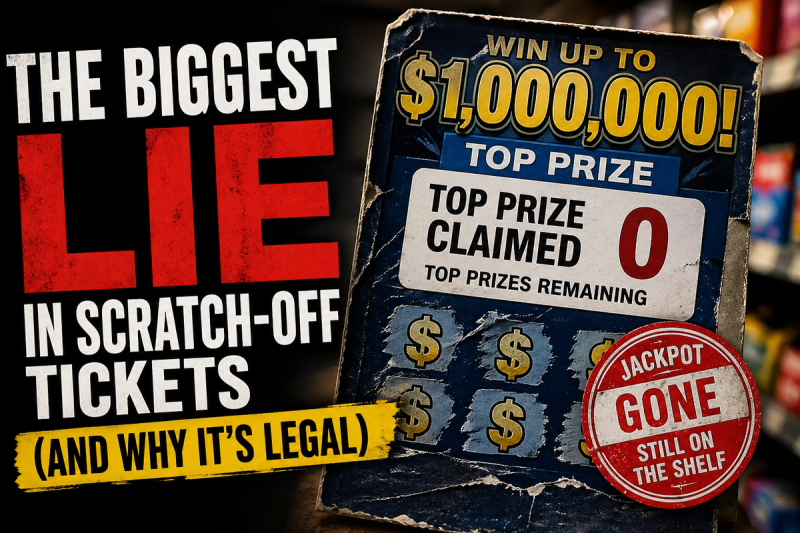
Here is what the rack does not tell you. The jackpot you are buying that ticket for might already be gone. Not "running low." Gone. Claimed weeks ago. Cashed out. The state knows it. The clerk does not. You definitely do not. And the game stays right there on the shelf at full price.
That is the biggest lie in scratch-off tickets. The reason it is the biggest lie is that it is technically not a lie at all. Nobody is breaking the law. Nobody is misrepresenting the product on the back of the ticket, where the launch-day odds were calculated and printed once and never touched again. The information you would need to know the truth is sitting on a state lottery website right now. The lottery just bets, correctly, that you will not look.
I have spent more than fifteen years making money in games of chance, mostly poker and blackjack card counting, with over $500,000 in lifetime winnings. The reason I built Savvy Scratch is that scratch-offs are the only retail gambling product I have ever seen where the gap between what is advertised on the front of the product and what is actually inside the product is this wide, this consistent, and this completely legal.
Let me show you exactly how the lie works, why nobody is technically breaking the rules, and how to stop being on the wrong side of it.
Why a Scratch-Off Is a Closed Shoe, Not a Slot Machine
Most lottery players assume scratch-offs work like Powerball. Pick numbers, cross your fingers, see what happens, repeat next week with the same odds. That is wrong, and the misunderstanding is the entire reason the lie keeps working.
A scratch-off game is a closed printing run. A fixed number of tickets, say five million. A fixed number of prizes, locked in at the print plant and shipped to retailers. From the moment that game launches, every prize that gets claimed is one less prize the rest of the unsold tickets can win. The losing tickets keep coming out of the pack at the same rate. The winning tickets do not get replaced.
If you have ever sat at a six-deck blackjack table while the dealer worked through the shoe, you already understand this. When most of the small cards have been dealt and the deck is rich in tens and aces, the next hand is a fundamentally different bet than the first hand off a fresh shuffle. Same rules. Same table. Different game, because the composition of what is left has changed. Card counters get paid because they know which side of that shift they are sitting on. The casino lets the math sit there in plain sight because almost nobody bothers to track it.
Scratch-offs are mechanically the same thing. The rules of the ticket do not change. The game underneath the rules absolutely does. When the top prizes get pulled out of the unsold inventory, what is left is a worse version of the game you thought you were buying. The Don Clemente artwork still looks like a fiesta. The flashy "Win $5,000,000" still glares out from the front. The current odds of actually hitting that five million dollar prize might be zero. I covered the math behind this drift in detail in The Truth About Lottery Odds, but the short version is that printed odds are launch-day odds. They never update.
How a Live Game Becomes a Dead Game While You Are Not Looking
Imagine a generic ten-million-ticket game with four jackpots advertised on the front. Day one, your odds at the top prize are one in 2.5 million. The math on the back of the ticket is honest. The math you would calculate yourself, if you bothered, would match.
Fast forward six months. Two of the four jackpots have been claimed. Six million tickets have been sold. The remaining inventory now holds two jackpots inside roughly four million unsold tickets. Your real odds at the top prize, right now, walking into the store today, are one in two million. That happens to be a meaningful improvement over the launch number. Nobody at the counter is going to tell you that either.
Now run the scenario the other direction. All four jackpots have been claimed in those first six million tickets. Same ticket. Same price. Same display case. Your odds of hitting the advertised top prize are now one in infinity, because the prize you are paying to chase no longer exists. The state will keep selling that game until the print run is gone, because every losing ticket pulled out of the dispenser is still revenue.
That second version of the game is what I call a dead game. The marketing photo is the same. The price is the same. The fantasy is the same. The actual product behind the artwork is a husk of the game that was advertised. Players walk past dead games and pay full price for them every single day, because they are buying off the front of the ticket instead of the data behind it. I broke down the full set of habits that lead to this in The Hidden Mistakes Most Lottery Players Don't Even Realize They're Making, and the dead-game problem is right at the top of that list for a reason.
Why This Is Legal When It Should Not Feel Legal
Here is the part that drives most players crazy when they first understand it. The lottery commission has done nothing wrong. They have published the prize remaining data on their public website. They have printed the launch-day odds on the back of the ticket exactly the way they were calculated. They have included generic disclaimers about prizes being subject to availability. They have technically given you the truth.
What they have not done, and what they will never do, is put a sticker on the dispenser at your gas station that says, "Top prize claimed, this game is now a refund machine." That sticker would crater their revenue overnight. Their job, from their point of view, is to sell tickets. Helping you avoid the bad ones is not on their list.
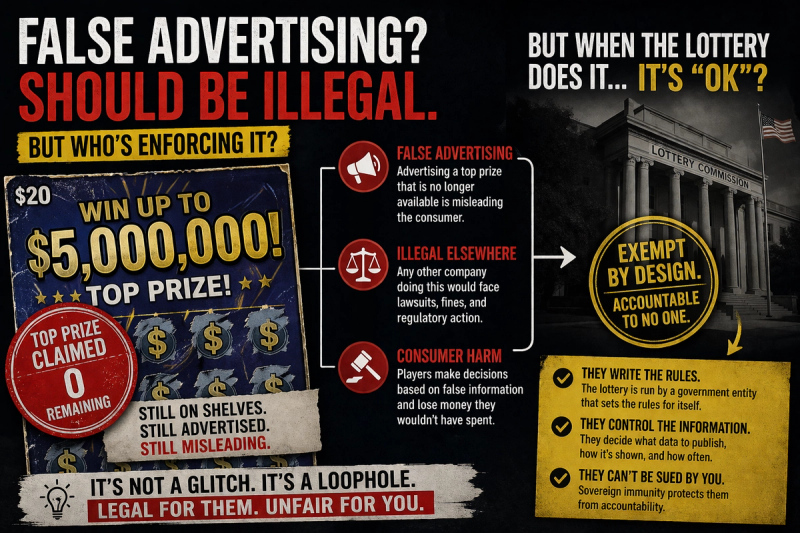
So you end up with a beautiful textbook case of information asymmetry. One side of the transaction has perfect information. The other side has a flashy photo and a slogan. In poker, when one player at the table has access to information the rest do not, that player owns the table. The pros call that an information edge, and it is the single most valuable thing you can have in any game. A pro counts down to the river card knowing what is in the muck, what folded preflop, and what the opponents are likely holding based on betting patterns. The recreational player at the same table is just looking at his own cards. Same hand. Wildly different bet. Over enough hands, the player with information takes the player without it apart.
Scratch-offs are an information asymmetry game played at the gas station counter. The state has the data. Most players have a hunch about which one looks lucky. That gap is where the money lives.
Stop Buying Off the Front of the Ticket
The fix is simple to describe and weirdly hard to do. Stop making your buying decision off the front of the ticket. The front is marketing. The artwork is designed by people whose job it is to make every game look exciting whether it has any prizes left or not. The headline number is the launch-day prize structure, frozen in time the day the game went to press. None of that tells you what is in the unsold pack on the dispenser in front of you.
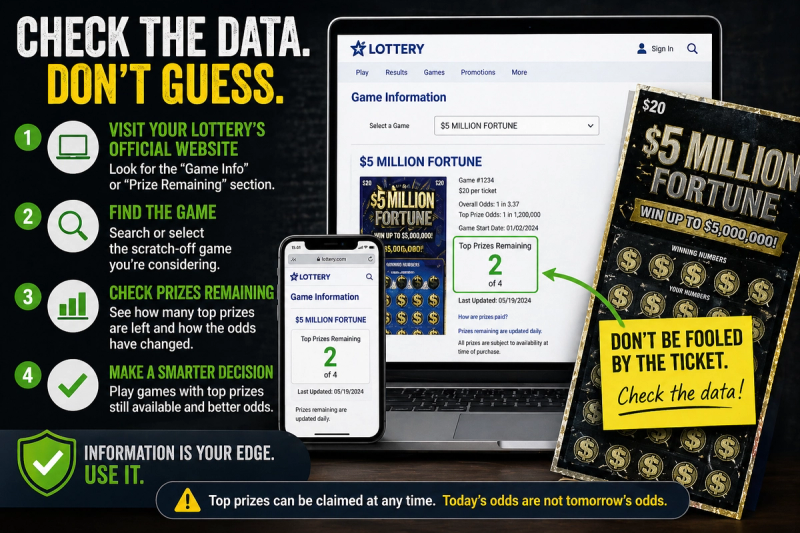
What does tell you is the prize remaining data. How many of the top prizes were originally printed. How many have already been claimed. How many tickets are still left to be sold. Compare those three numbers and you can immediately tell whether the game is live, drifting, or dead. I walked through the exact framework I use to read those numbers in Best Scratch-Off Tickets: What Data Tells You About Your Odds. The work is not hard once you know what you are looking at. It is just buried in PDFs and tables that nobody is going to read in line at the gas station.
That, frankly, is why I built the app. The data was already public. It was just impossible to use in the moment when you needed it most.
Stop buying tickets blind. Savvy Scratch pulls live prize-remaining data from your state lottery and ranks every active scratch-off as Good, Neutral, or Bad based on what is actually still in the pack. Free tier shows you Bad and New games. Good and Neutral tabs are $5/month or $50/year, with a 30-day worry-free guarantee. Get started at savvyscratch.com →
The Player Side of the Same Lie
The lottery's part of this is the part most people get angry about, because it is easier to be angry at a faceless commission than at the guy in the mirror. But there is a player-side version of the lie that costs regular scratch-off buyers just as much money, and it is worth being honest about.
The player-side lie is the story we tell ourselves when we walk past the rack. The bright artwork looks like opportunity. The headline number looks like possibility. The familiar game we played last month looks like an old friend that owes us a win. None of those feelings are facts. They are stories the brain runs to justify the ticket already half pulled out of the pocket.
The job of the data is to interrupt that story before the wallet opens. Not to kill the fun. Not to talk anyone out of playing. Just to make sure the game in your head matches the game in the dispenser before you hand over the cash. If the top prizes are still in there, play with confidence. If they are gone, walk past the dispenser and find a different game, or come back another day. The discipline of walking past a dead game is the cheapest edge in this entire hobby, and it is available to anyone willing to spend ten seconds checking before they buy. I covered the broader version of that discipline in Card Counting for Lottery? Here's How It Actually Works for Scratch-Offs.
What "Information Asymmetry" Actually Costs the Average Player
The reason this matters at the dollar level, not just at the principle level, is volume. A regular scratch-off player who buys two or three tickets a week is making more than a hundred buying decisions a year. If even a quarter of those decisions are landing on dead games, that is twenty-five-plus tickets in a year where the player paid full price for a product whose advertised top prize did not exist anymore.
That is real money on its own. Worse, a dead game does not hand you a refund ticket as a courtesy. The bottom-tier consolation prizes still pay out. The game still drips two and five dollar wins back at you, just often enough to keep the wallet open. So the player walks out of the store thinking they kind of broke even, while the math on the unsold pack guarantees that the meaningful prizes they were actually playing for are no longer in the building. If you want to see the exact math on how those small wins mask a losing position, How to Use an Odds Calculator to Pick Better Scratch-Offs walks through the calculation step by step.
The cumulative effect is the slow drip that quietly empties recreational bankrolls every year, and it is the part of the scratch-off business model that nobody is required to disclose at the counter.
The Honest Version of the Pitch
I am not telling you that scratch-offs become a winning game once you know which ones are dead. They do not. The state takes its cut and the long-run math is still negative no matter what you do. What changes is which side of the information asymmetry you are sitting on while you play.
Pros do not win every hand. Card counters do not win every shoe. The advantage is not certainty. The advantage is selection. Better games. More often. Avoiding the spots where you are paying full price for a product that has been gutted. That is the entire game, and it is the part the front of the ticket is specifically designed to keep you from thinking about.
The lie on the rack is technically not a lie. It is a published prize structure plus a generic availability disclaimer plus a hope that you do not look. You are the variable in that equation. You are also the only one who can stop being it.
Ready to see which games in your state are dead and which ones still have their top prizes intact? Pick your state on Savvy Scratch and look at the Good tab. The Bad and New tabs are free forever. Good and Neutral games are $5/month or $50/year with a 30-day worry-free guarantee. Open Savvy Scratch →
About the Author
Doug Moeller is a professional gambler with over fifteen years of experience in poker, blackjack card counting, and casino advantage play, with over $500K in lifetime winnings. He built Savvy Scratch to bring the same data-driven approach that works at casino tables to scratch-off lottery tickets. The app currently covers nineteen states and is the only scratch-off odds tool built by someone who has made a living beating games of chance. Follow Doug on X.
Stop paying full price for dead games. Savvy Scratch tracks every active scratch-off in your state and tells you which ones still have their top prizes inside the pack. $5/month or $50/year, 30-day worry-free guarantee. Get started at savvyscratch.com →