
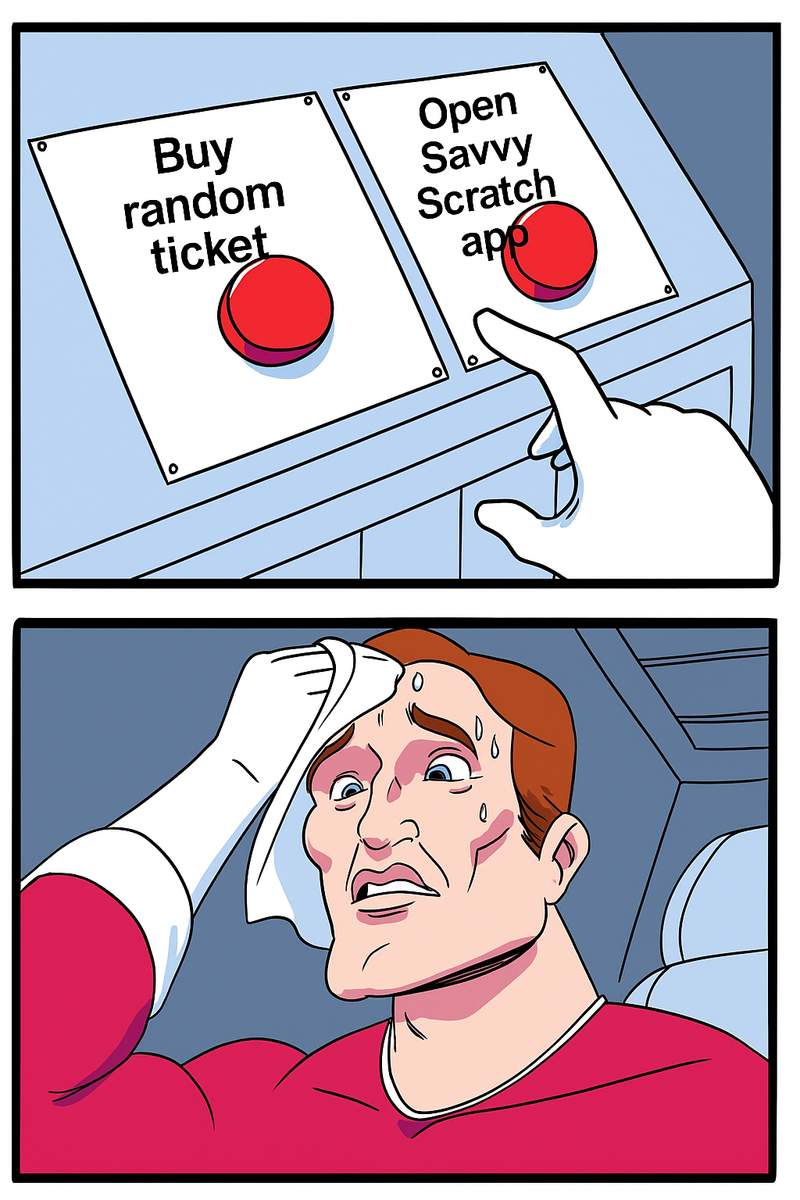
Lottery Strategies That Actually Work (and Which Don’t)
7/7/2025
By Doug Moeller | Professional Gambler & Founder of Savvy Scratch
Type “how to win the lottery” into Google and you’ll find the same junk over and over.
Lucky numbers. Lucky stores. Buy ten in a row. Play at 7:11 p.m. on a Tuesday. Ask the cashier what’s hot.
Most of it is superstition dressed up like strategy.
But here’s the part people miss: there are real lottery strategies, especially for scratch-offs. They’re just not the fun, magical kind people want to believe in. They’re the boring kind. The math kind. The data kind.
I’ve spent over 15 years in professional gambling, from poker to blackjack card counting to casino advantage play, and I’ve won over half a million dollars doing it. The reason was never luck. It was always the same thing: stop guessing, stop listening to stories, and start paying attention to what the numbers are actually saying.
That same mindset applies here.
If you want to sign up free, see the bad games and new games in your state, and stop buying blind, try Savvy Scratch free here.
The Strategies That Don’t Work
Let’s clear out the garbage first.
Because most lottery players are not losing to some sophisticated house edge. They’re losing to nonsense they picked up from other players.
Hot numbers and lucky numbers
For scratch-offs, this means absolutely nothing.
There is no live number selection happening when you scratch the ticket. The outcome is already baked into the ticket before it ever gets to the store. So your birthday, your anniversary, your dog’s age, or the number you keep seeing on license plates does exactly nothing for you.
That whole mindset is just another version of the same fantasy I wrote about in 13 Lottery Myths That Are Draining Your Wallet (And What to Do Instead).
Lucky stores
This one never dies.
People see a sign that says “Winning Ticket Sold Here” and suddenly decide the building itself has magic powers.
It doesn’t.
Stores have volume. That’s it. A busy store sells more tickets, which means it will eventually sell more winning tickets too. That does not make your next ticket from that store any better.
That’s why The Myth of the “Lucky Store” — Why Location Doesn’t Change Your Odds is such an important companion piece to this article.
Buy a bunch in a row
Buying ten tickets in a row does not magically improve the quality of the game you’re buying into.
It just increases your exposure to whatever that game already is.
If the game still has healthy top prizes left and decent current conditions, fine. If the game is depleted, dead, or just weak relative to the other options on the wall, then all you did was burn through money faster.
Volume without selectivity is not strategy. It’s just faster losing.
It’s due
This is one of the most expensive thoughts in gambling.
A game is not due. A roll is not due. A scratcher that “hasn’t hit in a while” is not building toward some cosmic payoff.
That is not how this works.
This is the same mental leak that kills people in casinos too. They confuse randomness with obligation. But the ticket does not owe you anything, and the game does not self-correct because you feel like it should.
If you want the short version, due is not a system. Due is a story people tell themselves while they keep spending.
The Strategies That Actually Work
Now for the part that matters.
The strategies that actually work are not glamorous. They are just grounded in information that most players never bother to use.
1. Check the remaining prizes
This is the biggest one.
Every state lottery publishes some form of prize-remaining data. Most players never look at it. That’s crazy to me.
Because if a game launched with four top prizes and all four are gone, there is no reason to buy it for jackpot purposes. None.
That’s why Why Top Prizes Are the Only Thing That Actually Matters in Scratch-Offs belongs naturally here. The giant number on the front of the ticket means nothing if the prize is already gone.
This is the single easiest way to avoid making dumb ticket choices.
2. Compare current odds, not launch-day odds
The printed odds on the ticket are launch-day odds.
They are not telling you what the game looks like now.
That matters because scratch-off conditions change over time. Tickets sell. Prizes get claimed. Some games improve. Some collapse.
If enough tickets have sold and enough top prizes are still alive, the game can become meaningfully stronger than it was when it launched. If the jackpots got hit early, the opposite happens.
That’s why How to Use an Odds Calculator to Pick Better Scratch-Offs and Lottery Data: How to Use Numbers to Spot Winning Tickets are both strong next reads from this section.
This is where real scratch-off strategy actually starts.
3. Avoid dead games completely
This is really an extension of the first point, but it deserves its own section because it matters that much.
A dead game is a game where the main top-end value is already gone.
Players still buy these every day because the ticket still looks alive. The design is still there. The big prize is still printed across the front. The ticket still feels like it offers the same dream.
It doesn’t.
And the average player has no idea.
That is why the player who checks the data before buying is playing a different game than the player who buys off the wall.
4. Use prize density, not just jackpot count
A lot of people make the mistake of only looking at how many top prizes remain.
That’s not enough by itself.
You also need to care about how much of the ticket pool is still out there. A game with fewer jackpots can still be the better buy if there are far fewer tickets left in circulation. A game with more jackpots can still be weak if there are too many tickets left to chew through.
That’s where the real comparison work starts.
And if you want the fuller version of how to evaluate all of that in one place, The Complete Guide to Lottery Analysis: How a Lotto Ticket Analyzer Can Transform Your Scratch-Off Strategy is the natural link here.
5. Timing matters
This is one of the few real edges in scratch-offs.
A game can get stronger over time if the right things happen underneath the surface. The average player never notices because they think of the ticket as fixed.
It isn’t fixed.
That’s why timing matters so much. And it’s why the same ticket can be a mediocre buy one month and a much stronger buy later.
The player who understands that is way ahead of the player who just buys whatever is new.
How To Apply This Yourself
You can absolutely do this by hand.
Go to your state lottery site. Pull up the scratch-off prize reports. Compare games at the same price point. Check how many top prizes launched versus how many are left. Estimate how much of the game has sold if the state gives you enough information to do it. Then compare the games and pick the one with the strongest current condition.
That works.
The problem is that most people are not going to do that consistently.
It’s tedious. It takes time. And the data moves.
That’s the whole reason Savvy Scratch exists.
Instead of digging through lottery pages yourself, you can sign up free, immediately see the bad games and new games, and get a much cleaner view of what is actually worth your attention right now.
That’s the real value.
Not luck. Not hype. Just cleaner decisions.
One Overlooked Strategy: Second chance entries
Most players treat a losing ticket like it’s dead the second the main game is over.
Sometimes that’s wrong.
A lot of games have second chance drawings attached to them, and most players either forget, don’t know, or don’t bother entering. That means they are literally throwing away extra value tied to a ticket they already bought.
That’s why Second Chance Lotteries: The Extra Play Most People Ignore fits so naturally into this article.
It does not make a bad game good. It does not rescue bad bankroll habits. But if you were already going to buy the ticket, and the loser still has bonus value attached to it, there is no good reason to leave that value behind.
What all of this still does not do
This part matters.
None of these strategies turn scratch-offs into a guaranteed winning game.
They do not beat the house in the pure sense.
They do not mean you will win every time.
What they do is help you avoid the dumbest buys, make cleaner decisions, and put your money into better situations than the average player is choosing.
That is still a big deal.
And it’s also why discipline matters as much as data. If you want the budget side of this, Treat Your Lottery Budget Like Entertainment — Not an Investment and Scratch-Off Bankroll Management: The Tournament Pro’s Guide to Surviving Variance are the right companion pieces.
Because better information is only useful if you still know how to control yourself around it.
The real difference
Most lottery players buy based on color, instinct, superstition, or whatever the cashier says.
Smart players check the game condition first.
That’s the whole divide.
One player is buying a fantasy. The other is at least checking whether the fantasy still exists.
If you want to be in the second group, Savvy Scratch is free to try. You can sign up free, see the bad games and new games, and start narrowing down which scratch-offs in your state are actually worth a closer look before your next stop.
About the Author: Doug Moeller is a professional gambler with over 15 years of experience in poker, blackjack card counting, and casino advantage play, with over $500K in lifetime winnings. He built Savvy Scratch to bring the same data-driven approach that works at casino tables to scratch-off lottery tickets. Follow Doug on X | YouTube