Savvy Scratch Is Now Live in Maryland
3/4/2026
By Doug Moeller | Professional Gambler & Founder of Savvy Scratch
A $5 million top prize sounds great until you find out all three have already been claimed.
That ticket is still sitting on the shelf at your gas station right now, printed up with big numbers and bold colors, doing exactly what it was designed to do: get you to point at it. Maryland has dozens of scratch-off games running at any given time, and the lottery commission has zero incentive to tell you which ones are past their prime. That's your job. And until today, doing that job meant digging through the Maryland Lottery website, comparing prize tables by hand, and hoping you didn't miss anything.
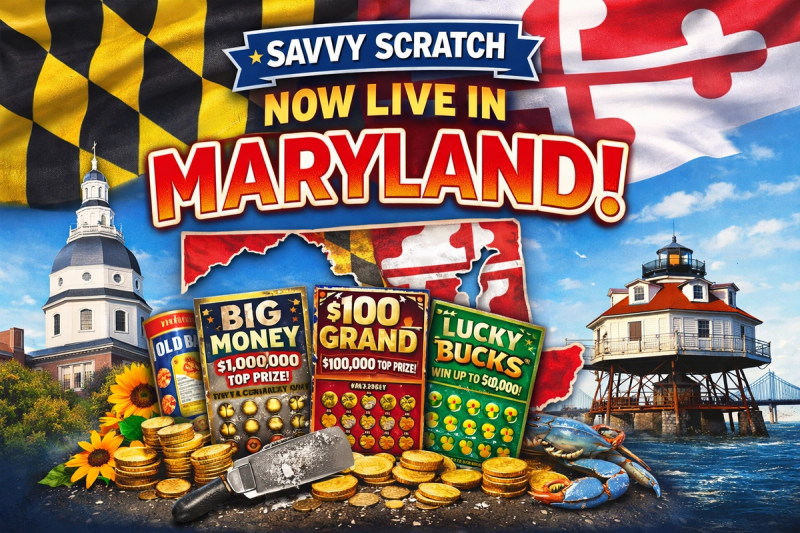
Savvy Scratch is now live in Maryland (MD), and it does all of that in seconds.
I built this tool from the same mindset that made me over half a million dollars as a professional gambler across poker, blackjack card counting, and casino advantage play. The principle is simple: never play a game blind when data is available. Scratch-offs have data. Most players just ignore it.
Savvy Scratch is $5/month or $50/year, with a 30-day money-back guarantee. If it doesn't change the way you buy tickets, you get your money back. See pricing here.
The problem: Maryland scratch-off players are forced to guess
Walk into any Maryland convenience store and look at the scratch-off display. You'll see a wall of tickets competing for your attention, every one of them screaming about a top prize. But standing at that counter, you have no idea which games still have their jackpots available, which ones are deep into their sales cycle with most of the good prizes already gone, or which games at your price point give you the best remaining shot at something meaningful.
So you guess. You grab the one that looks good, or the one the cashier recommends (they don't know either, by the way). And the lottery gets paid whether you made a smart pick or a terrible one. This is exactly how most people waste money on scratch-offs, and it's the problem Savvy Scratch was built to solve.
Scratch-offs are dependent games (and that changes everything)
Here's the concept that separates informed players from everyone else.
A scratch-off game is not the same on Day 1 as it is on Day 200. Unlike Powerball, where odds stay fixed draw after draw, scratch-off odds shift constantly. Every time someone buys a losing ticket, every remaining ticket gets marginally better. Every time someone claims a jackpot, every remaining ticket loses upside.
This is what gamblers call a "dependent" game. The quality of what's left depends on what's already been removed. If you've ever heard of card counting in blackjack, the logic is identical: when high cards leave the deck, the remaining deck changes. When top prizes leave a scratch-off game, the remaining tickets change too.
The printed odds on the ticket? Those are Day 1 numbers. They tell you what the game looked like at launch, not what it looks like today. The only question that actually matters is: what's left right now?
That's what Savvy Scratch tracks for every active game in Maryland.
Why "WIN UP TO $1,000,000" can be a trap
That headline on the front of the ticket is marketing. It's the lottery's version of a car dealership putting the red convertible in the showroom window. The number grabs your attention, but it tells you nothing about whether that prize is still available.
A game can be sitting on shelves across Maryland with a $1,000,000 top prize plastered across the front while every single million-dollar prize has already been claimed. The ticket doesn't change. The display doesn't change. The only thing that changes is your actual shot at winning, and it went from slim to zero without anyone telling you.
This is the marketing trick scratch-offs use, and it works because most players never check the data. Professional gamblers call these "dead games." I've spent 20+ years learning to spot dead situations across poker tables and blackjack pits, and the skill translates directly: you avoid the games where the upside has already walked out the door.
What Savvy Scratch does for Maryland players
Think of Savvy Scratch as three tools in one. It's a scratch-off odds calculator that shows you how jackpot odds have shifted since launch day. It's a lottery tracker that follows each game's prize status as tickets sell and prizes get claimed. And it's a scratch-off app built around one idea: help you avoid bad games and find the ones where your money has the best remaining shot.
For Maryland, that means you can quickly see which games still have top prizes available, how the current odds compare to the original odds, which games look strong relative to other options at the same price point, and which games are past their prime. This isn't about guaranteeing wins. Nobody can do that. This is about making higher-quality decisions with real data instead of pointing at a display case and hoping for the best.
What "good" and "bad" actually mean
When Savvy Scratch labels a game "Good" or "Bad," it's not predicting winners. It's evaluating the current state of the game's prize pool.
A "Good" game typically still has meaningful top prize availability relative to where it is in its sales cycle. The upside you're paying for is still actually in the game. A "Bad" game is one where the top prizes are mostly or entirely gone. The ticket is still advertising a massive prize, but the math says that prize probably isn't there anymore.
You can still win on any scratch-off at any time. Small prizes exist across every game. But if you're playing scratch-offs for the shot at something that actually changes your week, your month, or your year, then the distinction between a game that still has jackpots and one that doesn't is the whole ballgame. Smart players don't ask "Can I win?" They ask "Is this a good spot to put my money?" That distinction is exactly how professional gamblers think, and it's the same logic behind every decision Savvy Scratch helps you make.
Ready to see Maryland's scratch-off data for yourself? Start your subscription for $5/month and walk into the store with a plan instead of a prayer. 30-day money-back guarantee, no questions asked.
How to use Savvy Scratch in real life (Maryland edition)
Here's the actual workflow, and it takes about two minutes before you walk into the store.
Decide your price point first. Most people do it backwards. They pick the ticket, then justify the price. Instead, set your budget and your ticket price range before you look at anything. A $5 player comparing $5 games is making an informed decision. A player bouncing between $2 and $30 based on what catches their eye is gambling on top of their gambling.
Open Maryland inside Savvy Scratch. Pull up the game list for your price range and start with top prizes. That's the most honest data point in the entire system. If the top prizes are gone, the ticket's headline is basically an expired coupon.
Compare what's actually left, not what the ticket claims. Look for games where the jackpot situation is still real. Skip games where the top prizes look depleted or the game appears deep into its run. This is the same approach I used when choosing which poker tables to sit at: you scan the conditions, find the best available spot, and sit down with a plan.
Walk into the store already knowing your pick. This is the edge. You stop staring at the display like it's a slot machine. You already know which game has the best remaining conditions. You buy your ticket and you're done. No guesswork, no impulse buys, no letting the cashier choose for you.
Why this matters even if you only play sometimes
A lot of people say "it's only a few bucks." Fair enough. But scratch-offs add up over a year, and the worst part isn't the money. It's the habit of making blind bets when you could be making informed ones.
If you play once a week, you're spending somewhere between $260 and $1,560 a year depending on your price point. That's real money. And the difference between spending it on games with actual upside versus games that are running on marketing fumes is the difference between playing with intention and just donating to the state.
Even casual players benefit from one simple thing: avoiding games that are obviously past their prime. You wouldn't sit down at a poker table where someone told you all the aces were already dealt. Same principle applies here.
Built by someone who actually beats games for a living
Most lottery tools are built by software developers or marketing companies. Savvy Scratch is built by someone who has spent 20+ years finding mathematical edges in games of chance and turning those edges into real money.
Card counting taught me that dependent games, games where the odds change based on what's already happened, reward the players who track the data and punish the ones who don't. Poker taught me that the best decision isn't always the flashiest one; sometimes the smartest move is walking away from a bad situation entirely. Both of those lessons live inside Savvy Scratch.
Scratch-offs aren't beatable the way blackjack is. The house edge is baked in, and no tool changes that. But they are trackable. And tracking the data changes your behavior. You stop playing blind. You start avoiding dead games. You start putting your money into better situations more often.
That's the entire point.
Maryland scratch-off odds start here
Savvy Scratch is live in Maryland right now, joining our coverage across 17 states including Arizona, Ohio, North Carolina, and more.
If you play Maryland scratch-offs, you now have a choice: keep guessing at the counter, or spend $5/month to see what's actually going on inside every game. That's less than the cost of a single scratch-off ticket, and it covers every active game in your state, updated with real prize data.
30-day Worry free guarantee.
Responsible play note: Only play what you can afford to lose. If the fun stops, stop.
About the Author: Doug Moeller is a professional gambler with over 15 years of experience in poker, blackjack card counting, and casino advantage play, with over $500K in lifetime winnings. He built Savvy Scratch to bring the same data-driven approach that works at casino tables to scratch-off lottery tickets. Follow Doug on X | YouTube