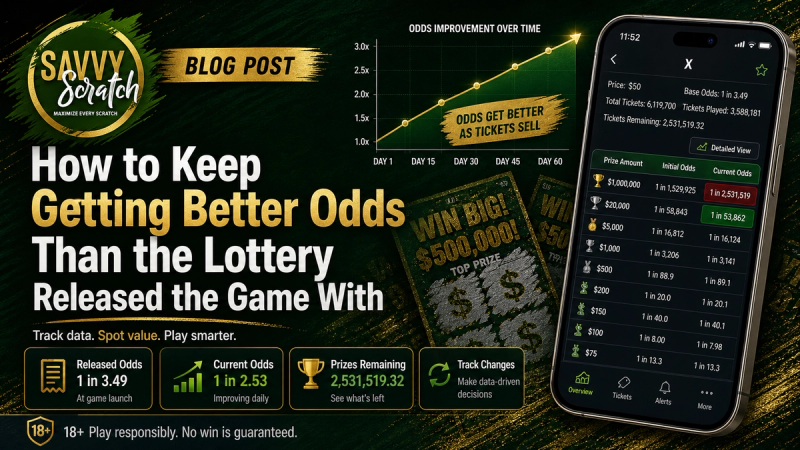
How to Keep Getting Better Odds Than the Lottery Released the Game With
5/5/2026
By Doug Moeller | Professional Gambler & Founder of Savvy Scratch
The advertised odds on the back of a scratch-off are not the odds of the ticket sitting in front of you at the gas station. They are the odds the game had on the day the lottery sent it to print. Once the first ticket sells, those numbers start drifting. Sometimes the game gets quietly worse. Sometimes it gets quietly better. The lottery has no obligation to tell you which.
That gap between launch-day odds and live odds is not a small detail. It is the entire game.
I spent fifteen years making a living off games of chance. Poker, blackjack card counting, casino advantage play. The single concept that put more money in my pocket than any other was understanding that conditions change inside a closed deck or a closed shoe, and the player who tracks the change has a real edge over the player who reads the rules off the felt and assumes nothing has moved. Scratch-offs work the exact same way. The ticket back is the rules off the felt. The current state of the prize pool is the count.
If you can train yourself to stop buying based on launch-day odds and start buying based on whether the game has improved past launch, you are no longer playing the way the average lottery customer plays. You are picking your spots.
The lottery hands you opening odds, not permanent ones
Pick up any scratcher and read the back. You will see a number that says something like "overall odds, one in three point eight." You will see how many tickets were printed, how many top prizes exist, what the prize tiers look like. That whole snapshot is a launch-day photograph. It describes the game the way it left the printer, with every prize still in the pack.
That is not the game you are buying.

By the time a ticket reaches a counter, the game has been moving for weeks or months. People have bought tickets. Winners have walked into claim centers. Losing tickets have been thrown in trash cans. The math under the marketing has shifted, sometimes by a little, sometimes by a lot. The number on the back of the ticket has not been updated. It cannot be. It is printed.
So most players are doing one of two things without knowing it. They are buying into a game where the numbers have drifted hard against them, paying full price for a depleted prize pool. Or, much more rarely, they are buying into a game where the numbers have drifted in their favor, getting better odds than the lottery originally offered. The price is the same in both cases. The difference is invisible at the rack.
If you want a deeper walk-through of why the printed odds become inaccurate the moment a game goes live, the truth about lottery odds covers the math.
Scratch-offs are dependent games, which is the whole reason this works
There is a word for this kind of game. Dependent. What happens next inside the system depends on what has already happened. A counted blackjack shoe is the textbook example. Once half the aces are out of the shoe, the player's odds of getting blackjack on the next hand are worse than they were on the first hand. Same shoe, same dealer, totally different math. That is dependence.
A scratch-off game is built the same way. Imagine a game printed with five top prizes inside a fixed inventory of tickets. Each top prize that gets claimed is one less in the pack. Every losing ticket sold is one less ticket competing with the remaining prizes. Both numbers move every day the game is on the shelf, and they do not always move at the same rate.
That second part is where the entire opportunity lives. When tickets sell faster than top prizes get claimed, the live odds of hitting a top prize on the next ticket actually improve. Slowly, sometimes barely, sometimes dramatically. When top prizes get claimed faster than tickets sell, the live odds get worse and the game starts to die.
The card counter in the casino is doing exactly this kind of bookkeeping in his head. He is not predicting the next card. He cannot. What he is doing is tracking what has been removed from the deck and adjusting his bet up or down based on whether the remaining cards favor him or the dealer. Every dollar I won counting blackjack came from being willing to do that math while everyone else at the table was watching the cocktail waitress. The scratch-off version of that work is a hundred times easier, because the lottery commission is required to publish the data and you can pull it up on a phone in seconds. The discipline is the same. The math is the same. The only thing missing for most players is the habit of looking.
If you're newer to this whole approach, the beginner's guide to lottery jackpot hunting walks the framework from the ground up.
The right question to ask before you buy
Most lottery players ask the wrong question at the counter. They ask whether a game looks good. The artwork, the headline jackpot, the price point, whether they hit on it last month. None of that is analysis. That is reading the menu and ordering the dish with the prettiest photo.
The right question is much simpler.
Is this game in better shape right now than it was on the day it launched?
That single question collapses every scratch-off in the rack into one of two categories. Games where the answer is yes are worth your attention. Games where the answer is no are not, no matter how loud the marketing photo is. You are not trying to find a guaranteed winner. There is no such thing. You are trying to consistently buy into games where the live conditions have improved past the original release version.
Said differently, you want the entry price to be the same as launch but the math to have moved in your favor. That is the entire definition of a better-than-launch ticket. It is also a moving target, which is why this only works as a habit, not a one-time check. The full daily-process version of that habit lives in scratch-off tickets with the best odds: a practical, data-driven guide.
Stop guessing at the rack. Savvy Scratch shows you which games in your state currently have improved odds compared to launch, and which ones have been picked clean. The Bad and New tabs are free forever. Good and Neutral are $5/month or $50/year with a 30-day worry-free guarantee. Sign up free at savvyscratch.com →
What better-than-launch actually looks like in the data
This is not theoretical. Pull up any active state lottery's prize-remaining report and you can see it for yourself if you are willing to spend an evening cross-referencing tables in a PDF. I used to do that work by hand for years before I built the tool that does it automatically.
Here is the pattern to look for. Take any prize tier inside a game and compare two numbers. The launch odds for that tier, which are essentially the total tickets printed divided by the total prizes printed at that tier. And the current odds for that tier, which are the estimated remaining tickets divided by the remaining prizes at that tier. If the current number is smaller than the launch number, the live odds have improved. If it is bigger, they have gotten worse.
A game where the top three prize tiers all show improved current odds compared to launch is a game that has gotten better since release. The unsold tickets sitting in the dispenser are statistically richer in top-tier prizes than the original game was on day one. You are paying the same price for a better-shaped pool.
A game where almost every tier has drifted worse is the opposite picture. Tickets are still on the rack. The price is still the same. The marketing photo still looks like a winner. Underneath the artwork, the math has been emptied out. That is the game most players never spot, because nothing on the surface tells them it has happened.
The full framework for reading those numbers across multiple games at once lives in best scratch-off tickets: what data tells you about your odds.
Why this beats every other selection method
Almost every alternative way of picking a scratcher is some version of guessing.
Picking the newest release sounds smart, because the prize pool is intact, but a brand new game with mediocre printed odds is just a freshly stocked mediocre game. Nothing has been claimed yet because the game has barely started. That is not an edge. That is starting from zero.
Picking a game because you won on it before is the gambler's version of restaurant nostalgia. The chef has changed. The ingredients have changed. Whether the place was good last summer tells you nothing about whether it is good tonight.
Picking the game with the biggest jackpot on the front is exactly what the lottery's design team is hoping you do. They put the headline number there for a reason. It does not tell you whether that headline number is still alive in the unsold inventory. Plenty of games keep selling for months after every top prize has been claimed.
Picking a game because the artwork is exciting is choosing dinner by the photo on the menu. It is not analysis at all.
Comparing live odds to launch odds is the only method that actually answers the question that matters. Has this game improved or gotten worse since the lottery shipped it. Everything else is theater.
Why top prizes are the only thing that actually matters in scratch-offs goes deeper into why the headline tier is the one that determines whether a game is worth playing at all.
The poker version of this exact mistake
There is a concept in poker called table selection. The biggest factor in whether a winning poker player has a winning month is not how well he plays his hands. It is which table he sits down at. A pro at a table full of other pros breaks even. The same pro at a table full of recreational players makes money. The cards do not change. The opponents do.
Recreational players almost never think this way. They walk into the cardroom, sit at the first open seat, and start playing. They are letting the room pick the table for them. The pro spends ten minutes scouting the room before he sits down anywhere, because he knows the cards he is about to be dealt are far less important than the people he is about to play them against.
Buying scratch-offs without comparing live odds to launch odds is the lottery equivalent of sitting at the first open seat. You are letting the rack pick the game for you. The lottery is fine with that, because their revenue does not depend on you sitting at a profitable table. It depends on you sitting at any table.
The fix is the same in both rooms. Pick the spot where the conditions have improved. Walk past the spots where they have not. Most players will not do this because most players prefer action to selection. That is what makes selection an edge in the first place.
What this approach is and is not
I want to be clear about something, because this is where every lottery skeptic in the comments wants to argue.
This approach does not turn scratch-offs into a profitable game in the long run. The lottery is, by design, a negative expectation product. The state takes its cut before any prize gets paid, and over a long enough horizon, the average recreational player ends up net negative no matter how clever the timing.
What buying into improved games does is keep you out of the worst situations and into the better ones. You stop funding games whose top prizes were claimed eight months ago. You stop paying full price for depleted inventories. Over hundreds of tickets across a year, that is real money. The same self-discipline that protects the bankroll also keeps you from falling for the design tricks the lottery uses to pull impulse buys, which I broke down in the hidden mistakes most lottery players don't even realize they're making.
The five-second habit that changes the whole game
Here is the practical takeaway, distilled.
Before you ever buy another scratcher, take five seconds to ask whether you are buying it because something on the rack caught your eye, or because you actually checked whether the game has improved past its launch odds. If the answer is the rack caught your eye, put the wallet back in the pocket and check first. That single question is the entire thesis of this post in practice.
You can do the check by hand. Pull up your state lottery's prize-remaining report, pick a few games at the same price point, compare the launch tier odds to the current tier odds, and decide whether the live numbers have moved in your favor. The data is public. The math is straightforward.
Or you can let a tool do it. Savvy Scratch pulls the data from your state lottery, runs the comparison, and shows you which games are sitting on improved live odds versus the day they shipped. The Good tab is the list of games whose current odds have moved in the player's favor. The Bad tab is the list of games whose odds have drifted hard against the player. New is exactly what it sounds like. The work I used to do with a spreadsheet now takes about thirty seconds before you walk into a store.
If you want to see the actual mechanics of how the comparison gets calculated, how to use an odds calculator to pick better scratch-offs lays it out.
The goal is not to play more scratch-offs. The goal is to spend the same money you would have spent anyway in better situations than the lottery originally offered. Better situations, more often. That is the whole game.
Ready to stop guessing? Open Savvy Scratch and check whether the games at your usual store have improved past launch. The Bad and New tabs are free for life. Good and Neutral games unlock for $5/month or $50/year with a 30-day worry-free guarantee. Get started at savvyscratch.com →
About the Author: Doug Moeller is a professional gambler with over 15 years of experience in poker, blackjack card counting, and casino advantage play, with over $500K in lifetime winnings. He built Savvy Scratch to bring the same data-driven approach that works at casino tables to scratch-off lottery tickets, currently covering 19 states. Follow Doug on X.