The 7 Dumbest Mistakes Smart Lottery Players Never Make (And How to Avoid Them)
7/20/2025
By Doug Moeller | Professional Gambler & Founder of Savvy Scratch
There's a $20 scratch-off game sitting on the shelf at your gas station right now. It launched four months ago, got heavy ad placement, and still has 30% of its tickets in circulation. What the lottery commission won't tell you: 94% of the top prizes are already gone.
Players buying that ticket today are paying $20 for the thrill of chasing prizes that statistically no longer exist.
I've won over half a million dollars lifetime from professional gambling: poker, blackjack card counting, casino advantage play. The math that beats casino games applies to scratch-offs too. You find the edge in available data and you use it. The difference with scratch-offs is that the relevant data is public. You just have to know where to look.
These seven mistakes separate the players donating to state revenue from the ones actually getting value for their money.
Stop Guessing Which Tickets to Buy. Savvy Scratch shows you exactly which scratch-off games have the best remaining prizes in your state, updated in real time. Takes 60 seconds to check before you buy. See Your State's Best Odds at Savvy Scratch.com →
Mistake #1: Buying Tickets from Games Where the Top Prizes Are Already Gone
This is the biggest one and the least obvious.
Every scratch-off game launches with a fixed number of top prizes. As tickets sell, those prizes get claimed. But the game stays on the shelf, months after the jackpot is gone. There's no countdown. No sign that flips from "jackpot active" to "jackpot claimed." No announcement when the last $100,000 prize gets scratched off in some convenience store three towns over.
The lottery commission doesn't advertise this. They're selling tickets, not providing financial transparency. Top prizes are the only thing that actually determines a ticket's remaining value once a game has been running for a while, and they disappear faster than the shelf display suggests.
A game with 2 top prizes left across 800,000 remaining tickets has odds of 1 in 400,000 for the top prize. A game with 15 top prizes across 900,000 remaining tickets has odds of 1 in 60,000. Both are $10 tickets sitting on the same shelf with identical packaging. The first is nearly seven times worse.
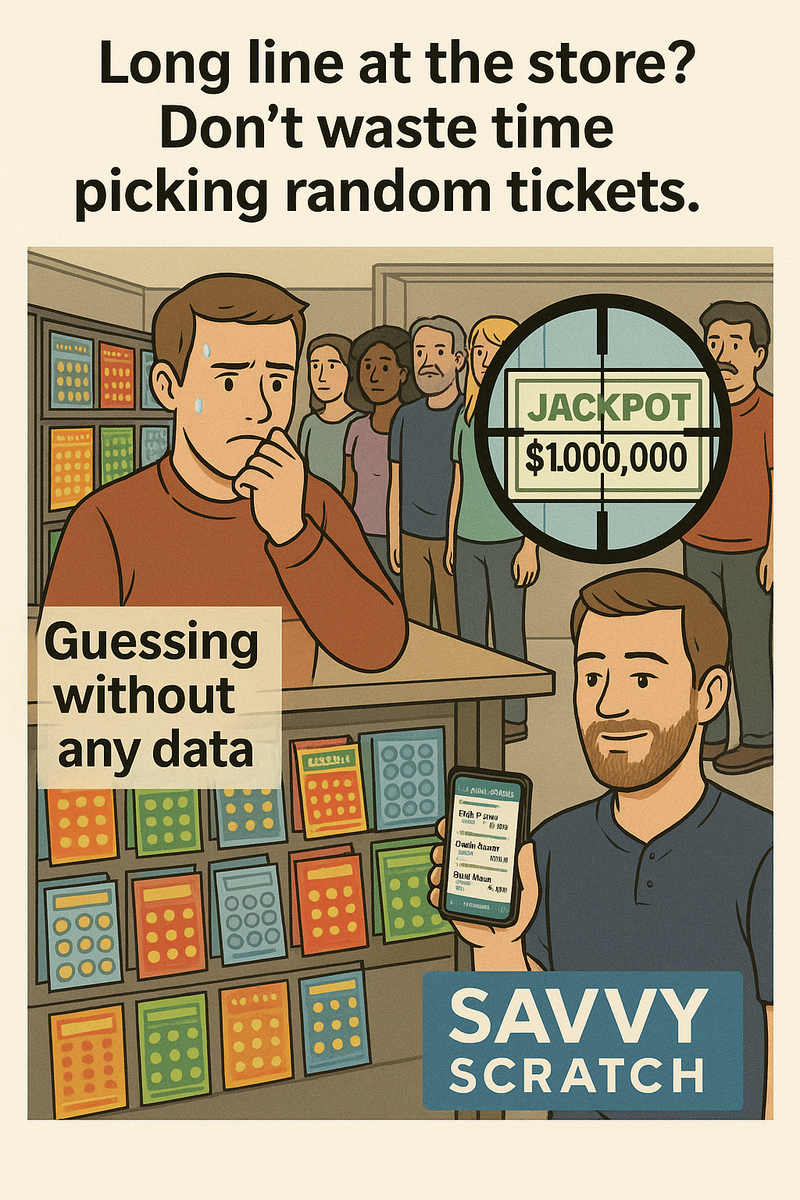
What to do instead: Check remaining prize data before you buy. Every state lottery posts this publicly, usually buried in a PDF on their site. Savvy Scratch pulls that data for every active game in your state and ranks them by expected value so you're not manually digging through government PDFs every week.
Mistake #2: Trusting the Odds Printed on the Ticket
That "overall odds of winning: 1 in 3.41" printed on the back of the ticket is accurate on launch day. It gets less accurate every day after.
Here's why. The printed odds are calculated at launch, based on the full print run. But as tickets sell and prizes get claimed, the ratio of winning to losing tickets left in circulation shifts. If a game is 60% sold through and 80% of the smaller prizes have already been claimed, those 1-in-3.41 odds are now meaningfully worse than what the ticket advertises.
This is not a fine-print technicality. Scratch-off odds shift every day as tickets sell across the state, and players who understand this are systematically getting better value than the ones taking printed odds at face value.
What to do instead: Use current prize data rather than launch-date odds. The number that actually matters is prizes remaining divided by tickets remaining, calculated right now. Savvy Scratch runs this calculation for you across all active games in your state so you're comparing current reality, not the press release from six months ago.
Mistake #3: Missing the New Game Launch Window
The best time to buy a scratch-off is in the first few weeks after it launches. All top prizes are still in circulation. No one has cherry-picked the winners yet. The expected value is as good as it'll ever be for that game.
Most players do the opposite. They wait until a game has been around a while, assuming popularity equals quality. The new-vs-old question is more nuanced than it first appears, but the short version is this: a game that's been on shelves for six months with heavy marketing may have had its top three prize tiers completely wiped out in the first two months.
New games are not always the best value, but the math favors them before significant sell-through happens. If the prize structure is solid on launch day, the first few weeks are the window.
What to do instead: Pay attention to when new games drop in your state. Savvy Scratch tracks new releases so you can check the initial odds without monitoring the state lottery site manually. If the numbers look good at launch, that's when to play it.
Mistake #4: Playing the Same Game Every Week Out of Habit
The player who buys the same $5 ticket every Friday because "that's what I always get" is not playing strategy. They're playing habit. Playing the same ticket week after week quietly costs more than most people realize, because the odds against them compound as the game ages.
Here's what actually happens over time: a game's expected value declines as it ages and top prizes disappear. A ticket with 72 cents of expected value per dollar spent at launch might be down to 55 cents six months later. That 17-cent gap matters if you're buying regularly.
The best-value game in your state changes week to week. Sometimes the $10 ticket beats the $20 ticket. Sometimes a specific $5 game outperforms everything else in its price range because a cluster of top prizes is still sitting unclaimed. You can't know this without checking.
What to do instead: Reassess which games you're playing before each session. The data changes. Your game plan should change with it. The five minutes it takes to look up current odds is worth more than years of buying the same ticket on autopilot.
The Best Scratch-Off Ticket in Your State Changes Every Week. Most players are playing last month's data. Savvy Scratch shows you which games have the best remaining prizes right now, across nine states. Find This Week's Best Tickets at SavvyScratch.com →
Mistake #5: Assuming Higher Price Means Better Odds
Players intuitively assume $30 tickets have better odds than $10 tickets. Lottery commissions lean into this assumption because it drives up average ticket price.
It's often wrong.
A $30 ticket with a $5 million top prize that was claimed two months ago is worth less per dollar spent than a $10 ticket with three $500,000 prizes still sitting in circulation. Ticket price and ticket value are not the same thing.
What actually matters is expected value: the average return per dollar spent based on current prizes remaining. A $10 ticket with an EV of 0.68 gives you more per dollar than a $30 ticket with an EV of 0.54. That comparison is invisible without current data.
What to do instead: Calculate or look up expected value across price points before buying. Savvy Scratch ranks every active game by odds, so you can compare a $5 ticket to a $20 ticket and see which actually returns more per dollar right now.
Mistake #6: Doubling Down When a Game "Feels Due"
This is the most expensive mistake on the list.
The idea that a game is "due" for a winner because you've had a losing streak is the gambler's fallacy. Each ticket is independent. A game that hasn't paid out for you in ten tries is not more likely to pay out on try eleven. The losing tickets don't know about your previous losses.
In practice, this plays out like this: a player drops $80 on a game without a win and decides to spend another $40 because they're "so close." They were not close. Scratch-off tickets are specifically designed to trigger the near-miss effect, making you feel like a win is imminent when you're statistically no closer than when you started. The math does not care about momentum.
I've played 15-hour poker sessions losing with statistically strong hands. The next hand is not more likely to win because of that history. Same principle applies here.
What to do instead: Set a per-session budget before you play and stop when it's spent, regardless of results. If a game consistently underperforms for you, the answer is probably that the odds are not worth it, not that your luck is about to turn. Check the prize data before the next session and compare it to games you've played before.
Mistake #7: Never Tracking What You Actually Spend and Win
Most lottery players have no idea what their actual return rate is over time.
This is not about guilt. It is about information. If you spend $150 per month on scratch-offs and win back $70, you're losing $80 per month. That might be a reasonable entertainment budget for you. But if you think you're "basically breaking even" and you're actually down $960 per year, that gap is worth knowing about.
Tracking also shows you which games and price points actually perform for you versus which ones consistently underperform. Over time, your personal data tells you things that general odds data cannot.
What to do instead: Keep a basic log. Date, game, amount spent, amount won. Review it monthly. The bankroll management principles from professional gambling apply directly here: knowing your numbers before you sit down separates informed play from guesswork. The players who track are the ones who notice when a game stops being worth it and move on. The ones who don't track just keep playing and wondering why they're never ahead.
Play the Data, Not the Shelf
You're already spending the money. The question is whether you're spending it on games with decent remaining odds or games where the good prizes were claimed months ago.
Most players don't check prize data because they don't know it exists or can't be bothered to find it. That's the edge. The lottery commission is not going to make this easy for you. They're in the business of selling tickets, not helping you select better ones.
Savvy Scratch exists specifically for this: real-time odds data across 13 states so you can see which games are worth playing before you hand over your money. Takes about 90 seconds to check your state's best tickets before your next stop at the lottery counter.
The players who don't check are subsidizing the ones who do.
See Which Tickets Are Worth Buying in Your State →
About the Author: Doug Moeller is a professional gambler with over 15 years of experience in poker, blackjack card counting, and casino advantage play, with over $500K in lifetime winnings. He built Savvy Scratch to bring the same data-driven approach that works at casino tables to scratch-off lottery tickets. Follow Doug on X | YouTube