
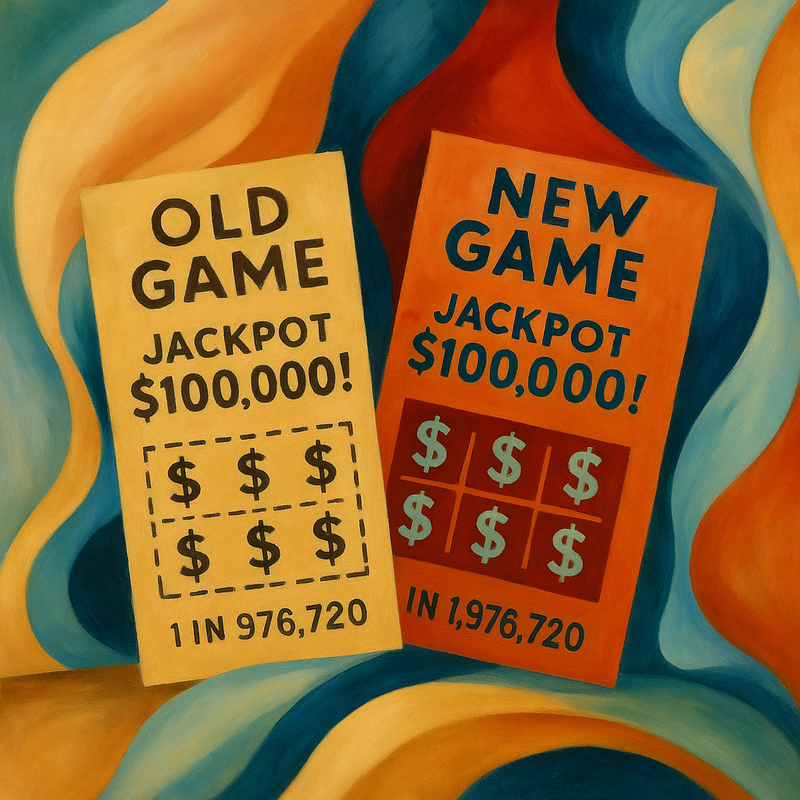
New vs. Old Scratchers: Why the Best Lottery Odds Might Be Hiding in Last Year’s Ticket
7/25/2025
By Doug Moeller | Professional Gambler & Founder of Savvy Scratch
Every time a new scratch-off drops, players line up. New packaging, new theme, new buzz. And sure, there's logic to it: fresh games have their full prize pool intact, nothing's been claimed yet, and the odds printed on the back are exactly what they'll be on day one.
But here's what most players miss: those day-one odds are exactly the odds the lottery sets for the game.
I've spent 15 years playing poker professionally, counting cards at blackjack tables, and studying the math behind games people think are pure luck. And the one thing I've learned that applies directly to scratch-offs is this: timing matters more than the ticket.
Check current odds across all active games with Savvy Scratch. Start your free trial today.
Why "New" Isn't the Edge You Think It Is
When a scratch-off game launches, the state prints a set number of tickets. Let's say a hypothetical game has 5 million total tickets and 4 jackpots at 1 in 1.25 million odds each. That's the baseline everyone sees. That's also the number the lottery advertises.
Now imagine 3 million of those tickets get sold over the next six months, but none of the jackpots get claimed. The odds haven't changed on the back of the ticket. But the real current odds are now based on only 2 million remaining tickets, still with all 4 jackpots unclaimed. If you ran that math, the jackpot odds have improved by over 60% from launch day.
The player who walks in blind and buys the shiny new ticket is working with stale odds. The player who checks what's actually left in circulation is working with a real edge.
That's not a system. That's just math.
The Concept Serious Players Call "Jackpot Hunting"
This is a real strategy with a real name, and it works on the same logic that makes card counting effective in blackjack. You're not predicting anything. You're not using a magic formula. You're simply identifying when the remaining composition of a game has shifted in your favor.
In blackjack, a deck gets richer in high-value cards as lows get played. The counter bets more when the odds tip. In scratch-offs, a game gets richer in jackpots (relative to remaining tickets) as non-jackpot tickets get scratched. The jackpot hunter bets more when the timing is right.
The math works. What's always been missing is the data infrastructure to actually execute it at scale.
That's what Savvy Scratch's odds calculator was built to solve. Instead of you manually cross-referencing state lottery websites, running the math, and comparing across dozens of active games, the tool does it in real time and surfaces the games where the odds have moved in your favor.
The "Dead Game" Problem: What New Players Never See Coming
On the other side of the coin, there's a trap that catches a lot of players who aren't paying attention.
States are allowed to keep selling scratch-off tickets after all the top prizes have been claimed. There's no legal requirement to pull a game off shelves just because the jackpot is gone. In some states, roughly 1 in every 10 active games has no remaining top prize at any given time.
Think about what that means: you're standing at the counter, you see a game you like, you buy a ticket. But every single jackpot in that game was claimed weeks ago. You have zero chance of hitting the top prize, but you had no way of knowing that from looking at the ticket.
This is called playing a dead game, and it's the single most expensive mistake casual players make. The good news is it's completely avoidable once you know how to check. Savvy Scratch's game analysis tool flags dead games automatically and filters them out of your view so you're never accidentally buying into a game where the real prize is already gone.
Stop playing dead games. See exactly which games have prizes still available in your state.
When New Tickets Actually Do Make Sense
I'm not saying new games are always a bad bet. There are situations where a fresh release is worth your money.
The strongest case for new games is when you want to maximize the number of mid-tier and jackpot prizes still in circulation. At launch, everything is there: every $500 prize, every $1,000, every top prize. Nothing has been touched yet. If your strategy is to play a high volume of tickets in a single session, a brand-new game gives you the most intact prize structure to work with.
The weaker case is when you're hunting jackpots specifically. A new game has all its jackpots, but it also has all 5 million tickets still out there competing for them. The odds haven't moved anywhere yet.
So the question isn't really "new or old," it's: what are you actually trying to accomplish when you walk up to that counter? If you want the most overall prizes still in play, new games can make sense. If you want improved jackpot odds per remaining ticket, you're almost always better off in an older game that's been played down without a jackpot claim.
How to Actually Find These Games Without Spending Hours on Lottery Websites
Here's the reality: this analysis is possible without any tool. Every state lottery publishes odds data publicly. You can go to your state's website, find the remaining prizes for each active game, divide remaining jackpots by estimated remaining tickets, and compare across every active game.
It takes about 45 minutes per state if you know what you're doing.
Most people don't have 45 minutes. And most people aren't going to run that math in the checkout line while a line forms behind them.
Savvy Scratch compresses that entire process into a few seconds. You open the app, select your state, and every active game is already sorted by current odds quality. You can filter by price, by evaluation rating, and see at a glance which games have their top prizes still intact versus which ones are running on fumes. The detailed view shows you exactly how many prizes are claimed and how many remain at every tier.
It's the same analysis a disciplined gambler would run. Just without the spreadsheet.
The Real Edge Isn't the Ticket. It's the Timing.
Most scratch-off players pick tickets based on the same things: the design looks good, the price feels right, it's a new release. None of that has anything to do with where the odds actually sit right now.
The player who understands that odds are dynamic, not fixed, has an informational edge over every casual player in the store. They're not psychic. They're just working with better data.
That's the whole premise behind Savvy Scratch. Not lucky numbers. Not "hot" games. Not patterns on the back of the ticket. Just current, accurate odds data applied to your actual purchase decision.
If you've been playing scratch-offs without this kind of analysis, you've probably walked past some legitimately good timing opportunities without knowing it. And you've probably also bought a few dead games without realizing it.
Both of those things stop the moment you start checking before you buy.
Doug is the creator of Savvy Scratch and a 15-year professional gambler with $500,000+ in career winnings from poker, blackjack card counting, and casino advantage play.