
Gambling Tax Changes 2026: The Hidden 10% You'll Owe (Even When You Break Even)
1/7/2026
By Doug Moeller | Professional Gambler & Founder of Savvy Scratch
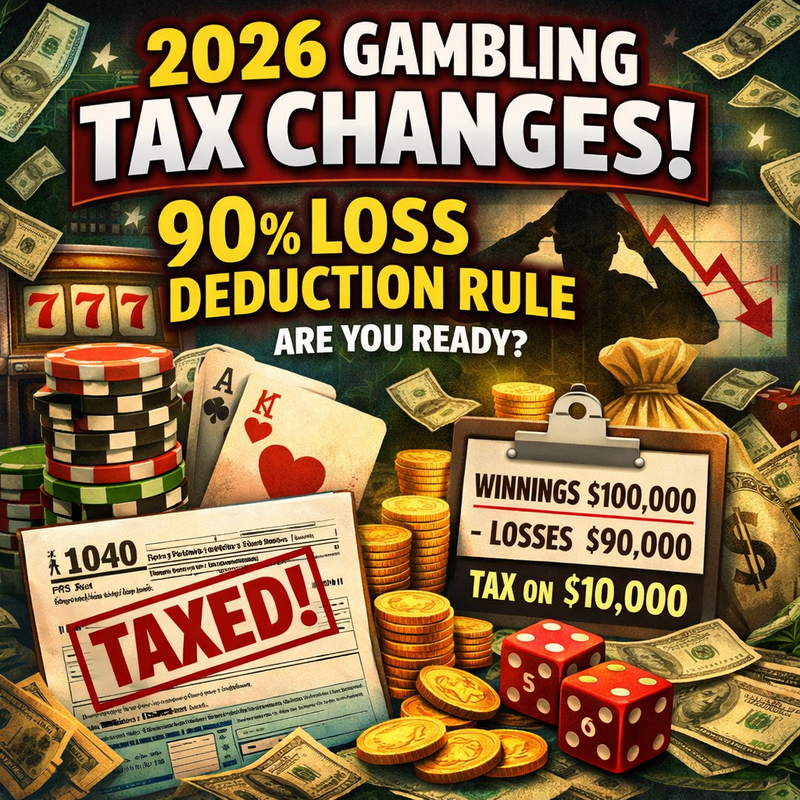
You play scratch-offs all year. You win $100,000. You lose $100,000. You finish dead even.
And under the new federal rule, that can still leave you with $10,000 of taxable gambling income. The key change is that, for tax years beginning in 2026, gambling-loss deductions are limited to 90% of losses and still can’t exceed gambling winnings.
That’s the part that’s going to catch a lot of people off guard.
A lot of players still think gambling taxes work the old way. You add up your wins, subtract your losses, and if you broke even, no real problem. But that clean version is gone. Now the government still counts 100% of your gambling wins on the way in, while only letting you use 90% of your losses on the way back out.
Quick disclosure before we go any further: I’m Doug. I’ve won over half a million dollars across poker, blackjack card counting, and casino advantage play. I’m not a CPA or tax attorney. This is an educational overview, not personal tax advice. If you gamble with any real volume, talk to a tax pro who actually understands gambling.
And yes, this matters for scratch-off players too.
If you want to make smarter ticket decisions while you’re putting volume through the year, sign up for Savvy Scratch here.
What Actually Changed
The old mental model was simple.
You reported all your gambling winnings. If you itemized and had the records, you could deduct gambling losses up to the amount of those winnings. So if you won $50,000 and lost $50,000, people thought of that as basically washing out.
For 2026 and after, that clean version is gone.
Section 165(d) now limits the deduction to 90% of your wagering losses, and that reduced number still can’t be more than your wagering gains for the year.
That’s the whole issue right there.
Why Scratch-Off Players Should Care
Most people writing about this are thinking about sports bettors, poker players, or casino grinders.
That makes sense, but scratch-off players can absolutely get hit by this too.
Why? Because of volume.
You buy a $20 ticket. You hit a small win. You roll that back into more tickets. You hit another one. Some of that gets recycled too. By the end of the year, you may have run a lot more gambling volume through the system than you realize. And this rule doesn’t really care whether you felt casual. It cares what the totals look like once the year is over.
That’s where the pain starts, and it’s one more version of the same theme I’ve talked about before in The Hidden Mistakes Most Lottery Players Don’t Even Realize They’re Making.
The Break-Even Example Everyone Needs to See
Here’s the simple version.
You win $100,000 during the year. You lose $100,000 during the year. In real life, your result is zero.
Under the new rule, only 90% of those losses are deductible. So now your deductible losses are $90,000, not $100,000. That leaves you with $10,000 of taxable gambling income even though you didn’t actually make $10,000.
That’s not some weird edge case. That’s literally what the math does now.
And it gets ugly even when you did finish ahead.
Say you won $50,000 and lost $45,000. Your real profit is $5,000. But only 90% of the $45,000 loss counts, which is $40,500. So now your taxable gambling income is $9,500.
You made five grand. The tax math can treat you like you made almost double that.
That’s the kind of thing people are going to learn the hard way if they don’t look at this early.
W-2Gs Are Not the Whole Story
This is another place people get tripped up.
A lot of players think, “Well, I only got a couple W-2Gs, so that’s probably the whole issue.”
Not really.
The IRS says all gambling winnings are taxable, whether or not you got a W-2G. The form is part of the reporting system. It is not the full definition of taxable gambling income. And for certain lottery-type winnings, there can also be 24% federal withholding when the proceeds are more than $5,000 after subtracting the wager.
So if you’re only thinking in terms of forms that showed up in the mail, that’s not enough.
The Recordkeeping Part Just Got More Important
The IRS already required people to keep records if they wanted to deduct gambling losses.
That part is not new.
What’s new is that sloppy records hurt even more now, because you’re already taking a haircut on the deduction before recordkeeping mistakes even enter the picture.
The IRS says if you want to deduct gambling losses, you need an accurate diary or similar record of winnings and losses, plus supporting proof like receipts, tickets, statements, or other records.
For scratch-off players, that matters a lot more than people think.
Because this is one of those gambling spaces where people throw losing tickets away, cash small winners instantly, roll them into more action, and never really keep a clean ledger of what happened.
That’s fine until the year gets big enough that it suddenly isn’t fine anymore.
And honestly, this is the same reason bankroll discipline matters in the first place. If you haven’t read Scratch-Off Bankroll Management: The Tournament Pro’s Guide to Surviving Variance, it fits this topic better than people might think. Once you start tracking seriously, you usually find out your “casual” play was not as casual as you thought.
Why This Sneaks Up on Lottery Players
Poker players usually know they’re gambling.
Sports bettors usually know they’re gambling.
Scratch-off players often feel like they’re just making little purchases here and there.
That’s why this thing can sneak up on people.
You can move a surprising amount of money through scratch-offs without it feeling like you ran major gambling volume. Especially if you buy regularly, recycle wins, chase certain games, or use data to focus on better spots.
The tax code does not care whether it felt casual.
It only cares what the numbers say when the year is over.
The “I Play Smart” Crowd Still Has a Problem
This is the part that’s especially annoying.
Let’s say you’re actually trying to be disciplined. You’re not just buying random tickets. You’re looking at live prize data. You’re trying to avoid dead games. You’re focusing on the games with healthier top-prize structure.
That’s better gambling behavior. It absolutely is.
But the new rule still doesn’t reward that. If anything, people who put more deliberate volume through the system can feel this harder, because the tax pain scales with volume more than it scales with how smart your process felt.
So yes, it still makes sense to make better ticket decisions. It still makes sense to avoid garbage games. It still makes sense to know what you’re buying.
That’s exactly why Why Top Prizes Are the Only Thing That Actually Matters in Scratch-Offs matters so much. Better selection still matters. It just doesn’t fix the tax law.
If you want help on the game-selection side, register for Savvy Scratch here.
Professional Gambler Status Is Not Something to Guess At
A few people are going to read about this and immediately start wondering whether they should file as a professional gambler.
Be careful there.
The updated statute says that “losses from wagering transactions” includes otherwise allowable deductions incurred in carrying on wagering transactions, which is exactly the kind of wording that makes this a bad topic to freestyle.
If you’re trying to argue professional-gambler treatment, deduct related expenses, mix gambling with content creation, or do anything more aggressive than straightforward casual reporting, that is CPA territory. Not Reddit territory. Not forum territory. Not “I read a thread about it” territory.
Get somebody real.
What I’d Be Doing Right Now
I’d start tracking every session like it actually matters.
Date, store, game, amount spent, amount won, what happened next.
I’d stop assuming that “I basically broke even” means “I won’t owe anything.”
I’d stop relying on memory.
And if I were putting real volume through the year, I’d talk to a CPA before year-end instead of waiting until filing season and discovering the surprise when nothing can be changed anymore. The IRS also notes that gambling winnings can create estimated-tax issues, which is another reason not to leave this until the last minute.
That’s also why I’d be trying to cut out avoidable waste everywhere I could. 5 Ways People Waste Money on Scratch-Off Tickets (And How to Stop) fits right here, because once gambling volume gets more expensive from a tax standpoint, every dumb ticket hurts a little more.
One More Thing Scratch-Off Players Miss
Scratch-offs have a way of hiding how expensive casual habits really are.
A player will think they’re just buying a few tickets a week.
Then if you force them to total the full year, they realize they ran way more money through lottery play than they thought. And once you combine that with a tax rule that only lets you deduct 90% of losses, the whole picture gets a lot less friendly.
That’s why I’d rather know exactly what I’m buying, exactly how much I’m playing, and exactly what the year looks like while it’s happening.
The cleaner you are during the year, the fewer ugly surprises you leave for yourself later.
For the ticket-selection side of that, Scratch-Off Tickets With the Best Odds: A Practical, Data-Driven Guide (and How Savvy Scratch Helps You Find Them) is probably the best companion piece to this one. And if you just want the tool itself, sign up here.
About the Author: Doug Moeller is a professional gambler with over $500K in lifetime winnings from poker, blackjack card counting, and casino advantage play. He built Savvy Scratch to bring the same data-driven thinking that works in other gambling markets to scratch-off lottery tickets.