How Group Play Can Change the Way You Play the Lottery
8/19/2025
By Doug Moeller | Professional Gambler & Founder of Savvy Scratch
For most of my poker career, I played alone. One bankroll, one seat, one set of decisions. That's how most people think about gambling, and it's how almost every scratch-off player operates: solo trips to the store, solo budget, solo outcomes.
But some of the most profitable stretches of my professional gambling career happened when I wasn't playing alone. I was part of a small blackjack team. We pooled bankroll, divided roles, and spread our action across multiple tables and sometimes multiple casinos in a single session. Each of us individually had a modest bankroll that limited where we could play and how aggressively we could bet. Combined, we had enough capital to play higher-stakes tables with better rules, absorb bigger swings, and cover more ground in a single night than any one of us could have managed solo.
The math behind that arrangement is the same math that makes group scratch-off play one of the smarter moves available to recreational lottery players. You're not changing the odds printed on any individual ticket. You're changing how much of the playing field you can cover with the same amount of personal risk. And that difference, the gap between what one person's budget can reach versus what four or five people's budgets can reach together, is bigger than most players realize.
Savvy Scratch shows your group which games have the best remaining odds so every pooled dollar goes to the strongest available tickets. Plans start at $5/month or $50/year with a 30-day money-back guarantee.
Why Coverage Matters More Than Most Players Think
In poker, there's a concept called "table selection" that separates the professionals from everyone else. A good poker player doesn't just sit down at the first available table. They scan the room, evaluate the competition at each game, and choose the table where their edge is biggest. But here's the catch: you can only sit at one table at a time. Your bankroll, your time, and your attention are all committed to a single game. If the table you chose turns out to be tougher than expected, or if a better game opens up across the room, you're stuck with your original choice until you can move.
Now imagine you had three friends who were also good players, and you could pool your collective bankroll and have each person sit at a different table. Suddenly you're not locked into one game. You're covering four games simultaneously, and if one of them turns out to be particularly profitable, the whole group benefits. Your individual risk is lower because you're only funding a quarter of the total action, but your exposure to opportunity is four times what it would be alone.
That's what group scratch-off play does. Instead of putting your entire $40 monthly entertainment budget into tickets from a single game, you and three friends each contribute $40, giving the group $160 to deploy across multiple games with strong remaining prize structures. More games covered means more exposure to different prize pools, which means a better chance of hitting something meaningful across the portfolio.
This isn't a guarantee of better results on any single ticket. Each ticket's odds are what they are. But across a larger sample of well-chosen tickets, the group is giving itself more opportunities for the math to work out, and that's the entire principle behind professional bankroll pooling.
The Bankroll Math That Changes Everything
The part of group play that gets underappreciated is what happens when you can access higher price points without increasing your personal spend.
If your solo scratch-off budget is $20 per week, you're probably buying from the $5 or $10 tier. Nothing wrong with that. But $20 and $30 tickets typically have better overall odds structures and larger top prizes. The reason is straightforward: higher-priced games are designed with more favorable prize distributions because the lottery commission can spread more prize money across a higher revenue base.
Playing solo at $20 per week, you can't responsibly touch that $30 tier. One ticket and your budget is nearly gone. Two tickets and you've blown through it. But in a group of four people each contributing $20, the pool has $80 to work with. That buys two $30 tickets from high-value games and a $20 ticket from a third game, all selected based on current remaining prize data. Each person's out-of-pocket cost is still $20. But the group's tickets are from a tier that none of them could have responsibly played alone.
This is directly analogous to how my blackjack team operated. Individually, I had a bankroll suited for $10 minimum tables with conservative bet spreads. Our combined bankroll let us play $25 and $50 tables with wider spreads, where the rules were often better and the earning potential per hour was significantly higher. My personal risk on any given session was capped at my share of the pool. But my upside was proportional to the group's total action, which was far more than I could have generated alone.
The Savvy Scratch blog post on budgeting scratch-off play as entertainment covers how to set a personal budget that doesn't strain your finances. Group play takes that fixed personal budget and multiplies its purchasing power without increasing anyone's individual risk.
The Part Nobody Talks About: Accountability
There's a hidden benefit to group play that has nothing to do with ticket coverage or prize pool math, and it might be the most valuable one.
When you play scratch-offs alone, nobody sees your decisions. Nobody knows if you overspent this week. Nobody knows if you chased a loss. Nobody knows if you bought from a depleted game because you were feeling impulsive. Solo play has zero accountability, and for the same reasons that most people exercise more consistently with a gym buddy than alone, that lack of accountability leads to worse behavior over time.
In a group, your spending is visible. When four people each commit $20 and the tickets are purchased together, there's no room for "I'll just grab one more on the way home." The budget is the budget because it's shared money with shared expectations. The social dynamic naturally enforces the kind of discipline that the emotional buying post talks about, except instead of relying on your own willpower, you're relying on the structure of the group.
I saw this effect on my blackjack team. When I played solo sessions, I'd occasionally push past my stop-loss because nobody was watching and I felt like the count was about to turn. On team sessions, I never deviated from the plan, because my results were being tracked and shared. The team didn't make me a better card counter. It made me a more disciplined one. And in gambling, discipline matters more than talent about 90% of the time.
Group scratch-off play creates the same dynamic. The person who would impulsively upgrade to a $30 ticket on a solo trip won't do it when the group's money is pooled and the plan says they're buying specific games for specific reasons. The structure does the work that willpower can't.
Savvy Scratch gives your group a shared reference point for which games to buy, eliminating arguments about ticket selection and keeping every purchase data-driven. $5/month or $50/year with a 30-day money-back guarantee.
How to Run a Group Without It Falling Apart
Most lottery pools collapse for one of three reasons: unclear rules about splitting, no records of who paid what, or disagreements about which tickets to buy. All three are preventable.
On splitting, agree in advance that every win gets divided equally among everyone who contributed that session, regardless of who physically scratched the ticket, regardless of the prize amount. This includes the $5 and $10 wins, not just the big ones. If you only split big prizes, you create an incentive for people to pocket small wins, which erodes trust immediately. Equal split on everything. No exceptions. Write it down and have everyone agree before the first ticket is purchased.
On records, keep them simple but keep them. A group text thread or shared note where someone logs the date, who paid in, which games were purchased, and the results works fine. You don't need a formal legal agreement for a casual pool among friends or coworkers, but you do need a paper trail. The worst lottery pool stories you've heard all involve situations where there was no documentation and someone disputed the arrangement after a win. Five minutes of record-keeping prevents five months of arguments.
On ticket selection, this is where data becomes the group's greatest asset. Instead of four people arguing about which game "feels lucky" or defaulting to whatever the loudest voice prefers, the group can check current remaining prize data and choose tickets based on actual numbers. The Savvy Scratch guide to lottery analysis shows exactly how to evaluate and compare games. When the decision is grounded in data, there's nothing to argue about. The best games are the best games. Personal preference doesn't enter the equation.
A simple rotation for who does the weekly data check and who physically buys the tickets keeps everyone involved without making it feel like a job. One person checks the odds this week, another person buys next week. Shared responsibility keeps the pool feeling collaborative rather than dependent on one organizer.
What Group Play Doesn't Do
I want to be clear about the limits here, because overpromising is something I refuse to do with anything related to Savvy Scratch.
Group play doesn't change the odds on any individual ticket. A $20 scratch-off with 1-in-300,000 odds for the top prize has those same odds whether one person buys it or a group of ten bought it together. The ticket doesn't know or care about your organizational structure.
What group play changes is your coverage and your effective cost. If the group buys five different tickets across five different games, and one of those games happens to produce a $1,000 winner, every member of the group benefits at a fraction of the individual cost. The trade-off is that the $1,000 gets split, so no single person gets the full amount. But the probability of someone in the group hitting something was higher than the probability of any individual player hitting something on their own, because the group had more tickets across more games.
This is a volume and diversification play, not an odds-changing play. It's the same logic behind diversifying a stock portfolio. You're not making any single position better. You're spreading across enough positions that the overall probability of a positive outcome improves, while your exposure to any single bad outcome is limited.
Group play also doesn't replace the need for good game selection. A group of four people pooling money to buy the worst available tickets is still making a bad purchase. The pool amplifies whatever strategy it's paired with. Paired with data-driven game selection, it's a powerful combination. Paired with impulse buying, it just means you're making bad choices with more money.
The Social Side That Shouldn't Be Ignored
I'll say something that might sound unusual coming from someone who approaches gambling analytically: the social aspect of group play has real value, and it doesn't need to be justified by the math.
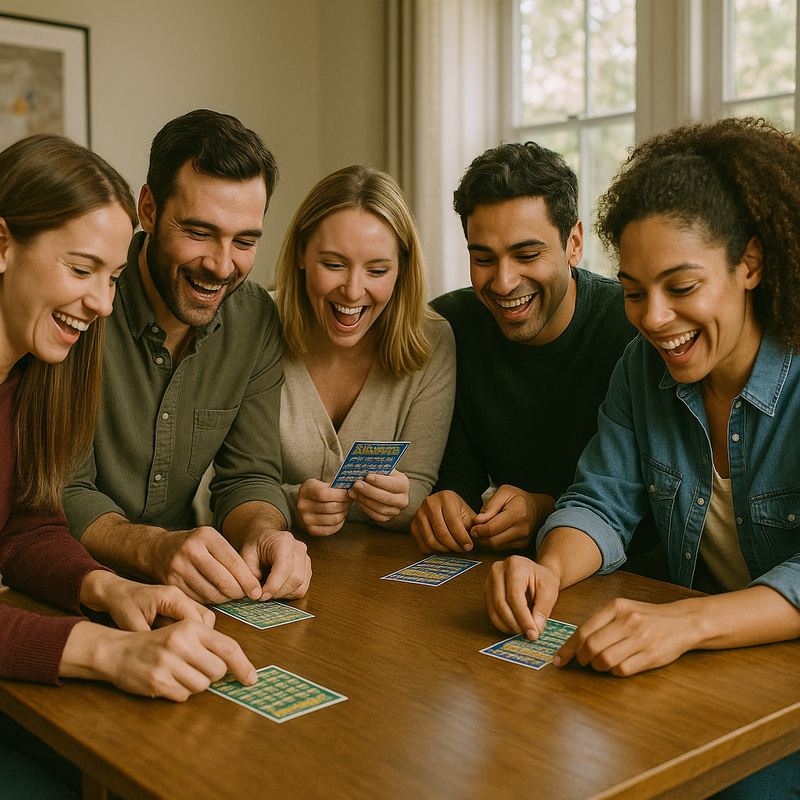
Playing scratch-offs with friends or coworkers turns a solitary transaction into a shared experience. The anticipation of scratching tickets together, the collective reaction to wins and losses, the running jokes about who has the "lucky fingers" (even when everyone in the group knows that's not real), these are genuine entertainment benefits that make the fixed entertainment budget deliver more enjoyment per dollar.
During my poker career, some of my best memories aren't from solo sessions where I won the most money. They're from the sessions I played with friends who were also grinding, where we'd debrief over dinner and laugh about the hands that went sideways. The social layer didn't change my results. It changed my experience of the results. Wins were better because they were shared. Losses were easier because they were shared too.
If you're already budgeting scratch-off play as entertainment (which, as the budgeting post covers, you should be), then maximizing the entertainment value matters. And for most people, shared experiences are more enjoyable than solitary ones. Group play delivers better coverage, better discipline, and a better time for the same money. That's a rare combination in any form of spending.
Find a few people who play scratch-offs regularly, agree on a weekly budget and a set of rules, check the current odds on Savvy Scratch before each buy, and put your pooled money into the games with the best remaining prize structures. You'll cover more ground, spend less individually, and have more fun doing it than you would standing at the counter alone.
See which scratch-offs have the best odds in your state right now. Savvy Scratch tracks real-time prize data across 16 states for $5/month or $50/year, backed by a 30-day worry free guarantee.
About the Author: Doug Moeller is a professional gambler with over 15 years of experience in poker, blackjack card counting, and casino advantage play, with over $500K in lifetime winnings. He built Savvy Scratch to bring the same data-driven approach that works at casino tables to scratch-off lottery tickets. Follow Doug on X | YouTube